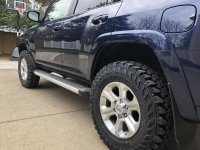
255/75/17 KO2 Pizza Cutters

Just wanted to thank you dawhoo for the pictures of your vehicle.

Just bought a 2018 Super White Off Road (Canada) today and having seen your pictures, they were the inspiration for choosing the grey TRD wheels, despite going the 265/70 KO2 route (and planning a wrap that will be complemented just as well as the white). Cheers
 
I think they look good. The height is what matters, not the width. I have the 255/75 Duratracts with a set of SpiderTrax spacers and it looks perfect. My only wish is that I would have got the 255/80's. I wanted a tire that would fully tuck up in the fender well under full articulation off-road. I also wanted the 32" height as well as a Load Range C tire. My tires only weigh 40 pounds per versus the guys running 285's at 60+ pounds per.


I actually really like that size. I may need to do that on my next set... Also, I know where that highway is (between Albuquerque and Four Corners). :D
 
T...
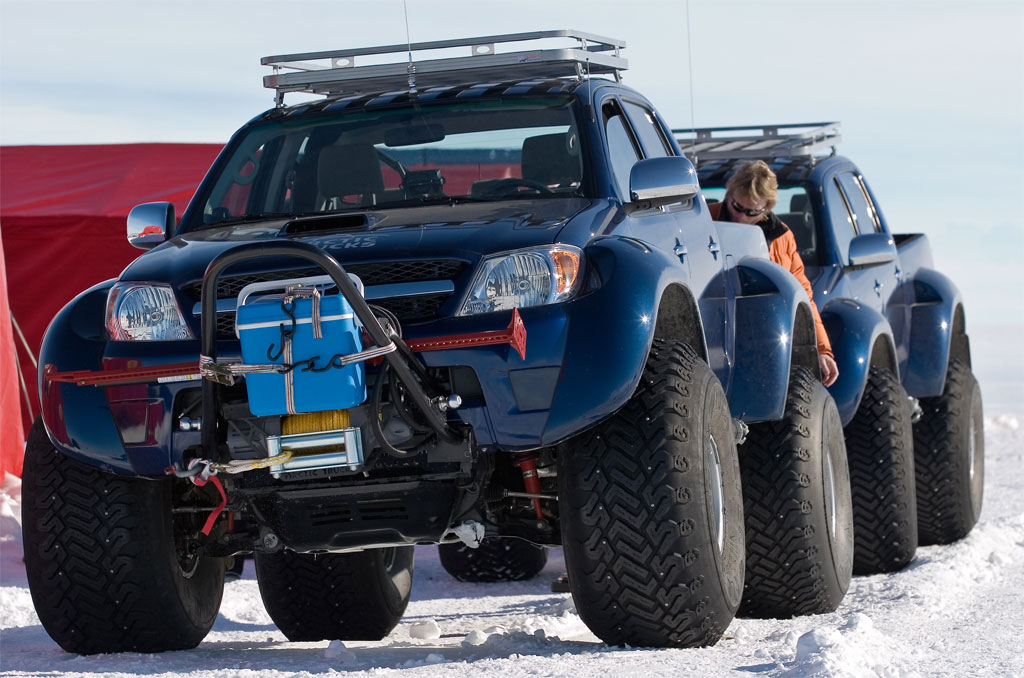
Finally, narrower tires are not better on snow or ice in almost any situation. Icelandic trucks look like they do for a reason. Those who speak should do. Those who do should speak. ....

Wow,, I see what you mean.

Toyota-Hilux-South-Pole-1.jpg
 
Wow,, I see what you mean.

Toyota-Hilux-South-Pole-1.jpg

That’s a bit of a silly comparison, are you (as a general term, not actually you specifically) trying to traverse Antarctica on an exposition to the South Pole or are you trying to make it safely to work/home/your favorite ski resort during a good snow storm? One would benefit from a set of Hakkapeliitta 44s to stay on top of the frozen crust and the other would benefit from a skinner tire that sinks down and applies more pressure to the contact patch where the tote is grabbing onto the ground beneath the snow for better traction.
 
I have 255/75r17 ko2 on my 4runner. For people tjat do occasional off-road, I think its perfect:

Better MPG on road.
Weight less.
Less wind resistance.

And for the amount of off-roading i’m doing, its doing the job.
 
I will never understand the desire to have a smaller contact patch than stock sized tires.

Explained to me by a very seasoned off-road driver… the smaller contact patch increases grip.

I know it’s counter intuitive for some, it was for me at the time too, but after he explained smaller contact patch = more pounds per square inch of vehicle weight distributed onto it = more grip.

The only good thing fat tires are good for is flotation, which is the name of the game for snow.

I run a 255/75/17 and it is to date my favorite tire size. I will gladly go taller, but not wider.
 
Last edited:
Explained to me by a very seasoned off-road driver… the smaller contact patch increases grip.

I know it’s counter intuitive for some, it was for me at the time too, but after he explained smaller contact patch = more pounds per square inch of vehicle weight distributed onto it = more grip.

The only good thing fat tires are good for is flotation, which is the name of the game for snow.

I run a 255/75/17 and it is to date my favorite tire size. I will gladly go taller, but not wider.

Do you reduce air pressure or increase it when you go off road?
 
Do you reduce air pressure or increase it when you go off road?

Obviously reduce, and I see what you are trying to get at, but that isn’t always done to increase contact patch, it's done to increase compliance over tough terrain.

Airing down allows the tire to flex, reduce the chance of puncture, increase ride comfort, and a myriad of other benefits.

Point being, apples to apples, airing down a 255 vs 285 both increase contact patch, and the smaller one will still provide more grip.
 
Im in the 255/75/17 KO2 club, been very happy with the switch. For the really rough stuff Ive been using a set of 285 KM2s, but those have a new home on my 80, so the 4R will have the 255s at all times now.

Its the perfect size for the TRD Pro wheels and their narrow width.

ev9TDxG.jpg
 
Obviously reduce, and I see what you are trying to get at, but that isn’t always done to increase contact patch, it's done to increase compliance over tough terrain.

Airing down allows the tire to flex, reduce the chance of puncture, increase ride comfort, and a myriad of other benefits.

Point being, apples to apples, airing down a 255 vs 285 both increase contact patch, and the smaller one will still provide more grip.

So something like a bicycle tire would be even better? That's probably why they put the really narrow tires on race cars.
 
So something like a bicycle tire would be even better? That's probably why they put the really narrow tires on race cars.

You can't jump to extremes to make a point... it's unreasonable.

This entire thing is a balancing act… between tire diameter, fitment, rubbing, load range, vehicle weight, application, all these things vary. The 255 isn't even that skinny, but it does solve problems in our application.

Airing down an E load vs a C load of the exact same tire size, the C load will provide more compliance because it will flex and absorb more terrain than it’s stiffer counterpart. It’s the reason we air down in the first place, to make things softer.

I can only speak on my own experiences and a 255 has been treating me very well. I also dislike E load range enough to take a C load 265 over a E load 255 if it weighed less.

I do it because the truck FEELS better, less rotational mass and un-sprung weight when compared to a 275 or 285 is noticeable especially when cruising our local deserts where sand is constantly bogging me down. For the limited power we have, the reduction in weight was welcome, and from a fitment and performance standpoint has been great.

Use what you like, use what works for you.

I never said 255 was an end all be all size, but it does balance out well all things considered.

As to your race car analogy, lateral G-forces with cambered tires usually on high friction surfaces in dry conditions with sticky compounds… I did think about that at one point in time too, but when climbing onto obstacles like rocks, for some reason the physics behind it appear to be in favor of the skinner tire.
 
Last edited:
Explained to me by a very seasoned off-road driver… the smaller contact patch increases grip.

I know it’s counter intuitive for some, it was for me at the time too, but after he explained smaller contact patch = more pounds per square inch of vehicle weight distributed onto it = more grip.

The only good thing fat tires are good for is flotation, which is the name of the game for snow.

I run a 255/75/17 and it is to date my favorite tire size. I will gladly go taller, but not wider.

Make sense!! The only thing I dislike about this size is that not every tire shop have this size in stock if something happens. But did someone know if running the stock spare tire with 3x 255/75r17 ko2 can broke something or use thing prematurely? What should I do if I need to drive with the spare?
 
Make sense!! The only thing I dislike about this size is that not every tire shop have this size in stock if something happens. But did someone know if running the stock spare tire with 3x 255/75r17 ko2 can broke something or use thing prematurely? What should I do if I need to drive with the spare?

I thought it was a very common size... at least the 255/75/17 MT is a stock size for a Jeep.

You can find near new take-offs from Jeeps all the time on the forums because they want to upgrade and increase tire size just like we do from our stock tires.

I always carry a matching full size spare, and buy a new spare when I change my tires. (I rotate my spare in with tire rotations)

Even if you don't have a matching spare, it's only the diameter that matters when running in 4WD / AWD. If you were in that situation I would put the odd sized tire up front and run 2WD or get a replacement that is the correct diameter and worry about it later if it was an emergency.

I forgot what the ratio is, but you can have some mismatch, but not a lot.

All of these tires were Jeep take-offs. Granted they are all MTs which is what I wanted. Perfect 4Runner upgrade size, cheap too.

NBeVjCA.jpg
 
I thought it was a very common size... at least the 255/75/17 MT is a stock size for a Jeep.

You can find near new take-offs from Jeeps all the time on the forums because they want to upgrade and increase tire size just like we do from our stock tires.

I always carry a matching full size spare, and buy a new spare when I change my tires. (I rotate my spare in with tire rotations)

Even if you don't have a matching spare, it's only the diameter that matters when running in 4WD / AWD. If you were in that situation I would put the odd sized tire up front and run 2WD or get a replacement that is the correct diameter and worry about it later if it was an emergency.

I forgot what the ratio is, but you can have some mismatch, but not a lot.

All of these tires were Jeep take-offs. Granted they are all MTs which is what I wanted. Perfect 4Runner upgrade size, cheap too.

NBeVjCA.jpg

Good to know!! I didn’t know this. Thanks for all the infos
 
Yokohama Geolandar MT 255 75 17

Finally got new kicks on my 2017 4R SR5 Premium. Researched going to 275 or 285’s, but daughter is learning to drive with my rig so 255/75r17 was a nice upgrade from stock Dunlop. For a mud tire, not loud on the highway or street driving. For reference, 2-4 clicks of the volume on radio took care of any extra noise I have Bilstein 5100’s set at 2.5” in front, with cornfed 1.5” spacers in rear. Spidertrax 1.25” wheel spacers all around. Plenty of clearance while driving, minimal rubbing when full lock in reverse both ways. Some nipping and tucking with a box cutter of the mud flaps took care of it quickly. This is my daily driver, all highway, zero off-roading for this guy. I wanted a more aggressive tire than stock without having to chop up the body, fenders and such. When I was researching this tire size I didn’t find a lot of info so feel free to ask questions.
 

Attachments

  • CE655FA8-259D-4E84-A2A3-4E05D1F2EA52.jpg
    CE655FA8-259D-4E84-A2A3-4E05D1F2EA52.jpg
    138.3 KB · Views: 4,159
  • 4499EF3C-0211-4C39-98BC-B3F20114E690.jpg
    4499EF3C-0211-4C39-98BC-B3F20114E690.jpg
    136.2 KB · Views: 6,724
That Geolandar looks legit, the Cooper ST Maxx also has my attention. I’ll consider both in the future.

I was never really into mud terrains but I got to admit, if you actually off-road and want an edge, MT tires are really nice to have.

My BFG MTs do drone a bit, between that and the roof rack wind noise, the cabin is noticeably louder. You do have to speak up to talk, but it’s not overbearing. Once I get off-road, it generally seems worth the on-road annoyance, MT tires inspire a ton of confidence, especially in the sand where I probably spend most of my time.
 
Obviously reduce, and I see what you are trying to get at, but that isn’t always done to increase contact patch, it's done to increase compliance over tough terrain.

Airing down allows the tire to flex, reduce the chance of puncture, increase ride comfort, and a myriad of other benefits.

Point being, apples to apples, airing down a 255 vs 285 both increase contact patch, and the smaller one will still provide more grip.

Contact patch size is weight of the vehicle divided by tire pressure. Physics. 255 has same contact patch area, only shaped differently.
 
Last edited:
Wider tires will do better since a wider contact patch with prevent the H1 from sinking into the snow.

Wider tires allow for lower pressure to achieve vehicle support without becoming unstable on the rim.

The only way to increase contact patch area is to lower the tire pressure. Width of the tire is not important by itself.
 

Members online

Forum statistics

Threads
278,316
Messages
3,554,105
Members
248,016
Latest member
Advally Service

Trending content

Back
Top