For those of you running 265/75r16's or equivalent tires with a 3" lift, I have a few questions for you.
What are the pros and cons of the lift other than ground clearance? From my understanding, most lift kits for our 4runners do nothing but bring your starting point in the travel arc down a few inches. Is there something else that I'm missing?
Now, I understand the lift will allow you to run bigger tires which will cause most people to regear their axles but there are a lot of people staying with the 265's rather than jumping to 33's or something bigger. Other than regearing, is there any specific reason why you don't run bigger tires?
Now, I am building my 96 to be my overlanding rig. I currently have a custom rear bumper with swingout tire and am just now starting on my sliders and front bumper. I'm also trying to decide what i'm going to do with my suspension (I believe it's the factory suspension with 220k miles) and can't decide if I want to lift it or bring it back to stock ride height. My concern is that some of the local trails that I go to quite often tend to get tight for my 4runner without a lift. What would you do?
Help please!:redbrick:
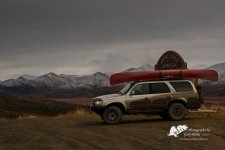
Currently running 3" Lift with Michelin LTX M+S 2, 265/75R16 light truck rated for the stronger sidewalls. You really need to build based on intended usage - overland usage generally means long stretches on the highway to get to places where you want to "overland". I picked these tires because they are tough enough to take a pounding on extended sharp gravel roads and won't kill your gas mileage. 3" lift and bumpers with better entry/exit angles for crossing the inevitable wash outs on exploratory side trips. Toytec lift will be going soon because it just didn't last and with the weight I am carrying I will be going with 2.5" body shocks (Icon) and heavier springs.
Photo taken on the Dempster Highway, Yukon Territory, on an 8 week 13,000 mile "overlanding" trip last year. (You can see the rear end is sagging quite a bit with probably only 3-400 lbs of gear)