'90 4Runner Engine rebuild or swap?

fabby5

New member
Hey, My buddy gave me his old '90 4Runner 4x4 that he bought brand new back in the day that is currently at 357K all on the original engine.
Its leaking a lot of oil from the front seal and from the rear seal. Needs a timing belt change and a couple of other things. I figured I'm just gonna pull the engine and work on it and contemplating a rebuild. The valves are really noisy.
I've never done anything this complex, but I'd like to learn.
I just dont want to throw money at a lost cause. Would it be easier to just get my same engine out of a wrecked car and put it into mine? But then I don't know what could go wrong with that in a little while. At least with my current engine I know what I need to fix... Of I could attempt some sort of swap and get a newer engine but I'm not even sure what that will cost.
I'm gonna start pulling my engine but I don't know what to do from there haha. Any ideas? Trying to do this the most cost effective way?
Thanks and sorry for noob-ness.
 
Register to hide this ad
Trust me don't buy anyones engine unless you can hear it run before you buy it. (Made that mistake twice and got burned). The odds are rebuilding yours is going to be cheapest route but for about 1000-1500 you could get a already rebuilt motor and give yours as a core.
 
Drive it till it goes AND then rebuild it. Like Brett said your gonna spend a good chunk of change anyway so maintain it and save up some money so that in the long run you have the funds to rebuild it.

That's just my 2 cents.

Good luck.
 
If you absolutely had to throw a junkyard engine in there to keep the truck on the road, I'd say do it and be done. But if time is aluxury you have, I vote you strip down your block and rebuild it from the crank up. Even if the bearings and pistons have some life left in them, ou'll learn a whole bunch along the way and have a brand new motor when you're done. And if the truck was free to you, you're already ahead of the game and can afford to throw some money at it.

I don't recommend you get yourself involved in an engine swap. There's complications to even the simple ones that you don't want to get involved in if you're new to wrenching.
 
Yeah, I am so far just gonna pull it and replace, front and rear seals, oil pump, timing chain...Not sold on a rebuild yet...However, I'm having difficulty following the FSM for removal. Does anyone know a good write up with pictures of the V6 (3VZE) engine removal? (Preferably 4wheel drive, A/T like mine):happy:
 
Does anyone know a good write up with pictures of the V6 (3VZE) engine removal? (Preferably 4wheel drive, A/T like mine):happy:

I've never removed a 3.0, but I can tell you it's much easier to pull the 22RE if you leave the harness and plenum in place. You'll want to pull the radiator, remove the fan and clutch. Motor mount bolts, bell housing bolts, fuel lines, heater lines, throttle cable, AC if you have it, and disconnect the harness in the kick panel and pull it through the firewall if you can. Maybe one or two other little things, and then bring the entire motor out at once. Then you'll have the luxury of tearing down that abominable mess of vacuum lines and switches with the motor out in the open when you can see stuff and take decent pics.

Get some egg cartons, ice cube trays, or even a bunch of ziploc baggies. Each time you pull a set of bolts or nuts or whatever, either put them back on the studs if you can, or if you can't put them in an egg carton slot or ziploc and label where they came from. Take oodles of pictures of everything you do from every angle. You'll save yourself a grip of time when it comes time to put everything back together.
 
Update

So, I got the engine out and before I tore into it I ran a compression test.
1. 147 psi
2. 139 psi
3. 0 (dry) and 50 psi wet.
4.150
5.150
6. 135

I didnt run wet on the other 5 cylinders because they seemed fine...What does this no compression dry and little compression wet mean? I rechecked 3 multiple times and constantly got 0???
 
So, I got the engine out and before I tore into it I ran a compression test.
1. 147 psi
2. 139 psi
3. 0 (dry) and 50 psi wet.
4.150
5.150
6. 135

I didnt run wet on the other 5 cylinders because they seemed fine...What does this no compression dry and little compression wet mean? I rechecked 3 multiple times and constantly got 0???

If the compression comes up when you add oil, that's generally a sign of bad rings. I've never seen bad rings return 0 PSI though, maybe that cylinder has more than one issue.
 
If the compression comes up when you add oil, that's generally a sign of bad rings. I've never seen bad rings return 0 PSI though, maybe that cylinder has more than one issue.

I did a leak down test and it appeared to be coming out of the exhaust manifold...I thought I was gonna have a burnt valve...
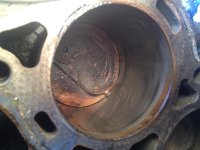
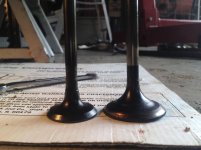
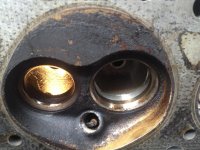
I pulled the head and my valves look pretty good. This cylinder though has black carbon build up...somewhat oily. I have no idea whats wrong... Ill try to post pics.
 
These could suck but its the best I got for now
 

Attachments

  • image_1.jpg
    image_1.jpg
    126.9 KB · Views: 217
  • image_5.jpg
    image_5.jpg
    125.1 KB · Views: 186
  • image_4.jpg
    image_4.jpg
    135.1 KB · Views: 202

Members online

No members online now.

Forum statistics

Threads
278,310
Messages
3,554,079
Members
248,016
Latest member
Advally Service

Trending content

Back
Top