This seemed like an appropriate time and place to insert, with a few modifications, the long story I told to friends a few months back. I had purchased in November, on eBay, a '97 4Runner. 5 speed, V6, with ABS. 176k on the odometer.
I thought I’d share what I’ve learned about ABS systems, and an underhanded used car lot trick I encountered.
First, some background on the “boot sequence” of contemporary vehicles. Assume a vehicle with airbags, ABS, and cruise control. Every car made since the early 90s has at least one airbag. ABS and cruise control continue to be options.
When you energize the car’s electrical system, you can pause before engaging the vehicle’s starter. No less than four computers go through a boot sequence:
The main computer, responsible for the engine and emissions systems, checks out all its components and turns on the CEL (check engine light). The CEL won’t go off until the engine is running.
The ABS computer checks out its components – the 4 wheel sensors, the ABS actuator, and various other relays and sensors – and once it’s done it turns off its light on the dashboard. The ABS doesn’t need the engine running to finish its job.
The airbag system – SRS, supplemental restraint system - checks out its components and turns off its light without requiring the engine to start
The cruise control system does likewise. I think it does not turn a light on and off during its boot sequence
I think cars with an automatic transmissions have a 5th computer that runs in a similar fashion, though this software may be part of the engine/emissions computer.
So if you’re purchasing a used vehicle and the various lights above don’t behave as I’ve described, you probably shouldn’t buy the vehicle. Or else be prepared to lay out more money to fix the faulty system.
Enough background.
OK, so my ‘97 4Runner, AKA Sisyphus, has its ABS light come on whenever its CEL light comes on. So I figured a problem in both areas. Read the error code for the CEL using one of those readers sold in any auto parts store and deal with that. Easy to do, and I’ve done this on other cars. Quite often it’s the forward oxygen sensor at fault, and it’s an easy fix.
There’s an alternate strategy for extracting the ABS error code. You link two contacts together on a special connector under the hood, which causes the ABS light on the dash to flash a code. Count the flashes and look up the code.
Only when I did that my ABS light didn’t flash. The Factory Shop Manual (FSM) suggests that if the light doesn’t flash the ABS computer is at fault. This computer, some $400 new, is under the passenger side kick panel. I looked at it, took down the part number (most Toyota electrical parts have the number on them) and found a used computer on eBay, where these computers are plentiful, for about $22. There’s an advantage to refurbishing a used Toyota, ‘96-‘02, of which 750,000 were sold in the US.
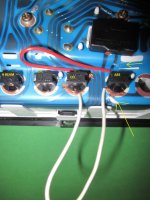
While waiting for that part to arrive, I decided to remove the instruments and replace a blown illumination light behind the tach. Look at what I found. Those 4 labeled items are light bulb sockets.
A previous “mechanic” has severed the ABS light from the circuit board (yellow arrows) and “wired” the ABS light – the red and white wires - to the CEL light. The effect is that when the CEL’s errors are reset, the CEL light comes on and goes off once the engine starts, just like a buyer sees on a perfectly functioning car. And the ABS light does the same. However, the ABS light, as designed, doesn’t need the engine running to turn off. That, of course, is a subtlety that most car owners aren’t aware of.
Thus any ABS errors were masked. But used car salesman could move that car off the lot!
Well, it turned out my vehicle’s ABS computer was fine, so I lost $22 purchasing that used ABS computer. Small matter. Now with a properly functioning ABS reporting system, I was able to do the jumper thing and count the ABS light flashes. Three flashes followed by three more, pause, repeat. Error code 33. Right rear wheel sensor.
The sensor itself is a small magnet, with about 4 feet of wiring, that fits into the axle. There’s a toothed ring on the axle that as it turns under the magnet generates a small AC current. (Identical setup at all 4 wheels.) The wire on the sensor was cut & abraded. The location was atop the axle but right underneath the exhaust pipe as it snaked its way above the axle. I’m guessing that a mechanic who did some exhaust system work – there was a jury-rigged bracket repair evident - managed to damage the ABS sensor wire at that time.
Now, that fellow who did the tweak to the instrument panel likely spent more time doing it than I spent repairing that broken sensor wire. Furthermore, what he did was if not illegal certainly lawsuit probable were a buyer to get into an accident which a functioning ABS system might have prevented. Masking a faulty brake system...wouldn’t an ambulance chasing attorney love to get
that into court?
If by chance I had not removed the instrument panel to replace a burnt out bulb, I would not have discovered this tweak and would have spent days fruitlessly looking for the reason why I couldn’t make the ABS computer report its fault. And if a different buyer had taken the vehicle to a mechanic to have the ABS system fixed, that mechanic would have struggled for a long time, too, and burned through a lot of the car owner’s money in a fruitless search. Maybe, just maybe, a really savvy mechanic might have noticed the link between the CEL and the ABS and figured something was amiss in that.
In conclusion, with respect to the original poster, look at the wires connecting each rear wheel's ABS sensor to the vehicle's wiring system.