Thank you for that interesting information as it seems this is a common question, where the answers are mostly jokes since everyone just assumes everyone else knows intuitively where to put the safety stands.
I, for one, put them in the front in the intuitive location, as I did the jack, both of which were correct.
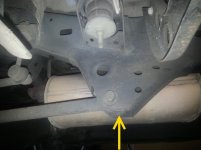
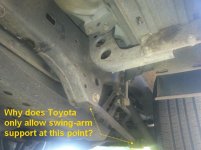
In the rear, I jacked in the intuitive location, which was correct, but I put the safety stands on the "joint" (swing arm?) in front of the wheel on the outside of the frame, which is apparently the wrong location for changing wheels.
It did seem a bit dodgy because there is only a "bulge" at that (swing arm?) bushing, so that's why I started looking up where the proper place for jack stands was.
It turns out that, at least according to Toyota, most of us are putting our safety stands in the wrong direction, but when you ask the question, most people ridicule the question.
I think it's a fair question, and I did my homework first, so, I do appreciate very much your clarification.
I certainly understand your words, but that's not what the Toyota diagram says.
In general, there is usually a good reason Toyota says not to put safety stands at the point that I used just fore of the wheels at that bushing location.
What that reason is we should know before we use those points for our safety stands.
Do I know why Toyota doesn't suggest that point?
Nope.
It looked good to me. Intuitively anyway.
But it doesn't hold up to inspection.
The reason Toyota says not to use that particular point for a jack stand is not because it's not strong enough. After all, they indicate that it is strong enough to lift the vehicle from that point using a 2 or 4 post swing-arm lift. Rather, that point is unstable when using a jack stand. The suspension arm moves relative to the frame, and when the suspension droops it can push the top of the jack stand forward and cause it to pop out of position. That's not a concern with a swing arm lift.
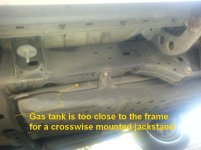
I'll stand by my original advice. Use the rear axle if you're changing tires or doing brakes, wheel bearings, etc. If you're working on the rear suspension you will have to support the vehicle by the frame. It's safe to do so as long as you make sure the support is secure and stable.