Advice requested from those of you who have mounted tires & balanced wheels at home

Status
Not open for further replies.
Thank you for that interesting information as it seems this is a common question, where the answers are mostly jokes since everyone just assumes everyone else knows intuitively where to put the safety stands.

I, for one, put them in the front in the intuitive location, as I did the jack, both of which were correct.

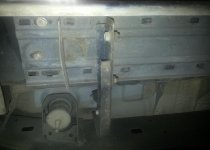
In the rear, I jacked in the intuitive location, which was correct, but I put the safety stands on the "joint" (swing arm?) in front of the wheel on the outside of the frame, which is apparently the wrong location for changing wheels.

It did seem a bit dodgy because there is only a "bulge" at that (swing arm?) bushing, so that's why I started looking up where the proper place for jack stands was.

It turns out that, at least according to Toyota, most of us are putting our safety stands in the wrong direction, but when you ask the question, most people ridicule the question.

I think it's a fair question, and I did my homework first, so, I do appreciate very much your clarification.


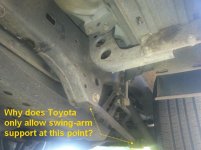
I certainly understand your words, but that's not what the Toyota diagram says.

In general, there is usually a good reason Toyota says not to put safety stands at the point that I used just fore of the wheels at that bushing location.

What that reason is we should know before we use those points for our safety stands.
Do I know why Toyota doesn't suggest that point?
Nope.
It looked good to me. Intuitively anyway.
But it doesn't hold up to inspection.

The reason Toyota says not to use that particular point for a jack stand is not because it's not strong enough. After all, they indicate that it is strong enough to lift the vehicle from that point using a 2 or 4 post swing-arm lift. Rather, that point is unstable when using a jack stand. The suspension arm moves relative to the frame, and when the suspension droops it can push the top of the jack stand forward and cause it to pop out of position. That's not a concern with a swing arm lift.

I'll stand by my original advice. Use the rear axle if you're changing tires or doing brakes, wheel bearings, etc. If you're working on the rear suspension you will have to support the vehicle by the frame. It's safe to do so as long as you make sure the support is secure and stable.
 
The reason Toyota says not to use that particular point for a jack stand is not because it's not strong enough. After all, they indicate that it is strong enough to lift the vehicle from that point using a 2 or 4 post swing-arm lift.

That point was not lost on me that the spot on the "thing" that is just in front of the rear wheels (see photo below on the SUV I was working on) is strong enough for a swing-arm lift, so why isn't it the right place for a jack stand?

Rather, that point is unstable when using a jack stand. The suspension arm moves relative to the frame, and when the suspension droops it can push the top of the jack stand forward and cause it to pop out of position. That's not a concern with a swing arm lift.
Oooooh. I see. I think ...

So what you're saying is that, for some jobs, that suspension point (what is it physically called?) can move whereas the axle won't move?

I'll stand by my original advice. Use the rear axle if you're changing tires or doing brakes, wheel bearings, etc.

I think the axle should be fine. It's just lower than the suspension "bulb" (what is it called) that I had used. But other than that, using the rear axle should be fine. I just didn't know it when I changed the four wheels and tires.

If you're working on the rear suspension you will have to support the vehicle by the frame. It's safe to do so as long as you make sure the support is secure and stable.

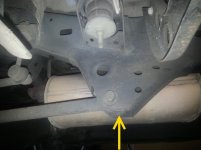
You said "frame" but here is a picture of the underside of the 4Runner I was working on, just in front of the rear tires.

Where is the "frame" in these two photos?
 

Attachments

  • 01_rear_mount_point.jpg
    01_rear_mount_point.jpg
    43.7 KB · Views: 29,400
  • 00_rear_mount_point.jpg
    00_rear_mount_point.jpg
    36.9 KB · Views: 21,119
The frame is the two large box beams running front to back underneath the vehicle, plus the connecting crossmembers. The control arm bracket you show in your first picture is welded to the frame above it.

Generally the most solid place to lift or support the 4runner is any flat place under the frame. That control arm bracket is not so good because it's too easy for a jack or stand to slip off it. Just forward of that would be better.
 
The frame is the two large box beams running front to back underneath the vehicle, plus the connecting crossmembers. The control arm bracket you show in your first picture is welded to the frame above it.

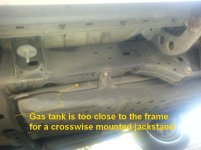
I guess my stumbling block in using the "rest" of the frame in front of the rear tire is that the gas tank proximity precludes putting the jack stands in the crosswise (perpendicular) position on that frame (for fear of puncturing the tank or denting the shield).

So it seems to me, intuitively, the jackstand head has to be placed in line (parallel) to the frame, which is, to me, a substandard position.

Which way (parallel or perpendicular to the frame) do you place your safety stands?

Generally the most solid place to lift or support the 4runner is any flat place under the frame.
Except that the gas tank is in the way, is it not?

That control arm bracket is not so good because it's too easy for a jack or stand to slip off it. Just forward of that would be better.

I guess for these two reasons, that Toyota decided NOT to allow jack stands in those two spots:
  1. The control-arm bracket is problematic
  2. The frame in front of the control-arm bracket is problematic
 

Attachments

  • 02_rear_frame.jpg
    02_rear_frame.jpg
    44 KB · Views: 20,859
  • 05_rear_frame.jpg
    05_rear_frame.jpg
    56.5 KB · Views: 22,588
Status
Not open for further replies.

Members online

Forum statistics

Threads
278,315
Messages
3,554,125
Members
248,016
Latest member
Advally Service

Trending content

Back
Top