Axle shift

Correct. But the poster suggested relocating a fuel tank into the spare tire area and changing the suspension components.

This would equate to a custom fuel tank in the 4runner's spare tire location, with no crash testing data of having a fuel tank there at any speeds. For which the area was not designed to have a fuel tank in the 1st place (i.e. could be a crumple zone). In addition to not having any repeated engineering testing to validate that a custom one off fuel tank would prevent rupture upon applied force.

All these items to me raise a redflag of not a good idea.

Dude read the thread. This is off road. Pretty sure if they want to change out the rear geometry to the illustration then they have the smarts to protect the tank.

Back on topic as this is a good discussion.
 
A triangulated four link would kick ass, but have you looked at relocating the panhard? When you lengthen it you attenuate the axle shift you're talking about but you don't eliminate it. If you extend the panhard mount either on the axle or the crossmember to return the panhard to level when the truck is static, you won't get nearly as much axle shift.

If that doesn't float your boat but you're not ready to move the gas tank, check out the Watts Linkage. And there's always leaf springs if you get desperate... :D
 
A triangulated four link would kick ass, but have you looked at relocating the panhard? When you lengthen it you attenuate the axle shift you're talking about but you don't eliminate it. If you extend the panhard mount either on the axle or the crossmember to return the panhard to level when the truck is static, you won't get nearly as much axle shift.

If that doesn't float your boat but you're not ready to move the gas tank, check out the Watts Linkage. And there's always leaf springs if you get desperate... :D

I'm going to get out later today and flex it out a bit and get the angle of the panhard in the driver tucked position. If it is near horizontal, then I'll feel like dropping the frame bracket on the passenger side is worth the effort.

I don't mind having some axle shift... I just want it moving away from the tank vs towards it.

The movement is minimal to begin with, but the clearance between tanks and shaft is also minimal....
 
Last edited:
The other thing you could do would be to get a universal fabricated track bar mount from someone like ruff stuff or poly performance, cut the factory one off and weld the new one on. That's what I did with my jeep. I raised the roll center on the rear axle 6" overall and it increased its handling characteristics substantially.

The 4runners track bar is super long and nearly flat stock anyway, so returning it to a similar level would aide in cornering and body roll huge in addition to negating axle drift while drooped out

Stock, shin sheet metal bullshit weak as **** mount.


Poly performance mount for a 3.0" axle tube burned on


Painted and re-assembled with a currie adjustable track bar. Rokmen makes one for our trucks with Johnny joints out of 7075 aluminum. It's solid. I'm friends with the owners and they won't steer you wrong

 
Last edited:
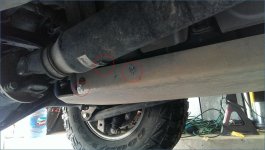
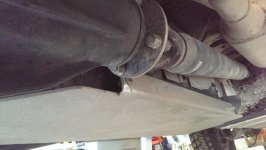
A few pics of the contact area.
 

Attachments

  • axle_shift3.jpg
    axle_shift3.jpg
    78.5 KB · Views: 304
  • axle_shift4.jpg
    axle_shift4.jpg
    74.6 KB · Views: 288
Last edited:
After taking some measurements... I think lowering the frame mount on the drivers side is the way to go. This should provide just enough change in the arc for it to pull back towards the passenger side a tiny bit at full stuff. Raising the axle mount would be similar (if that ends up being easier). Both mounts look pretty beefy on the 4r.

I have 3" bump stop extensions, so my axle does not have much up travel... If dropping it does not solve the issue completely I could get an adjustable panHard and shorten it a tad and that will solve the stuff issue without creating strange alignment at ride height.

The fab work will be a bit of a PITA, but I know a guy who is pretty good at stuff like this. I could probably do it myself, but with a recent shoulder injury... it is not worth the pain (literally).
 
Last edited:
The other thing you could do would be to get a universal fabricated track bar mount from someone like ruff stuff or poly performance, cut the factory one off and weld the new one on. That's what I did with my jeep. I raised the roll center on the rear axle 6" overall and it increased its handling characteristics substantially.

The 4runners track bar is super long and nearly flat stock anyway, so returning it to a similar level would aide in cornering and body roll huge in addition to negating axle drift while drooped out

Stock, shin sheet metal bullshit weak as **** mount.

I like the idea of multiple mounting positions... Too bad they don't come from the factory like that.
 
Track bar and triangulated control arms

Simple fix.
Put fuel tank where spare tire is. Do a true 4 link with longer triangulated upper and lower links

I like the way you're thinking here, but I believe the system you drew is fixed and cannot move. It's basically a truss since the 4 forward points are fixed to the same rigid frame. This is why the 4 control arms are all straight and perpendicular to the axle.

If he moved the fuel tank and spare tire the OP's initial problem would be solved. The fuel tank would no longer rub.

But never mind the spare tire or fuel tank, you'd need to remove the cargo bed to allow room for that tall frame to rise. That is, if it could move.

Keep working on this. I'd like to see a solution to the single arm track bar that keeps the axle and diff centered below the truck when the suspension travels out to max rotation.

The most important alignment is when the vehicle is on flat ground during normal operation at city and highway speeds. And in it's current trailing arm configuration the truck must have a track bar to hold the axle centered below the vehicle.
 
After taking some measurements... I think lowering the frame mount on the drivers side is the way to go. This should provide just enough change in the arc for it to pull back towards the passenger side a tiny bit at full stuff. Raising the axle mount would be similar (if that ends up being easier). Both mounts look pretty beefy on the 4r.

I have 3" bump stop extensions, so my axle does not have much up travel... If dropping it does not solve the issue completely I could get an adjustable panHard and shorten it a tad and that will solve the stuff issue without creating strange alignment at ride height.

The fab work will be a bit of a PITA, but I know a guy who is pretty good at stuff like this. I could probably do it myself, but with a recent shoulder injury... it is not worth the pain (literally).


How much up travel do you have? Can you take a photo of your truck on level ground so I can see the space between the bump and axle? Shocks?
 
How much up travel do you have? Can you take a photo of your truck on level ground so I can see the space between the bump and axle? Shocks?
It's only about 3.5 inches. Sounds small, but it ends up being a really good with lots of down travel unless you wheel at speed. The springs are also dual rate, so they are really loose up top.
 
Track bar rotation

Ok, I've brought this up before, .... The axle is shifting over about 2".

It rubs in two places. One is at the forward portion of the U-Joint half yoke and the other is further forward on a weight or some other metal bump on on the smooth portion of the drive shaft (this is the area where it is very close the gas tank itself)

I have trimmed the skid as much as possible plus relocated the rear bracket, and don't think there is really much more I can do for clearance besides coming up with a way to keep the axle more centered.

This only happens with the rear sway off...
...
So, my question is what would potentially resolve this. The track bar seems like the obvious place to start, but it seems odd that I would need to shorten it. That seems like the only way to keep it centered with the driver wheel tucked. Normally, you lengthen it a bit after a lift to match normal ride height... In this case, the arc should already be starting to pull it towards the passenger side as shown in the attached picture. Thoughts?

I don't understand one comment (at least one) you made. "This only happens with the rear sway off..." I think you said you have KDSS. How do you remove or disconnect the anti-sway bar if you have hydraulic KDSS?

The point you make after that is reversed. By raising the frame over the axle with the LT suspension you've moved the axle to the right (passenger side), towards the frame-end anchor point of the track bar (on the passenger side, correct). You potentially need a longer track bar (adjustable) to align the drive shaft, diff and axle back under the center of the truck and get the vehicle to drive straight at normal speeds on flat pavement. But that would also move the drive shaft further left towards your fuel tank skid.

An illustration of the stock trailing arms and track bar:
2015 Toyota 4Runner Parts - TRDParts.com

Currently on your truck, on deflecting down, the track bar anchored to the axle is pushing the diff left and the drive shaft is moving up with it. That's two directions that bring the drive shaft closer to the skid.

It seems unlikely the drive shaft would move 2" left as the suspension compresses, as you said. That seems like a lot. But do the trigonometry for the angle and max flex to predict what the true shift might be, based on a measurement of the angle at rest and the distance of compression at the track bar anchor. Or, you said you were going drive it off road and get the car up on two tires and measure it directly. Any high curb will do.

The best fix I've seen above is moving the anchor point at either or both ends and bringing the track bar to level when the vehicle is at rest, on flat ground. [MENTION=104049]marshal[/MENTION] 's photos of the axle anchor relocation above are awesome. It looks like he also used a bent track bar.

I suggest you make a mock track bar out of very straight wood stick or steel tube and try various locations for the anchor points -just to predict the height of the new anchor points and see what's easier or better to change.

Great thread BTW. Thanks for everyone's useful comments. I'm learning with/from the rest of you.

 
Last edited:
I don't understand one comment (at least one) you made. "This only happens with the rear sway off..." I think you said you have KDSS. How do you remove or disconnect the anti-sway bar if you have hydraulic KDSS?

I do not have KDSS. That was rochmpr saying he had LT with KDSS. I've never heard of that working, so it surprised me.... and yes if I put the swaybar on (with extended links). The axle does not hit the gas tank skid. The sway bar helps keep it centered... but I loose some articulation. Good enough for almost every condition, but I like to play with it off.

The point you make after that is reversed. By raising the frame over the axle with the LT suspension you've moved the axle to the right (passenger side), towards the frame-end anchor point of the track bar (on the passenger side, correct). You potentially need a longer track bar (adjustable) to align the drive shaft, diff and axle back under the center of the truck and get the vehicle to drive straight at normal speeds on flat pavement. But that would also move the drive shaft further left towards your fuel tank skid.
Technically LT has nothing to do with moving the axle, it just exacerbates normal axle shift by allowing more down travel. Just lifting will shift the axle a little bit to the passenger side... That is why I mentioned making it shorter. That would keep it even more passenger side when fully articulated with the driver tire tucked. Moving the frame attachment point down or the axle attachment point up would do the same, but without the negative effect of more out of center shift at ride height.
An illustration of the stock trailing arms and track bar:
2015 Toyota 4Runner Parts - TRDParts.com

Currently on your truck, on deflecting down, the track bar anchored to the axle is pushing the diff left and the drive shaft is moving up with it. That's two directions that bring the drive shaft closer to the skid.

It seems unlikely the drive shaft would move 2" left as the suspension compresses, as you said. That seems like a lot. But do the trigonometry for the angle and max flex to predict what the true shift might be, based on a measurement of the angle at rest and the distance of compression at the track bar anchor. Or, you said you were going drive it off road and get the car up on two tires and measure it directly. Any high curb will do.

Yea, BTW it take about a 3.5 foot curb to flex it much... not easy to find that. There is more going on than simple angles. Multiple forces are shifting and there is give in various bushings.... I did the math... and it should only be about .16" of movement from a pure trig perspective (unless I screwed it up). Based on 40" bar, and a 5* delta to horizontal.

The best fix I've seen above is moving the anchor point at either or both ends and bringing the track bar to level when the vehicle is at rest, on flat ground. [MENTION=104049]marshal[/MENTION] 's photos of the axle anchor relocation above are awesome. It looks like he also used a bent track bar.

I suggest you make a mock track bar out of very straight wood stick or steel tube and try various locations for the anchor points -just to predict the height of the new anchor points and see what's easier or better to change.

Great thread BTW. Thanks for everyone's useful comments. I'm learning with/from the rest of you.

That is the basic direction I'm going. Just need to worry about clearance everywhere and ease of getting in there to weld stuff...
 
Last edited:
I think its amazing that no one else has had this issue considering how many are running the MT LT system without a rear sway bar. the only differences on mine is the adjustable panhard bar and I still have the stock gas skid. I have never had any rub, and it is hard to believe the RCI skids over hang that much further
 
Axle alignment

I do not have KDSS. That was rochmpr saying he had LT with KDSS. I've never heard of that working, so it surprised me.... and yes if I put the sway bar on (with extended links). The axle does not hit the gas tank skid. The sway bar helps keep it centered... but I loose some articulation. Good enough for almost every condition, but I like to play with it off.

Thanks for the reply. My mistake for shooting from memory here. Yes, the sway bar can be disconnected if you don't have KDSS. I was torn about ordering KDSS for my truck.

Technically LT has nothing to do with moving the axle, it just exacerbates normal axle shift by allowing more down travel. Just lifting will shift the axle a little bit to the passenger side... That is why I mentioned making it shorter. That would keep it even more passenger side when fully articulated with the driver tire tucked. Moving the frame attachment point down or the axle attachment point up would do the same, but without the negative effect of more out of center shift at ride height.

I think the most important axle & diff alignment is for every day normal driving on pavement at normal to fast speeds. For that you want the axle square with the frame so the truck drives straight. Alignment at crawling speeds on uneven ground just doesn't matter that much.

Yea, BTW it take about a 3.5 foot curb to flex it much... not easy to find that. There is more going on than simple angles. Multiple forces are shifting and there is give in various bushings.... I did the math... and it should only be about .16" of movement from a pure trig perspective (unless I screwed it up). Based on 40" bar, and a 5* delta to horizontal.

I think you only need to get two tires off the ground.

That is the basic direction I'm going. Just need to worry about clearance everywhere and ease of getting in there to weld stuff..

Thanks again for the details.
 
I think its amazing that no one else has had this issue considering how many are running the MT LT system without a rear sway bar. the only differences on mine is the adjustable panhard bar and I still have the stock gas skid. I have never had any rub, and it is hard to believe the RCI skids over hang that much further

I'm not making it up. LOL. I wish I was. And like I said before it barely rubs now, I'm just a bit of a perfectionist about noises. I don't think it is hurting anything at this point, just annoying.

Actually a bunch of people have had rubbing on the gas tank skid (even without LT). A little trimming usually resolves it. The greater the flex the more potential for it. I think the stock sheet metal skid gives way more clearance.

Additionally, mine was clearing until I put the 34s and got some major leverage going. From that point forward it flexed more and rubbed. If you look at the pics where it is rubbing that is right where the bracket comes down... It just can't go anymore forward since there is no frame tab above to mount on.

And. all these truck are a little different.... especially when it comes to things like alignment.

The more I ponder the solution the more I'm thinking an adjustable panHard will solve it. Even set to the same length it will probably just have stiffer bushings... Might just go that route and tweak it just enough to stop the rubbing. A drop bracket would be the better way to go, but the fab might be a PITA and cost too much time and money.
 
Last edited:
The Rokmen website has some really good photos of the panhard bar and control arms installed. It's easy to see how you might extend the axle end connection upward to level out the bar when the truck is on level ground.

Suspension Components - 4Runner 10+ - Toyota

It's too bad someone does not make a bolt in drop/riser bracket. They would sell like hotcakes. Anyone with a lift would probably buy one just to get the alignment and angles back to stock.
 
Panhard track bar anchor at axle

It's too bad someone does not make a bolt in drop/riser bracket. They would sell like hotcakes. Anyone with a lift would probably buy one just to get the alignment and angles back to stock.

Looking at those Rokmen photos I thought it would be fairly easy to bolt in a tube steel section or U-shaped bent plate that fits tightly into the bracket at the axle. Then weld heavy plates to the tube at the right width with a track bar hole at the desired height. It could be bolt-in with no welding on the axle. All fab and welding could be done in a shop on a table.
 

Members online

Forum statistics

Threads
278,306
Messages
3,554,046
Members
248,016
Latest member
Advally Service

Trending content

Back
Top