Just FYI: If your LBJ is limiting your suspension travel, your suspension is not setup properly. The "articulation" of the balljoint is really a moot point.
On compression, your LCA bumpstops should limit travel well before BJ end-travel. On droop, your shocks' internal bump stop should limit travel before BJ end-travel again.
If planning on adding droop- or abusing your suspension- limit straps should be added. Either way- the ball joints should NEVER be used as limiting points in your suspension.
Why do you keep saying "THE RESULTS WILL SHOCK YOU!"? because it gets your attention, it gets people going and interested, and opens the discussion
I just see two cut open ball joints, which is what I expected. Also, the aftermarket is completely different than the OEM- again, what weyou expected.
What is the shocking part that I am missing?
Just wondering, does anyone know who actually manufactures the OEM part? I don't imagine Toyota has a ball joint factory somewhere.
With my Volvo for instance, people on the Volvo board have compiled a list of who makes which part. So, for instance, instead of paying $250 for the OEM "blue box" Volvo branded unit bearing, I paid $150 for the FAG (actual name of the company) unit bearing which is the same part just in a different box.

...because there is NO research on it.
So you are telling me you knew the exact construction of Mevotech ball joint? I found it very interesting the way there were constructed.
Is there any way to change the forces on the BJ from tension to compression? Then they will "never" fail. Or would this require a complete replacement of the assemblies like the Total Chaos ones?
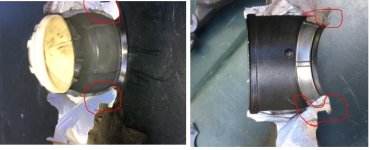
OEM housing
Mevotech
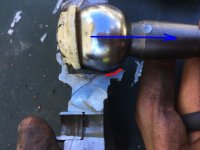
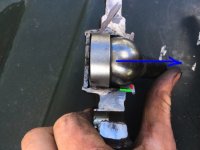
Pretty easy to see that the Mevotech has thinner exterior walls on the top where the failure of these usually occurs. And the design increases the stress concentrations on fewer points. Thinner wall+increased stress concentrations=buy OEM
I believe the failure usually occurs when the ball gets pulled out of the housing. Just looking that area in particular (let's refer to it as stud side), the OEM is indeed cast thicker, but Mevotech has a larger casting area.
Everyone keeps mentioning "stress concentrations" but no one is specific lol, maybe someone can enlighten me.
However I do see that OE ball will be pushing directly down onto the metal part, while the Mevotech (hypothetically) will spread the load better because of the "L" shape bearing.
I'm considering finding a shop with hydraulic press and having them press the ball joint out of the housing and seeing how much force each took.
Sometimes I wonder if you can just go to the junkyard and find an entire LCA, UCA, wheel assembly the uses the opposite designed ball joint and just swap them out.
Woah. What are you talking about? Like off of a completely different make and model of vehicle?