Ball joint extravaganza...the results will shock you!

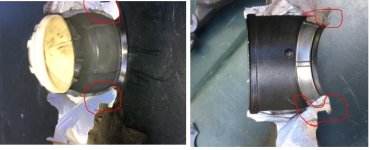
OEM housing
5cfuhu.jpg

9fw4ut.jpg

15km0m.jpg


Mevotech
24lq35x.jpg

15xwk91.jpg

293zywi.jpg

bjls.jpg

Thrust washer??
2qdv6ko.jpg
 
Why do you keep saying "THE RESULTS WILL SHOCK YOU!"?
I just see two cut open ball joints, which is what I expected. Also, the aftermarket is completely different than the OEM- again, what we expected.
What is the shocking part that I am missing?
 
Just FYI: If your LBJ is limiting your suspension travel, your suspension is not setup properly. The "articulation" of the balljoint is really a moot point.
On compression, your LCA bumpstops should limit travel well before BJ end-travel. On droop, your shocks' internal bump stop should limit travel before BJ end-travel again.
If planning on adding droop- or abusing your suspension- limit straps should be added. Either way- the ball joints should NEVER be used as limiting points in your suspension.

Yeah sure I agree. But more travel angle is beneficial. Maybe OEM BJ are failing because they stop travel before bump the strut or bump stop can. You cannot prove or disprove it because there is NO research on it.

Why do you keep saying "THE RESULTS WILL SHOCK YOU!"? because it gets your attention, it gets people going and interested, and opens the discussion
I just see two cut open ball joints, which is what I expected. Also, the aftermarket is completely different than the OEM- again, what weyou expected.
What is the shocking part that I am missing?

So you are telling me you knew the exact construction of Mevotech ball joint? I found it very interesting the way there were constructed. Also I've seen no pictures of an opened up 3rd gen ball joints - OEM or aftermarket. The point is one is superior than the other one, either an OEM or mevotech. You'll also notice that I've never stated WHICH one is more superior. That is to be found out by the end of this conversation, and no one is forcing you to be a part of it.
 
Last edited:
Aisin

Just wondering, does anyone know who actually manufactures the OEM part? I don't imagine Toyota has a ball joint factory somewhere.

With my Volvo for instance, people on the Volvo board have compiled a list of who makes which part. So, for instance, instead of paying $250 for the OEM "blue box" Volvo branded unit bearing, I paid $150 for the FAG (actual name of the company) unit bearing which is the same part just in a different box.


Thanks for taking time to open up an OEM ball joint.

Most mechanical parts are made by toyota and Aisin is a part of Toyota. Denso is also owned by Toyota. OEM toyota is superior, that's all I know by working with Toyota cars/truck for the past 30 years.

One example. If I find a good used toyota OEM lower ball joint (without any play), I'll take it than installing any aftermarket ball joint. The used toyota part will still outlast the aftermarket ball joint.
 
Last edited:
At around 290k miles I decided to replace the front suspension components with aftermarket items. Now after only around 15k miles my suspension has a looser and more worn feeling than under my original oem parts. Because of my stupidity, I now have to do the job over again with all eom. Go oem and cry once, or go aftermarket and cry twice!:redbrick::redbrick::redbrick::redbrick::redbrick:
 
My machinists/mechanical designer eye is seeing many more manufacturing processes in the casting of the Toyota part. I can see where the OEM part does a much better job of capturing the top of the ball stud.
 
...because there is NO research on it.
So you are telling me you knew the exact construction of Mevotech ball joint? I found it very interesting the way there were constructed.

Ah, you're new here; now I understand.
Yes, I did know "the exact construction". I hadn't seen pictures, but a member here cut open an OEM LBJ- as well as multiple aftermarket joints- and explained in one of the LBJ threads how the OEM joints completely differed from the aftermarket joints, but all the aftermarket joints were built the same as each other.
Cool of you to cut these open and post pics.
I just kept looking for the SHOCKING RESULTS, and realized there are none [emoji30]
 
Is there any way to change the forces on the BJ from tension to compression? Then they will "never" fail. Or would this require a complete replacement of the assemblies like the Total Chaos ones?
 
Is there any way to change the forces on the BJ from tension to compression? Then they will "never" fail. Or would this require a complete replacement of the assemblies like the Total Chaos ones?

Sure, there's a way! All you have to do is completely re-design the suspension [emoji6] Definitely no easy way to go about it.
 
The OEMs actually have slightly more meat in the areas which count. However, it's surprising to see how thin the teflon is because if this wears through (dirt ingress), the ball will churn through the housing very quickly.

In principle, a metal on metal design is superior to the teflon design for high shock/load/temperature situations but only if they are periodically greased. I think the most common mode of failure is the ball pulling out from the socket from a worn body or ball. It would help to have a larger ball because the contact area of the portion of the ball that's under load is actually very small.
 

Attachments

  • Untitled.jpg
    Untitled.jpg
    69.3 KB · Views: 2,106
As stated before unless something is defiantly amiss you cant judge the superiority of a product by visuals. as for manufacturing it appears to be 2 different thought processes. one is build it tough, use it till it is bad then replace. the other requires regular maintenance, but is less expensive to make. You pay for it either way. Both have their pros and cons. for this part I will stick with the OEM, Consistent quality and the car is for my daughter and that is less maintenance I have to worry about her doing.

and please note. If you spent more than 15 minutes measuring, cutting apart, or otherwise dissecting ball joints, go have a beer, find a girl, watch some porn expand your horizons ect :p
 

That's a very narrow minded statement. The whole point of this forum is for us to share and discuss our experiences and observations. You can absolutely make MANY deductions about a part from visual obervations. We have theories about what's going on in other star systems and the universe JUST from observation!

Many members here love their vehicles and it's a hobby to understand what goes on and how things work. Even if you don't agree with the OP's observations atleast present a logical argument and alternative instead of just bashing the guy for wasting his time.
 
OEM housing

Mevotech

Pretty easy to see that the Mevotech has thinner exterior walls on the top where the failure of these usually occurs. And the design increases the stress concentrations on fewer points. Thinner wall+increased stress concentrations=buy OEM
 
Pretty easy to see that the Mevotech has thinner exterior walls on the top where the failure of these usually occurs. And the design increases the stress concentrations on fewer points. Thinner wall+increased stress concentrations=buy OEM

I believe the failure usually occurs when the ball gets pulled out of the housing. Just looking that area in particular (let's refer to it as stud side), the OEM is indeed cast thicker, but Mevotech has a larger casting area.
Everyone keeps mentioning "stress concentrations" but no one is specific lol, maybe someone can enlighten me.
However I do see that OE ball will be pushing directly down onto the metal part, while the Mevotech (hypothetically) will spread the load better because of the "L" shape bearing.

I'm considering finding a shop with hydraulic press and having them press the ball joint out of the housing and seeing how much force each took.
 
I believe the failure usually occurs when the ball gets pulled out of the housing. Just looking that area in particular (let's refer to it as stud side), the OEM is indeed cast thicker, but Mevotech has a larger casting area.
Everyone keeps mentioning "stress concentrations" but no one is specific lol, maybe someone can enlighten me.
However I do see that OE ball will be pushing directly down onto the metal part, while the Mevotech (hypothetically) will spread the load better because of the "L" shape bearing.

I'm considering finding a shop with hydraulic press and having them press the ball joint out of the housing and seeing how much force each took.

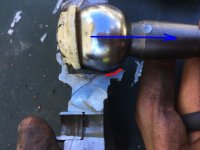
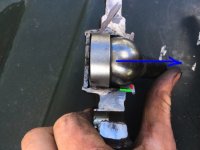
OK - here goes very quick summary.
OEM is top pic - Mevotech is bottom.

With force wanting to pull the ball out of the socket in the direction of the blue arrow the OEM distributes stress along the red line. The Mevotech design by using the metal collar has thinner outside wall thickness. And the collar acts to focus the stress on the little red line because it will slide along the green line.
 

Attachments

  • 15km0m.jpg
    15km0m.jpg
    85 KB · Views: 1,541
  • bjls.jpg
    bjls.jpg
    78.1 KB · Views: 1,514
Sometimes I wonder if you can just go to the junkyard and find an entire LCA, UCA, wheel assembly the uses the opposite designed ball joint and just swap them out.
 
Sometimes I wonder if you can just go to the junkyard and find an entire LCA, UCA, wheel assembly the uses the opposite designed ball joint and just swap them out.

Woah. What are you talking about? Like off of a completely different make and model of vehicle?
 
4th Gen 'runners and 3rd gen Tacos got it right w/ the re-design of the front suspension, those BJs are in a constant compression load. It would be interesting to compare some dimensioned drawings of the 2 suspensions, just to see how the mounting points line up. I'd be very doubtful that anything is close to bolting up.
 
I wonder if there have been any documented fatalities from 4runner LBJ failure. Considering the amount of them still on the road you'd think that might warrant some kind of response / action from Toyota.
 

Members online

Forum statistics

Threads
278,316
Messages
3,554,120
Members
248,016
Latest member
Advally Service

Trending content

Back
Top