Best speculation of a 2023 6th generation I have seen

LOL, lemme guess, Ford?

I was meaning the Tundra. But my last truck was a power stroke and anything major required the cab off. So it's $2000 to start before any actual work starts. And it means you can't do it at home unless you have a lift and about 16 foot ceilings. And a refrigerant service setup because you have to split the AC system. It also basically means that it's impossible to fix in the field. That's okay for a fleet truck that's never far from a shop. Not okay for a vehicle you want to go anywhere remote. New tundra is the same way along with the Land Cruiser and Sequoia. As you can imagine it never really goes back the same way.

You gonna pull the body off a Land Cruiser in the interior of Australia? The world is getting smaller and nothing is as remote as it was 50 years ago but it's still a poor setup for remote travel. Even the power stroke turbos are accessable with the cab on though. I'm really amazed Toyota stuffed them so far underneath with no access.


The worst offender I've owned was a gm hd2500 with the 8.1/Allison. The crank position sensor was in the bellhousing from the top . GM called for the cab off to replace a $50 sensor. And GM quality meant that sensor failed pretty regularly. How could you engineer something so stupid? There's no reason not to have the sensor from the bottom or just in front like every other vehicle in history.

New taco looks pretty wide open under the hood. That's really good imo.
 
Last edited:
Lol, had no idea, thanks guys. That Tesla Cybertruck looks better by the day!

Good that I have no use for a full size.
 
Lol, had no idea, thanks guys. That Tesla Cybertruck looks better by the day!

Good that I have no use for a full size.

A cab off will seem cheap compared to almost any repair on a Cybertruck. Cold rolled stainless can't be welded if it is in fact structural. I've yet to hear anyone explain if or how it could be repaired. My guess is that if you crease any body panel it's a total loss. Like the $42k fender bender on a Rivian that somehow requires the roof liner removed for a rear bumper repair. No excuse for making the Tundra a cab-off repair like the domestics. But the EV trucks are going from only repairable at a shop to truly unrepairable.

I'm not a big fan of overregulation, but this is something I think would benefit the public generally to have a federal standard for minimum reparability cost laws. Or at a minimum, a liability limit. If you want to drive a 100k eggshell down the road - great. The owner needs to be responsible for not all, but just the excessive risk when they choose to go beyond the common vehicle cost to repair for common occurrences. Or design standards to withstand a 10mph impact with less than $5k in repair cost.
 
Just saw a table at 4:05 in the new Savagegeese Tacoma video. It confirms that all three engine grades make their maximum torque output at 1700RPM. That should feel very good behind the wheel, for all three.

All it needs to do is be reliable. Hopefully Toyota got that one right. I expect that they did. The engineer on camera emphasized that they thoroughly tested these new powertrains to very high standards, like they always do, and doubly so for trucks.
 
Last edited:
I'd guess there's good bit of headroom in the tune. You can see on pretty much all of the small turbo 4's including Toyotas rely on the software to cap the torque well below what it would be capable of. Not sure what drives the cap though as far as driveline durability or engine internals. May also be for drivability. I think all of Toyota's new turbos have twin scroll turbos, so there's a double peak in power if they were run without restriction and it would feel odd to have it drop power at 2000 rpms and pick back up again like the 90's Japanese twin turbos did. I can't find an official power curve graph for the T24AFTS, but the 8AR is basically a scaled down version of the same engine. And GM's 2.7 is pretty similar, just scaled up a bit from Toyota's so it's around 430 ftlbs at 1500 rpms. I don't think there's much room for more peak power. It's pretty well tapped out at the high end of the rpm range both the turbo runs out of breath and the engine is going to struggle for more rpm because of the design being optimized for lower rpm power (long stroke narrow bore). Very different from Ford's EB engines that are wide bore short stroke and more free revving. IMO the toyota/GM choice is the better option for a truck engine. Ford's design is better for a sports car.

enkxof7lrzf71.jpg


It's very similar to the Toyota 4.6L v8 in power below around 2k rpms and then would fall behind from there up to peak power. It's a good bit short of the 3.5 TTv6 that hits 450 tq at 1600 rpms, but that's to be expected. I think it'll be really nice at elevation where it might outperform the 4.6 v8. Almost certainly will with the 8 speed over the 6 speed. It'll be maxed out on boost to match the sort of lazy output of the 4.6 v8 though. So it'll be really interesting to see how well balanced and isolated it is in comparison.


I haven't seen any info on what rear axle or front diff it will use. Has anyone seen that yet? The 8.2 seems to be on the small side for that much torque, especially in the hybrids. If it's the 9.5, that's pretty great for a Tacoma. It's probably stronger than most Dana 60 versions. Or will there continue to be an 8.75 diff like the outgoing truck? Max ground clearance is listed at 9.5, TRD Pro Tundra is 9.4 with the same tire height and the 10.5" rear end, so that sort of points to the 9.5 being the axle choice. That would be really great news also for aftermarket support as there's already 2OEM ratios available and a bunch of aftermarket ratios. Also - has anyone seen any info on the front steering design? The LC300 uses an electric/hydraulic system that's a bit complex but very strong. I REALLY hope the Taco/4R share the HD front steering setup from the Tundra/LC300. That was the biggest weak link up front for bigger tires.
 
Last edited:
I haven't seen any info on what rear axle or front diff it will use. Has anyone seen that yet? The 8.2 seems to be on the small side for that much torque, especially in the hybrids. If it's the 9.5, that's pretty great for a Tacoma. It's probably stronger than most Dana 60 versions. Or will there continue to be an 8.75 diff like the outgoing truck? Max ground clearance is listed at 9.5, TRD Pro Tundra is 9.4 with the same tire height and the 10.5" rear end, so that sort of points to the 9.5 being the axle choice. That would be really great news also for aftermarket support as there's already 2OEM ratios available and a bunch of aftermarket ratios. Also - has anyone seen any info on the front steering design? The LC300 uses an electric/hydraulic system that's a bit complex but very strong. I REALLY hope the Taco/4R share the HD front steering setup from the Tundra/LC300. That was the biggest weak link up front for bigger tires.
I found some info on steering but not on the rear axle ratio. Note the necked down tierod.

Chassis upgrades range from a new front cross member with a more rigid steering box mount, for improved steering feel and electric power steering allow the new Tacoma to take advantage of modern driver-assist tech, including radar cruise control and lane keeping assist.
2024 Toyota Tacoma: A Ground Up Redesign For The Midsize Truck King

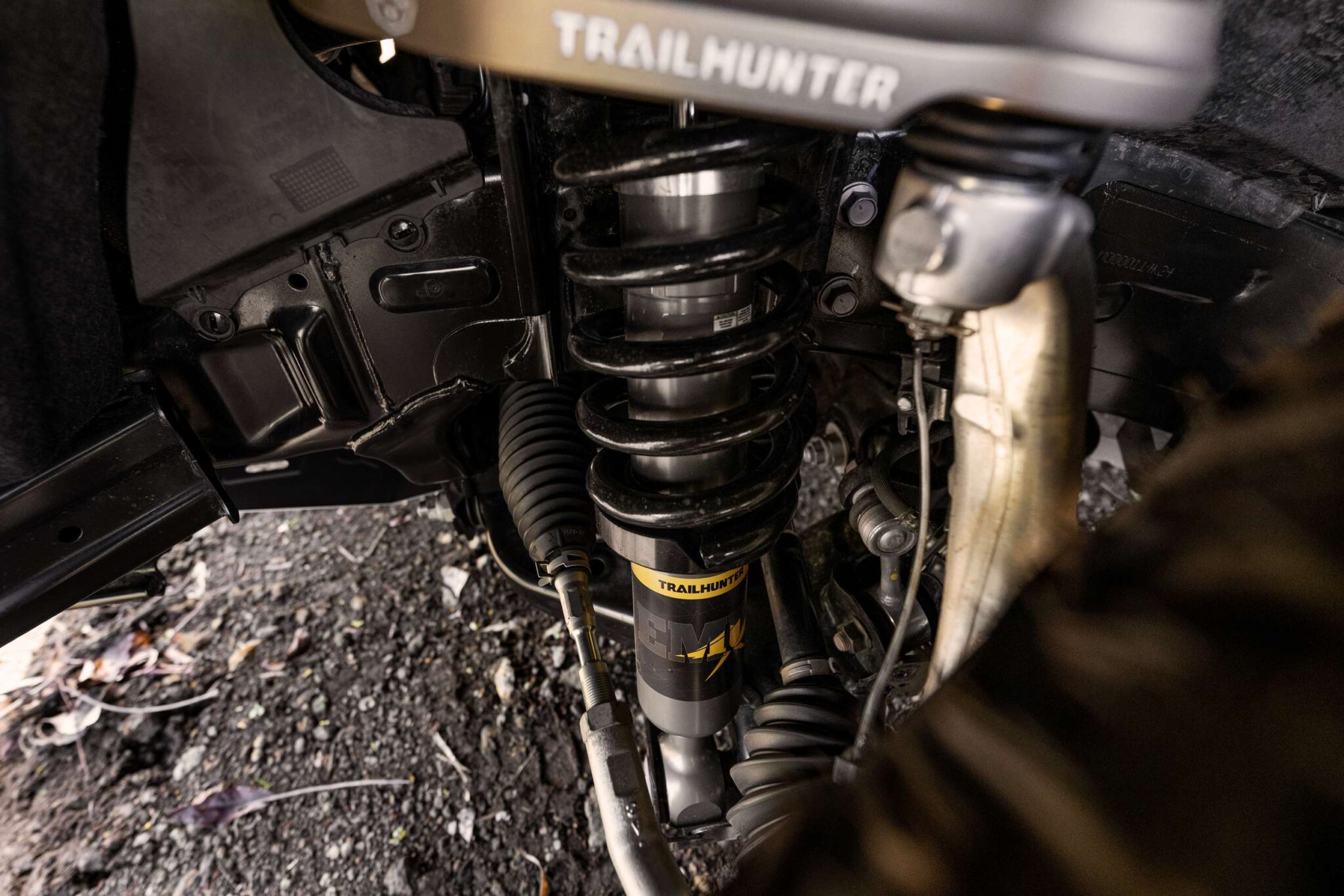
2024_Toyota_Tacoma_Trailhunter_029-2048x1366.jpg
 
Last edited:
I haven't seen any info on what rear axle or front diff it will use. Has anyone seen that yet? The 8.2 seems to be on the small side for that much torque, especially in the hybrids. If it's the 9.5, that's pretty great for a Tacoma. It's probably stronger than most Dana 60 versions. Or will there continue to be an 8.75 diff like the outgoing truck? Max ground clearance is listed at 9.5, TRD Pro Tundra is 9.4 with the same tire height and the 10.5" rear end, so that sort of points to the 9.5 being the axle choice. That would be really great news also for aftermarket support as there's already 2OEM ratios available and a bunch of aftermarket ratios. Also - has anyone seen any info on the front steering design? The LC300 uses an electric/hydraulic system that's a bit complex but very strong. I REALLY hope the Taco/4R share the HD front steering setup from the Tundra/LC300. That was the biggest weak link up front for bigger tires.

Whatever steering they're going with this time, I think it's safe to say that it's beefed up from prior, not only because they know enthusiasts will put bigger tires on, but because Toyota themselves has raised the ceiling on what size factory tires they're willing to put on the Tacoma.

The Tacoma is currently offered with a maximum 30.6" tire size, even on TRD PRO, if I'm not mistaken. They're touting that the new Pro/Trailhunter or both can have factory 33" tires. That's a big increase. There's no way they'd put a rack in that blows on the factory size tires, so, well, it can at least be assumed it'll be plenty reliable for 33's. Hopefully even bigger, since they know what people are going to do to these trucks.
 
I found some info on steering but not on the rear axle ratio. Note the necked down tierod.


2024_Toyota_Tacoma_Trailhunter_029-2048x1366.jpg

That tierod does look small - but it depends on what it's made of and the leverage ratio with the tire, so maybe it's okay?

3rd gen Tundra looks pretty similar. Hard to tell if it's the same or not.

22TUNDRAUCAWKING1_1024x1024@2x.jpg


LC300 does not appear to be necked down. Possibly it's an engineered failure point and the LC has a more robust steering setup. I think the Tundra is an electric rack and the LC is hydraulic rack with electric steering on the steering shaft. Or it could just be the nature of how they are designing them and they all start with the same basic design and as you lengthen that link it uses a tapered shaft. The Tacoma and Tundra having longer shafts have a longer reduced area and the LC300 has a narrower stance and the threaded portion ends up right at the end of the hex portion for the wrench to fit. 2024 Taco Pro and TH models are 3" wider than the std model. Assuming std model track width is 64" that puts the others at 67". LC300 is 66.4". Not really sure why they wouldn't use the same parts if they did share the same steering rack. Looks like Taco at a minimum has a narrower rack.

Bilstein2.jpg
 
Last edited:
[MENTION=118321]Jetboy[/MENTION], the Tundrua tierod is a larger diameter overall and the necked down area is part of the forging.

The Tacoma tierod has been machined down at the neck after forging. The neck down will snap first, before the threaded area, making repairs eaiser.
 
[MENTION=118321]Jetboy[/MENTION], the Tundrua tierod is a larger diameter overall and the necked down area is part of the forging.

The Tacoma tierod has been machined down at the neck after forging. The neck down will snap first, before the threaded area, making repairs eaiser.

It's possible it's just part of being a prototype?

It seems unusual that they would add a machining step to a production version of that part.

It's an interesting engineering problem that I haven't every really thought much about. If it's going to fail it'll almost always be from buckling. And it'll almost always be on the inner tie rod because it's weaker. And then it would make sense that the maximum tension on the buckling assembly will be at the joint between the more rigid outer TRE and inner TRE. Add in the threads as a stress concentration and it seems like where it should be expected to fail most of the time. A thinner diameter section shouldn't help this. It would be more prone to buckle out of the column and would still fail at the threads unless the idea is for it to be elastic deformation at the narrow point. I'd love to understand more about the design and testing. The LC has no narrow section, tundra does, and Tacoma has a very pronounced one in this image. I think the strongest design is the LC version with the shortest inner TRE and no narrowed section.
 
Last edited:
It's possible it's just part of being a prototype?

It seems unusual that they would add a machining step to a production version of that part.

It's an interesting engineering problem that I haven't every really thought much about.
Jetboy, it seems way too late in the process for Prototype parts, I would think at this stage they are either pre-production or production parts.

I completely agree that it seems unusual that they would add a machining step to a production version of that part. From my engineering knowledge, I to did a double take when looking at the photos closer. However, the bright surface of the necked area, to me, suggests post-process machining. Below are marked up photos comparing the two.

Regarding the failure point, this came from an observation by a suspension engineer in this Bronco forum post.
This is interesting...
(photo of Tacoma tie rod...)

A necked tie rod does not inherently make anything stronger or less failure prone, but it does control the failure point. I like the idea of moving the failure point away from the threads. Would just make field service that much easier if/when needed.
The Ford Suspension Engineer I know, who first noticed the neck down, concurred it is machined, but is not a typical production step, so Toyota may be trying to minimize the failures by more closely controlling the stress point.

(remote image link since forum software has limitations)
Tacoma-vs-Tundra-Tie-Rods-N7-5-24-2023-Copy hosted at ImgBB — ImgBB
 
Last edited:
FWIW, turbo looks really easy to access. That's a huge plus for long term ownership. They'll need to be replaced periodically. Tundra would be much more appealing with an i6 for the same reason. I think it's a big win on that issue. No need to pull the cab just to access the turbo!


The cab off on the Tundra that you are likely thinking about was in support for investigating a specific early case. The factory manual does not recommend removing the cab. It isn’t an easy job to get the turbos off (still a bit of labor involved), but you don’t remove the cab.


Sent from my iPhone using Tapatalk
 
The cab off on the Tundra that you are likely thinking about was in support for investigating a specific early case. The factory manual does not recommend removing the cab. It isn’t an easy job to get the turbos off (still a bit of labor involved), but you don’t remove the cab.


Sent from my iPhone using Tapatalk

Hopefully not 37 hours of labor or whatever it is for the LS to do it. $7k in labor cost might make a cab-off seem cheap. I'm curious if they can also be removed in the LC300 with the body on. The turbos on the diesel LC300 are super easy to access being mounted right on the top in front. Would be nice to see them mounted in an accessible location like that on the Tundra.
 
It is a 9.5 Rear axle! Gotta say I'm impressed with that choice. It's a big step up in rear end strength from any prior Tacoma. Same rear axle as the Tundra and Land Cruiser/LX600 means a lot of aftermarket support.
 
In short, I am happy to know that if I want a new vehicle or have to have a new one, there is something that really suits me. Until this Taco was revealed, there was literally nothing that truly fit my wants. The 4R is the closest but I would rather not have to buy another 5th gen in like 2024.

I do not intend to replace it as a Plan A, but there is a scenario in which the stars end up aligning that way come early 2025.
 
It is a 9.5 Rear axle! Gotta say I'm impressed with that choice. It's a big step up in rear end strength from any prior Tacoma. Same rear axle as the Tundra and Land Cruiser/LX600 means a lot of aftermarket support.
I haven't kept up--how does the outgoing Tacoma's rear axle compare to the 5th gen's rear axle? I swear I've heard that the 5th gen 4Runner got a beefier rear axle than the 4th gen, and the 5th gen gained an inch in factory tire size while the Tacoma never previously did.
 
I haven't kept up--how does the outgoing Tacoma's rear axle compare to the 5th gen's rear axle? I swear I've heard that the 5th gen 4Runner got a beefier rear axle than the 4th gen, and the 5th gen gained an inch in factory tire size while the Tacoma never previously did.

The 5th gen 4runner rear diff is significantly stronger than the 4th. The ring gear is marginally bigger, but it's reinforced with more bolts to the carrier. The big upgrade is the pinion though. The pinion diameter got much bigger and the main pinion bearing is huge. So less deflection and less breakage.

The current Tacoma is usually called an 8.75 but in actual size it's really about 8.9". It makes a lot of sense to just bump up to 9.5. The new taco has a smaller axle in the basic models and the 9.5 in the higher output turbo and hybrid models. Other big update is rear discs.

Not really sure why the 9.5 over the 8.9. They're pretty close. Interestingly the 9.5 is probably stronger than the axle in most half ton trucks. The current version is very robust. It should handle 40s without any upgrades. I hope the front is equally strong.

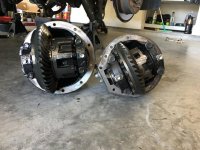
For rough comparison below is an 8" vs 9.5.
 

Attachments

  • IMG_0571.jpg
    IMG_0571.jpg
    133.3 KB · Views: 372
Last edited:
In short, I am happy to know that if I want a new vehicle or have to have a new one, there is something that really suits me. Until this Taco was revealed, there was literally nothing that truly fit my wants. The 4R is the closest but I would rather not have to buy another 5th gen in like 2024.

I do not intend to replace it as a Plan A, but there is a scenario in which the stars end up aligning that way come early 2025.

Same here. I looked at the competition but personally I don't want removable doors and tops. Way too much NVH and seals and gaskets that go bad. So that took the Bronco and Wrangler out of contention.

Took a look at Lexus GXs and they actually provide a lot of value. But they have poor out of the box off-roading capabilities stemming mainly from the low hanging body work. That and they're ugly but that's preference.

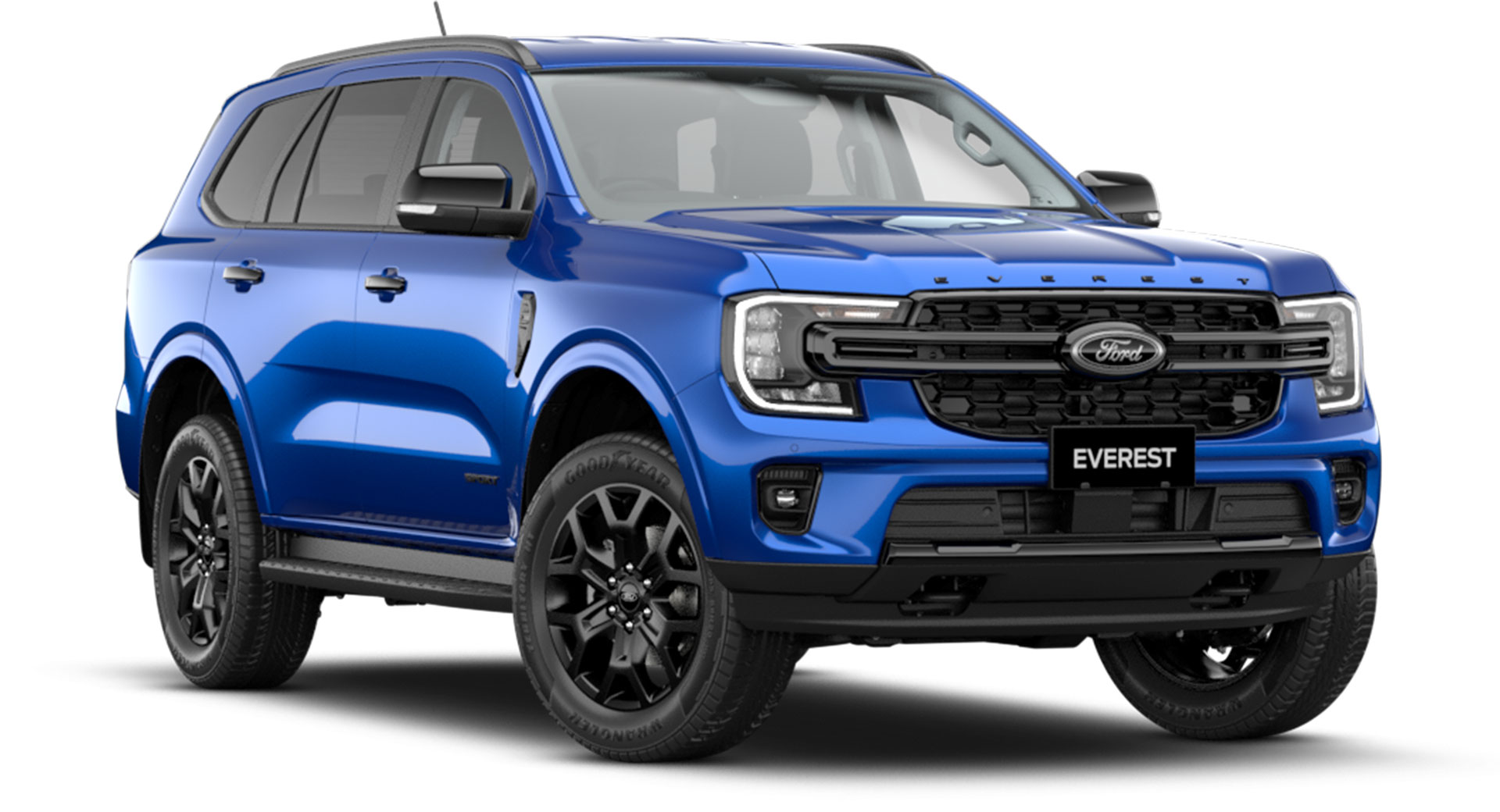
There's actually two vehicles I would happily consider if they were sold in the US or existed. One is the Ford Everest that is sold overseas, based on the Ford Ranger.

Ford-Everest-Sport-1a.jpg


The other is if Chevy had some proper leadership and brought back the Blazer as an SUV based on the Colorado. Imagine a Blazer ZR2?


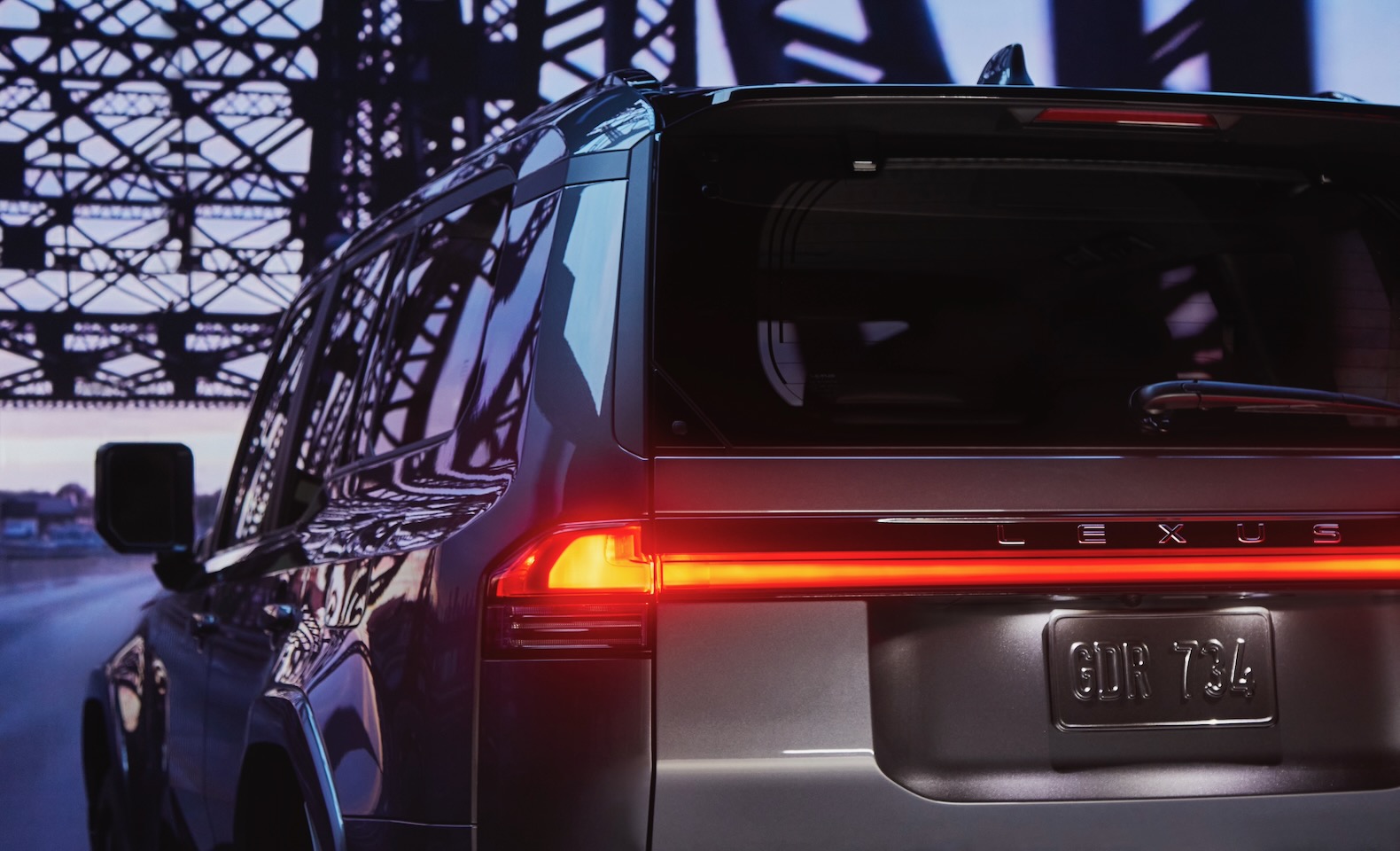
In other news, the next-generation Lexus GX is to be fully revealed June 8th

GX-Teaser-2.jpeg
 
New GX teaser. I love the belt line and protruding fenders.

Not sure if the tailgate is a clamshell design like in the old LC200, but the wiper placement suggests that the rear window can be open independently.

Looking good so far!
 

Attachments

  • IMG_7682.jpeg
    IMG_7682.jpeg
    103.8 KB · Views: 333
New GX teaser. I love the belt line and protruding fenders.

Not sure if the tailgate is a clamshell design like in the old LC200, but the wiper placement suggests that the rear window can be open independently.

Looking good so far!

You can see the button to release the rear window. I doubt the tailgate is a clamshell design (unfortunately).

Also, someone else pointed out the FJ style mirrors. A bit odd for a luxury SUV like this.
 

Members online

No members online now.

Forum statistics

Threads
278,315
Messages
3,554,130
Members
248,016
Latest member
Advally Service

Trending content

Back
Top