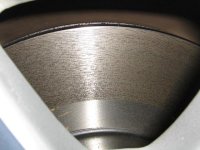
Brake rotors warp easily....

I did my brakes for the first time at 62K with all original factory. The calipers and rotors were still good and just had to replace the pads and pins. I suggest the factory pads and aftermarket semi heavy duty calipers and rotors. I am in the market soon for such at 102K miles present. :fishing:
 
See, there's where I think you're wrong. No matter what caused the excessive runout, there are really only two ways to correct it. 1-buy and install new rotors or 2- repair the old rotors..

Hi Jed,

This whole "warp" thing is fascinating!

I KNOW you know all about uneven pad deposition:
- Here is a picture of YOUR rotor's even pad deposition
- Here is your discussion of the pad imprint on a rotor
- And, I know you know about the "racers' trick" of scraping off uneven deposits

In this thread, you might be talking about solving "excessive runout"; but I'm talking about pedal pulsations caused by uneven pad deposition caused disc thickness variation (DTV) and the OP was talking about 'warp' which isn't either of those per se (since warp needs to be measured off the car to distinguish from runout).

My whole point was that people who don't understand the main cause of pedal pulsation often assume the wrong solution ... simply because they do not understand the cause of the problem (well, to be precise, the solution of replacing rotors every single time you have uneven deposition DTV would work - but it's like replacing the windshield every time you get a spot of dirt on it).

More explicitly ...

To solve DTV caused by uneven pad deposits, you have to remove the uneven pad deposits (& the easiest way to do that is to rebed the rotors although other options exist) ... and then you have to also prevent the uneven pad deposition from re-occuring (mostly by changing your braking habits).

In DIY step-by-step format ...

To FIX an existing DTV-caused pedal pulsation:
(in increasing orders of effort & expense)
A) Rebed your brake pads properly ... and if that doesn't work (it usually does) ... then
B) Make a few runs on more abrasive pads ...
Those steps rarely fail; but if they do ...
C) Then consider machining the rotors (if they're within tolerance).

To PREVENT uneven pad deposition pulsation from re-occurring:
a) Bed the rotors properly ... and then also ...
b) Change your braking habits so that you do not leave pad imprints
c) Then ... if you do get a pad imprint which grows enough to be felt, then immediately (before it gets worse), reapply the ABC fixes above ASAP.

Note: It has been stated The tundra modification seems to keep the rotors cooler, based on anecdotal evidence, so running the rotors cooler may also prevent uneven pad deposition from occurring - but this has yet to be proven.
 
Last edited:
Hi Jed,

This whole "warp" thing is fascinating!

I KNOW you know all about uneven pad deposition:
- Here is a picture of YOUR rotor's even pad deposition
- Here is your discussion of the pad imprint on a rotor
- And, I know you know about the "racers' trick" of scraping off uneven deposits

In this thread, you might be talking about solving "excessive runout"; but I'm talking about pedal pulsations caused by uneven pad deposition caused disc thickness variation (DTV) and the OP was talking about 'warp' which isn't either of those per se (since warp needs to be measured off the car to distinguish from runout).

My whole point was that people who don't understand the main cause of pedal pulsation often assume the wrong solution ... simply because they do not understand the cause of the problem (well, to be precise, the solution of replacing rotors every single time you have uneven deposition DTV would work - but it's like replacing the windshield every time you get a spot of dirt on it).

More explicitly ...

To solve DTV caused by uneven pad deposits, you have to remove the uneven pad deposits (& the easiest way to do that is to rebed the rotors although other options exist) ... and then you have to also prevent the uneven pad deposition from re-occuring (mostly by changing your braking habits).

In DIY step-by-step format ...

To FIX an existing DTV-caused pedal pulsation:
(in increasing orders of effort & expense)
A) Rebed your brake pads properly ... and if that doesn't work (it usually does) ... then
B) Make a few runs on more abrasive pads ...
Those steps rarely fail; but if they do ...
C) Then consider machining the rotors (if they're within tolerance).

To PREVENT uneven pad deposition pulsation from re-occurring:
a) Bed the rotors properly ... and then also ...
b) Change your braking habits so that you do not leave pad imprints
c) Then ... if you do get a pad imprint which grows enough to be felt, then immediately (before it gets worse), reapply the ABC fixes above ASAP.

Note: It has been stated The tundra modification seems to keep the rotors cooler, based on anecdotal evidence, so running the rotors cooler may also prevent uneven pad deposition from occurring - but this has yet to be proven.

I'm not disagreeing with you, BUT...when you say "...you might be talking about solving "excessive runout"; but I'm talking about pedal pulsations caused by uneven pad deposition caused disc thickness variation (DTV)..." don't you realize that we're talking about the same thing? Excessive runout results in pedal pulsation. That's my whole point. Thickness variation and excessive runout is one in the same. Any time a rotor is warped, as it is rotated the pads will obviously follow the "in and out" curvature of the warped metal. You can't really see this with the naked eye because it's so subtle (we're talking .005+ of an inch). The same is true for a rotor that has uneven deposits--as it is rotated, the pads get "pushed out" as they pass over the section of the rotor where the deposits are built up. In either case, you can measure this as runout with a dial indicator. And in both cases, the driver feels pedal pulsation as the pads move in and out because of the irregularity of the rotor.

One question--have you ever bedded pads/rotors before? It's a relatively simple process. I've done it hundreds of times (I used to be an auto tech) and I can tell you that it definitely helps you get maximum braking performance. At the same time, rebedding pads almost never works unless you switch to a harder pad. Think about it logically---once the pad material is unevenly deposited on the rotor, how can you expect the same pad material to be hard enough to remove it from the rotor? You need a HARDER pad to effectively "scrape" the softer pad material off the rotor. I'm not saying it's impossible to rebed pads/rotors, but if you're fix a problem, it's just not going to work unless you switch to harder pads. If you try with the same pads, most likely you'll just add to the uneven deposits already there.
 
.... (since warp needs to be measured off the car to distinguish from runout)....[/I][/SIZE]

That's not exactly correct either. Here's why-- if you have a vehicle with hubs that are true (and most are true or very close to true (less than .001")), then you can measure the rotors on the car to determine if your runout is excessive. And if the runout is excessive, then it's either warp or deposits that's causing it. You can check runout of the hub in much the same way as a rotor.

In fact, a lot of shops will now cut rotors while on the car because of the fact that this method will compensate for any possible runout present in the hubs. In other words, if the hubs have runout, the rotors can be cut in such a way that it compensates for that runout an you end up with a completely true hub/rotor assembly. To save time, a lot of guys won't bother even checking the hubs...if they have a brake lathe that cuts rotors on the car, they'll just use it to save time.

But my point is that the majority of vehicles out there don't have excessive runout of their hubs. That's why most guys either cut their rotors and install new ones and end up with smooth braking again. If the hubs were an issue, installing new rotors wouldn't solve their pedal pulsation problems.
 
Excessive runout results in pedal pulsation. That's my whole point.

Hi Jed,
I don't at all disagree with that statement.

Thickness variation and excessive runout is one in the same.

I disagree with the absoluteness of that statement (although, see below, the experts have conflicting opinions as shown below) ... :)

Excessive runout, as we all know, is generally measured with a dial gauge. Excessive runout certainly can be the cause of both chassis judder (or chassis vibration) and pedal pulsation transmitted to the brake pedal.

Excessive uneven pad deposition is harder to measure (because the specification is muuuuuch lower). It certainly can be the cause of chassis vibration, sometimes without any pulsation felt in the brake pedal.

Some feel that uneven pad deposition causes chassis vibration because of brake torque variation (BTV) and not because of disk thickness variation (DTV).

And, disc thickness variation is almost always felt in the brake pedal.

Notice that the references state that disc thickness variation of as little as 15 microns (0.00059") can be the cause of pedal pulsations while runout specifications are typically on the order of 0.002".

Point is, disc thickness variation and runout are NOT the same thing, according to some references.

However, I do agree, that even the experts disagree. Here for example, is one of my references saying "This uneven deposition results in thickness variation (TV) or run-out".

So, we're both right. We're a victim of even the experts either not knowing the right answer - or the experts not being precise with their explanations! :(

PICTURE OF PAD IMPRINTING:
warped_5.jpg


have you ever bedded pads/rotors before? It's a relatively simple process.

Yes. I did it to cure my pedal pulsation. And, unless I'm lying, it worked to "melt" off the uneven deposits. It took three different sets of rebedding runs over a span of three attempts.

The first rebedding run lessened the pedal pulsation and lowered the speed at which the vibration began.

The second rebedding run vastly lowered the judder overall.

And the last rebedding run eliminated the chassis vibration and pedal pulsation.

Note: Here I use vibration and judder loosely to mean the chassis oscillations; whereas I use pulsation to loosly indicate the brake pedal sensation.


once the pad material is unevenly deposited on the rotor, how can you expect the same pad material to be hard enough to remove it from the rotor?

According to the references, the difference is HEAT & TIME. When you rebed the pads to the rotors, you heat the pads and rotors to the adherent friction temperature (typically 100°F-600°F for street pads and 600°F-1400°F for race pads) and you KEEP it there, as they say in the reference "long enough to start the pad material transfer process".

I'm going out on a limb by explaining it this way, but, personally, I think of it as not so much "scraping" uneven pad deposits smooth as "melting" the deposit humps of chocolate into even layers on top of the cake.

:)

The main reason for this thread is in my first statement in this post!

People can't correctly solve a problem until they understand the cause of the problem(well, replacing rotors every time they vibrate works but it's like replacing the windshield ever time it get a bunch of bugs stuck on it ...)

PS: Here's a picture of a nicely bedded rotor, about a month into use, which shows no pad imprints. I think you may recognize the source of this picture. :)

 

Attachments

  • nicely_beddor_rotor_from_jed.resized.jpg
    nicely_beddor_rotor_from_jed.resized.jpg
    48 KB · Views: 11,861
Last edited:
Excessive uneven pad deposition is harder to measure (because the specification is muuuuuch lower). It certainly can be the cause of chassis vibration, sometimes without any pulsation felt in the brake pedal.

Excessive uneven pad deposition WILL ALWAYS be felt as pulsation in the brake pedal. They key words here are "excessive" and "uneven"

Trust me, when the pads move in and out over excessive uneven deposits, the driver will feel a pulsation in the brake pedal.

Some feel that uneven pad deposition causes chassis vibration because of brake torque variation (BTV) and not because of disk thickness variation (DTV).

That's true and I've experienced it on my 4Runner. Most often, it results in a "grabby" feeling as the rotors rotate and the pads "catch" harder in some places and softer in others. The brake pedal may not pulsate at all, but you'll still feel the herky-jerky grab-then-let-go-then-grab-again feeling as you come to a stop. This type of problem is MUCH more noticeable in very low speed stops and not nearly as noticeable at high speeds. In other words, you'll probably first notice it during your last 10 or 20 feet of motion before you come to a complete stop.

Notice that the references state that disc thickness variation of as little as 15 microns (0.00059") can be the cause of pedal pulsations while runout specifications are typically on the order of 0.002".

15 microns? That I don't agree with at all...I'm not buying it. And from my experience, runout has to be at or above 0.005" before it will be noticeable on most vehicles. Of course some vehicles are inherently more sensitive for whatever reason. BTW, when you buy new aftermarket rotors, there are usually at least two versions available--the premium rotors and the standard rotors (forget about budget lightweight rotors...you should never buy them). There are really only two differences between standard rotors and premium rotors. First, most premium rotors are cut to tighter tolerances and should spec out at a max of 0.002". Standard rotors, as a rule, allow a max of 0.004". Now of course you may get better than 0.004" if you choose the standard rotors, but the point here is that the QC is tighter on the premium rotors. BTW, the rotor finish is often better on the premium rotors too. The second difference is that premium rotors usually have their hats and cooling vanes coated in a rust-proof finish. Not only does this look nice if you have wheels that allow you to see the brake rotors, but it also helps avoid building up a nasty ridge of rust on the outermost surface of the rotor. You know--just outside the area that the pad reaches. As rust builds up there, it can cause brake noise.

Point is, disc thickness variation and runout are NOT the same thing, according to some references.

They are to a dial indicator. And they are to your right foot when it's on the brake pedal.

Yes. I did it to cure my pedal pulsation. And, unless I'm lying, it worked to "melt" off the uneven deposits. It took three different sets of rebedding runs over a span of three attempts.

The first rebedding run lessened the pedal pulsation and lowered the speed at which the vibration began.

The second rebedding run vastly lowered the judder overall.

And the last rebedding run eliminated the chassis vibration and pedal pulsation.

Note: Here I use vibration and judder loosely to mean the chassis oscillations; whereas I use pulsation to loosly indicate the brake pedal sensation.


According to the references, the difference is HEAT & TIME. When you rebed the pads to the rotors, you heat the pads and rotors to the adherent friction temperature (typically 100°F-600°F for street pads and 600°F-1400°F for race pads) and you KEEP it there, as they say in the reference "long enough to start the pad material transfer process".

I'm going out on a limb by explaining it this way, but, personally, I think of it as not so much "scraping" uneven pad deposits smooth as "melting" the deposit humps of chocolate into even layers on top of the cake.

Well, I'm 99% sure that the reason race pads can easily clean up the rotors is because they are effectively "scraping" the surface of the rotors clean. Or maybe I should say they are scraping the softer deposited material from the street pads.

There's something else you haven't considered---street pads can be easily glazed. I've actually had to sand my pads down to get rid of the glaze and get back to good pad material again. Once your pads are glazed, there's nothing you can do short of removing them and manually sanding them to fix them. Rebedding just doesn't work on glazed pads.

 
Mom, awesome stuff! Thank-you. I am beginning to rethink my stance that the OE pads are the best way to go for most.

Thread bookmarked:D
 
What I did to fix this problem was replace the pads and rotors, and to take the calipers apart to clean the pistons and slide pins. These were all gummed up with dirt and grime. This would not allow the calipers to apply even pressure to the brake pads and rotors, thus warping the rotors over time.
 
The 4th generation 4runner has a design problem with their calipers. A stuck caliper can give the same symptoms as a warped rotor. The uneven pressure applied by the pistons makes it feel like the rotor is warped. So many times when you think you have a warped rotor...it's just a stuck caliper. Since buying my first vehicle in 1973...this is the ONLY vehicle that I've ever seen having this problem.
 
Toyota should have put clips on the piston boots, but they didn't. Evidently they can freeze up due to contamination. If there is uneven pressure on the rotor, it will distort (can we say "distort" without a nauseating argument about the various nuances?) It hasn't happened to me, but I have seen it before. My FJ60 calipers had close to 400k on them when I swapped them out, same design WITH CLIPS.
 
PS: Here's a picture of a nicely bedded rotor, about a month into use, which shows no pad imprints. I think you may recognize the source of this picture. :)

actually, whoever cut that rotor did a terrible job. it started to chatter out toward the end. no good.
 
Not a brake expert, but have heard that over-tightening wheel lug nuts can cause damage to rotors. True? And what is the correct torque for T4R lug nuts?
 
Not a brake expert, but have heard that over-tightening wheel lug nuts can cause damage to rotors. True?

That's true with ALL cars. Not just the 4runner. It's not just OVER-tightening..but uneven tightening.
 
Not a brake expert, but have heard that over-tightening wheel lug nuts can cause damage to rotors. True? And what is the correct torque for T4R lug nuts?

It is basically imperative that you torque all the lug nuts on a floating type rotor system to prevent warpage. It is not as important to how tight you get them, just get them even. Of course they need to be tight though...

On a non floating type brake system it is not as important, although I still do it anyway.
On a side note, it is best to have your torque wrench calibrated once a year.
 
I'm too new here to comment on the T4R as I just purchased my first Toyota last December, but rotor material composition probably has a significant impact on warpage.

I had a 1998 Honda Accord for many years. I turned rotors for the first time at 140,000 miles and just started to feel a slight pulsation in the brake pedal. I put at least 4 sets of brake pads purchased from Advance Auto Parts. They weren't the cheapest nor the most expensive at roughly $40/set. The rotors had quite a lip on outer perimeter, but it didn't concern me because the brake pad will take shape to conform to the surface of the rotor rather quickly. I suspect Honda used a very high grade of nodular iron in their rotors. Also, the front and rear pads wore quite evenly which meant a good distribution of braking force applied at each wheel.

I just sold a 97' GMC K1500 with 160,000 miles on it and front rotors warped quickly and I went through at least 3 sets. I attributed this to poor rotor material grade, overall braking system undersized for size/weight of vehicle, and poor distribution of braking force. I put on at least 5 sets of front pads and never changed the rear drum brake pads (after 160,000 miles, they were only half worn).
 
I'm too new here to comment on the T4R as I just purchased my first Toyota last December, but rotor material composition probably has a significant impact on warpage.

I had a 1998 Honda Accord for many years. I turned rotors for the first time at 140,000 miles and just started to feel a slight pulsation in the brake pedal. I put at least 4 sets of brake pads purchased from Advance Auto Parts. They weren't the cheapest nor the most expensive at roughly $40/set. The rotors had quite a lip on outer perimeter, but it didn't concern me because the brake pad will take shape to conform to the surface of the rotor rather quickly. I suspect Honda used a very high grade of nodular iron in their rotors. Also, the front and rear pads wore quite evenly which meant a good distribution of braking force applied at each wheel.

I just sold a 97' GMC K1500 with 160,000 miles on it and front rotors warped quickly and I went through at least 3 sets. I attributed this to poor rotor material grade, overall braking system undersized for size/weight of vehicle, and poor distribution of braking force. I put on at least 5 sets of front pads and never changed the rear drum brake pads (after 160,000 miles, they were only half worn).

One of the contributing factors for brake warpage is the lack of "meat" on rotors. The manufactures try to save weight in every possible area. Some rotors you can only turn one time, just not enough meat. The good thing is the cost of rotors have come down in price a lot.
 
had brakes and pads replaced twice

Anyone experience this problem?


is their an aftermarket solution?


I would quickly learn how to do this yourself and use premium parts. I use the 60 rotor vs the 25 one. Or buy the premium parts yourself and have your mechanic install them.


Sent from my iPhone using Tapatalk
 

Members online

Forum statistics

Threads
278,312
Messages
3,554,086
Members
248,016
Latest member
Advally Service

Trending content

Back
Top