Excessive runout results in pedal pulsation. That's my whole point.
Hi Jed,
I don't at all disagree with that statement.
Thickness variation and excessive runout is one in the same.
I disagree with the absoluteness of that statement (
although, see below, the experts have conflicting opinions as shown below) ...

Excessive runout, as we all know, is generally measured with a dial gauge. Excessive runout certainly can be the cause of both chassis judder (or chassis vibration) and pedal pulsation transmitted to the brake pedal.
Excessive uneven pad deposition is harder to measure (
because the specification is muuuuuch lower). It certainly can be the cause of chassis vibration,
sometimes without any pulsation felt in the brake pedal.
Some feel that uneven pad deposition causes chassis vibration because of brake torque variation (
BTV) and not because of disk thickness variation (DTV).
And, disc thickness variation is almost always felt in the brake pedal.
Notice that the
references state that disc thickness variation of as little as 15 microns (0.00059") can be the cause of pedal pulsations while runout specifications are typically on the order of 0.002".
Point is, disc thickness variation and runout are NOT the same thing, according to some references.
However, I do agree, that even the experts disagree. Here for example, is one of my references saying "
This uneven deposition results in thickness variation (TV) or run-out".
So, we're both right. We're a victim of even the experts either not knowing the right answer - or the experts not being precise with their explanations!
 PICTURE OF PAD IMPRINTING:
have you ever bedded pads/rotors before? It's a relatively simple process.
Yes. I did it to cure my pedal pulsation. And, unless I'm lying, it worked to "melt" off the uneven deposits. It took three different sets of rebedding runs over a span of three attempts.
The first rebedding run lessened the pedal pulsation and lowered the speed at which the vibration began.
The second rebedding run vastly lowered the judder overall.
And the last rebedding run eliminated the chassis vibration and pedal pulsation.
Note: Here I use vibration and judder loosely to mean the chassis oscillations; whereas I use pulsation to loosly indicate the brake pedal sensation.
once the pad material is unevenly deposited on the rotor, how can you expect the same pad material to be hard enough to remove it from the rotor?
According to the references, the difference is HEAT & TIME. When you rebed the pads to the rotors, you heat the pads and rotors to the adherent friction temperature (typically 100°F-600°F for street pads and 600°F-1400°F for race pads) and you KEEP it there, as they say in the reference "long enough to start the pad material transfer process".
I'm going out on a limb by explaining it this way, but, personally, I think of it as not so much "scraping" uneven pad deposits smooth as "melting" the deposit humps of chocolate into even layers on top of the cake.
The main reason for this thread is in my first statement in this post!
People can't correctly solve a problem until they understand the cause of the problem(well, replacing rotors every time they vibrate works but it's like replacing the windshield ever time it get a bunch of bugs stuck on it ...)
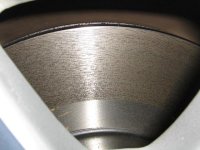
PS: Here's a picture of a nicely bedded rotor, about a month into use, which shows no pad imprints.
I think you may recognize the source of this picture.