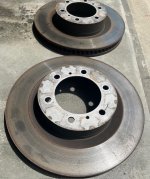
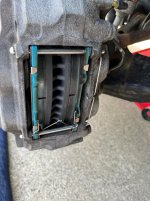
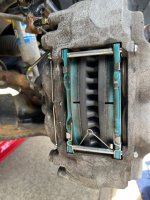
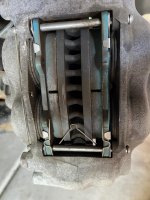
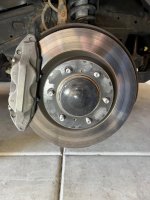
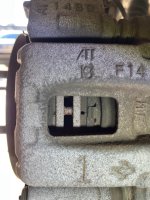
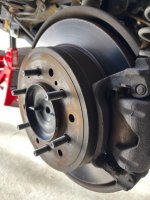
Brakepad check at 32,000 Miles, 80,000+ Miles,101,000 Miles

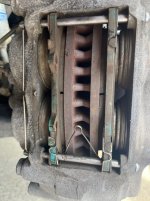
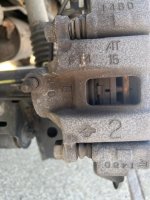
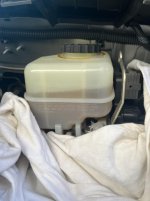
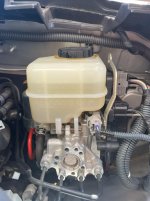
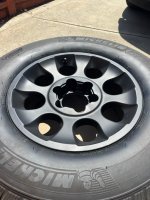
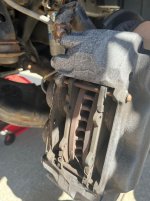
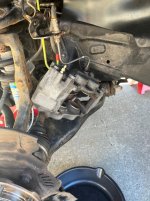
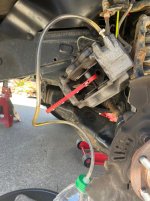
I’m now at 135k miles on my 2010 Trail, time for a tire rotation, wheel bearing check, brake pad check, caliper pin cleaning, and brake fluid flush. I also cleaned and resprayed my plasti-dipped wheels while I was waiting for gravity bleed to do it’s thing.
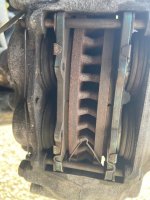
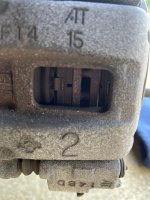
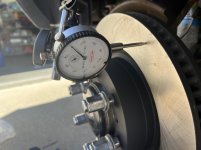
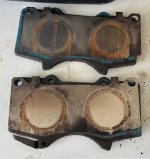
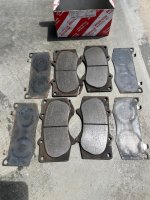
This time I pulled out my calipers and measured the front pads: 4.95mm for the inboard pads and 5.21mm for the outboards. Front disc minimum allowed thickness is 29mm, I’m seeing 31.95mm on the right front disc. I’ve been heavy on brakes for the past year so I thought they were getting close, but not this year I guess.
 

Attachments

  • IMG_1865.jpg
    IMG_1865.jpg
    134.9 KB · Views: 434
  • IMG_1872.jpg
    IMG_1872.jpg
    133.3 KB · Views: 437
  • IMG_1867.jpg
    IMG_1867.jpg
    97.9 KB · Views: 453
  • IMG_1873.jpg
    IMG_1873.jpg
    119.5 KB · Views: 439
  • IMG_1866.jpg
    IMG_1866.jpg
    135.1 KB · Views: 437
Last edited:
Got 130K on mine and still had life left in them.
Unfortunately, my original wheel bearing on the driver side rear wheel went out so I replaced both rear wheel bearings and replaced both rear wheel discs and pads just because.
I still have 3mm left on the front pads after 130K miles on original pads and discs.
It helps to understand that there is another choice between gas and brake; its called coasting and it works well.


Sent from my iPhone using Tapatalk

long shot here since it's been 3 years, but I'm curious do you throw it in neutral when you coast?

coming from a 94 manual runner I coasted a lot of big hills here in neutral which was a ok with a manual trans. But with my new truck 5th gen with auto trans I'm just not sure if coasting down in neutral is gonna cause any issues with the trans? I can't see why it would but I'm not familiar with these fancy auto shifting transmissions haha.
 
long shot here since it's been 3 years, but I'm curious do you throw it in neutral when you coast?

coming from a 94 manual runner I coasted a lot of big hills here in neutral which was a ok with a manual trans. But with my new truck 5th gen with auto trans I'm just not sure if coasting down in neutral is gonna cause any issues with the trans? I can't see why it would but I'm not familiar with these fancy auto shifting transmissions haha.

It does no harm to coast in neutral; if it did, Toyota (and all other manufacturers) would put a way to prevent it unless the driver did some special steps to do it.

If going down a long, steep hill, however, you should leave the transmission in gear, for that will provide engine braking, thus saving the friction brakes from over heating, and slowing the pads from wearing out.

The fuel savings from coasting in neutral are minimal, for even in gear, the transmission will be in top gear and the engine turning slowing, burning little fuel. (There are a few, very few, cars that actually turn off all fuel delivery to the engine when coasting, thus no fuel is used at all).

You cite coasting with a manual transmission, which is usually done by disengaging the clutch, not actually shifting. That was actually discouraged by some manufacturers (notably VW) for it put added stress on the throw out bearing. But for most cars now, the throw out bearing is better and causes little additional problems if you coast.

I know the 4Runner is not a hybrid (the 6th generation 4Runner is a mild hybrid), but for hybrids, it is imperative to leave the transmission in gear, for that is when regeneration occurs, which leads to the best gas mileage. (Regeneration is when the car's momentum is changed to electrical energy and stored in a battery for future propulsion, thus saving gas). Regeneration cannot occur if the transmission is in neutral.

For me, I just leave the transmission in gear, so I don't need to do anything when engine power is needed later.

 
Was fun to do it in a manual, I’ve accidentally shifted from N to D while rolling and it sounded like it was suggesting I don’t do that again. It’s not saving a measurable amount of fuel.
I purposely use S vs. D in the hills to keep the gradelogic or whatever it is from downshifting on downhills. I would much rather use my brakes. I also like to use unpopulated long fast downhills to rebed my brakes, and check for shimmy, etc., quite often.
 
long shot here since it's been 3 years, but I'm curious do you throw it in neutral when you coast?

coming from a 94 manual runner I coasted a lot of big hills here in neutral which was a ok with a manual trans. But with my new truck 5th gen with auto trans I'm just not sure if coasting down in neutral is gonna cause any issues with the trans? I can't see why it would but I'm not familiar with these fancy auto shifting transmissions haha.

My understanding is that with computer controlled fuel injection a car can run downhill, in gear, with no fuel being used because the wheels turn over the engine. If you put the car in Neutral the wheels can't rotate the engine, so fuel is used to keep the engine idling. So, it’s more efficient to leave in gear.
 
My understanding is that with computer controlled fuel injection a car can run downhill, in gear, with no fuel being used because the wheels turn over the engine. If you put the car in Neutral the wheels can't rotate the engine, so fuel is used to keep the engine idling. So, it’s more efficient to leave in gear.

You are correct.
 
My understanding is that with computer controlled fuel injection a car can run downhill, in gear, with no fuel being used because the wheels turn over the engine. If you put the car in Neutral the wheels can't rotate the engine, so fuel is used to keep the engine idling. So, it’s more efficient to leave in gear.

Hmmm I guess I'm basing it off rpm, but maybe I can watch fuel more closely with OBD fusion or something.

In neutral coasting the RPMs drop to idle.

In D coasting the RPMS are up like 1200-1500 from memory.

I guess my thinking also is engine braking is putting wear on the engine which is internal parts and costly to replace. Whereas coasting in neutral you're using brakes which are much cheaper and easier to replace haha.

I dunno I imagine it's negligible my main concern is there any possibility of damage to the transmission or engine for that matter but that sounds like a no.

I'll have to try and do some back to back tests to see if there's any increase in mpg in N and in D. Should be easy as long as weather/wind is same to do two days in a row on same drive. Just reset the MPG gauge at the top of the big hill and see what it says.
 
Hmmm I guess I'm basing it off rpm, but maybe I can watch fuel more closely with OBD fusion or something.

In neutral coasting the RPMs drop to idle.

In D coasting the RPMS are up like 1200-1500 from memory.

I guess my thinking also is engine braking is putting wear on the engine which is internal parts and costly to replace. Whereas coasting in neutral you're using brakes which are much cheaper and easier to replace haha.

I dunno I imagine it's negligible my main concern is there any possibility of damage to the transmission or engine for that matter but that sounds like a no.

I'll have to try and do some back to back tests to see if there's any increase in mpg in N and in D. Should be easy as long as weather/wind is same to do two days in a row on same drive. Just reset the MPG gauge at the top of the big hill and see what it says.
Engine braking does no harm to the engine.

I take it you have never had your brakes overheat on a long, steep downhill run. I have; it isn't nice when you have absolutely no brakes!

Granted, the 4Runner brakes are great, but they can still overheat.

BTW, the 4Runner will automatically down shift to provide engine braking, especially when using cruise control. I have also had it down shift even though the cruise control is not being used.
 
Engine braking does no harm to the engine.

I take it you have never had your brakes overheat on a long, steep downhill run. I have; it isn't nice when you have absolutely no brakes!

Granted, the 4Runner brakes are great, but they can still overheat.

BTW, the 4Runner will automatically down shift to provide engine braking, especially when using cruise control. I have also had it down shift even though the cruise control is not being used.

Yeah, this is the gradelogic I was referring to. You can use “S” mode in the hills to keep it from kicking in. It usually comes on when you don’t want it to and doesn’t want to upshift once it kicks in.
 
Yeah, this is the gradelogic I was referring to. You can use “S” mode in the hills to keep it from kicking in. It usually comes on when you don’t want it to and doesn’t want to upshift once it kicks in.

Cruise control does not work if S mode is below 4th gear; it is disabled.

Why would you not want the trans to downshift when your speed goes to 70 MPH and the cruise is set to 65 MPH down a hill? You want your car to go to 80? I say, let the computer control your speed; no need to manually do anything (shift to S mode).

Mine always up shifts when I get to the bottom of the hill and the road flattens out.
 
Checked my brakes again today during rotation. 146,434 miles.
Was thinking I would replace this coming summer but probably go another year.
Also thinking I’ll replace all four discs after all.
 

Attachments

  • IMG_3299.jpg
    IMG_3299.jpg
    132.7 KB · Views: 398
  • IMG_3295.jpg
    IMG_3295.jpg
    131.6 KB · Views: 391
153,600 miles. Today was the day!
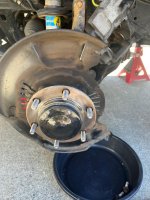
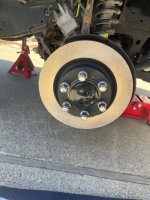
Replaced the Front rotors, pads, shims, and pins.
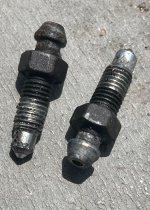
I also replaced the bleeders with speedbleeders.
A little more rust than I would prefer but I had no problems removing the caliper bolts, bracket bolts, or rotors.

Speed Bleeders:
Front: SB7100 (7mm x 1.0)
Rear: SB1010 (10mm x 1.0)
 

Attachments

  • IMG_3909.jpg
    IMG_3909.jpg
    130.9 KB · Views: 292
  • IMG_3900.jpg
    IMG_3900.jpg
    136 KB · Views: 287
  • IMG_3912.jpg
    IMG_3912.jpg
    134.5 KB · Views: 284
  • IMG_3907.jpg
    IMG_3907.jpg
    98.8 KB · Views: 290
  • IMG_3896.jpg
    IMG_3896.jpg
    126.7 KB · Views: 290
  • IMG_3899.jpg
    IMG_3899.jpg
    132 KB · Views: 284
  • IMG_3913.jpg
    IMG_3913.jpg
    135.5 KB · Views: 286
Last edited:
OP [MENTION=53327]1000MPH[/MENTION]:

Colour me inspired!

You achieved phenomenol pad-life, and maintained diligently along the way.

OUTSTANDING!
 
Adding a few more pics.
 

Attachments

  • IMG_3918.jpg
    IMG_3918.jpg
    143.4 KB · Views: 222
  • IMG_3920.jpg
    IMG_3920.jpg
    139.5 KB · Views: 296
  • IMG_3922.jpg
    IMG_3922.jpg
    135.5 KB · Views: 306
  • IMG_3934.jpg
    IMG_3934.jpg
    133.8 KB · Views: 149
  • IMG_3948.jpg
    IMG_3948.jpg
    136 KB · Views: 151
Last edited:
I put 1000 miles on the new front pads and rotors last week. A couple long downhills where I could get on them hard and one panic stop early on in the trip. Brakes are great. Shoulda replaced them sooner for improved pedal feel and perceivably better performance.
 
Checked my brakes again during a regular tire rotation.
4,000 miles in the new front pads and rotors. 157,500 on the original rears. Slight discoloration on the new rotors but nothing grooves. Pins move freely, no squealing. The new brakes work great so far.
Will definitely be changing the rear pads and rotors in the next few months.
 

Attachments

  • IMG_4322.jpg
    IMG_4322.jpg
    137 KB · Views: 83
  • IMG_4323.jpg
    IMG_4323.jpg
    133.3 KB · Views: 85
  • IMG_4331.jpg
    IMG_4331.jpg
    136 KB · Views: 82
  • IMG_4332.jpg
    IMG_4332.jpg
    128.2 KB · Views: 85

Members online

Forum statistics

Threads
278,315
Messages
3,554,125
Members
248,016
Latest member
Advally Service

Trending content

Back
Top