Cold Air Horsepower

1engineer

Moderator
Many of us have experienced colder than normal temperatures in the past few days. Two days ago I was riding my bike in 70 degree F temperatures in SC. This morning it was 7 degrees F at my house, which is quite a bit of difference. As I was driving this morning, I noticed my TE throttle was more responsive. I knew immediately why but thought I would share it with you guys too.

The Rules:
For every 10- to 11-degree Fahrenheit rise in intake air temperature past 77 degrees, (SAE J1349 standard test correction temperature), you can expect engine horsepower to decrease by about one percent at the same barometric pressure. That works out to a 6.80-percent increase in horsepower for every 1-psi rise in barometric pressure, and a 6.8-percent drop in horsepower for every 1-psi under 14.7 (ambient sea level)
Credit: SAE

Dynojet's rule of thumb is that a 1% increase in power occurs for every 10 degrees F cooler. So,

Our 4Runners have 270 HP at sea level and 77 degrees F.

Alright, now that I have given you the background, here is what I calculated my horsepower was in my TE this morning:

270hp * 1.07 = 288.9 or approximately 290 HP! The 1.07 comes from the differential temperature of tested vs actual. Now, barometric pressure comes into play also and it just so happens that the pressures were within 2 millibars of each other at these different locations so they were a wash.

To conclude, I had around 270 HP on Sunday and 290 HP today. 20 more HP and I did not spend a dime lol. If you guys would like I could make a chart except barometric pressure factors into this equation too. I was lucky and had almost the same pressures even though the altitude is over 2000' different from where I rode Sunday to where I am today. Normally the altitude would have negated any gains caused by temperature. Anyway, just thought it was interesting and you would like to know how temperature affects horsepower either for the good or bad.

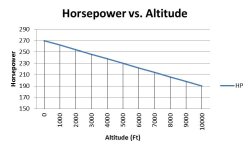
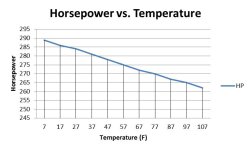
These Chart(s) are THEORETICAL! I added a chart on HP vs. Altitude also. It really all depends on air density and altitude or temperature effect density. Here you go:
 

Attachments
  • HP vs Temp.jpg
    HP vs Temp.jpg
    33.5 KB · Views: 3,030
  • HP vs Altitude.jpg
    HP vs Altitude.jpg
    31 KB · Views: 2,784
Last edited:
Register to hide this ad
Our 4Runners have 270 HP at sea level and 77 degrees F.

Alright, now that I have given you the background, here is what I calculated my horsepower was in my TE this morning:

270hp * 1.07 = 288.9 or approximately 290 HP! The 1.07 comes from the differential temperature of tested vs actual. Now, barometric pressure comes into play also and it just so happens that the pressures were within 2 millibars of each other at these different locations so they were a wash.

To conclude, I had around 270 HP on Sunday and 290 HP today. 20 more HP and I did not spend a dime lol. If you guys would like I could make a chart except barometric pressure factors into this equation too. I was lucky and had almost the same pressures even though the altitude is over 2000' different from where I rode Sunday to where I am today. Normally the altitude would have negated any gains caused by temperature. Anyway, just thought it was interesting and you would like to know how temperature affects horsepower either for the good or bad.
though you could put premium in the tank and supposedly get ”285 hp and 289 lb-ft” every day due to the 1GR-FE's adaptive, dual VVTi. :dizzy:

1e, do us all a solid and suss out the truth on this here matter, whydontcha?
 
So, is a millibar larger than a microbar? And if we have microbrewerys, why are there no millibrewerys? Yer makin' me crazy over here 1E.
 
though you could put premium in the tank and supposedly get ”285 hp and 289 lb-ft” every day due to the 1GR-FE's adaptive, dual VVTi. :dizzy:

1e, do us all a solid and suss out the truth on this here matter, whydontcha?

Not unless you can figure how to change compression ratios.
 
Not unless you can figure how to change compression ratios.
Harper posted this link recently that speaks to the point:

"Prado petrol engines are equipped with adaptive ignition timing however the rate at which the timing advances is very slow indeed...

When high octane fuel is used, the likelihood of detonation is diminished and the engine management system can advance the ignition timing further than that with standard fuel. Resulting in higher efficiency, greater power and torque as well as reduced fuel consumption
."

Welcome to Land Cruiser Owners On Line
 
Hmmm so what you are saying is that it is a wash of power....typically higher elevations have colder temps. So you lose the power with the high elevation but you gain it with the colder air, so an even wash, right? :naughty: Ahhh, if only it was that simple, but then again there is a bit of truth and accuracy to it though. All in all it comes down to the density of air, correct? Cold air is more dense than warm air. Lower elevation air is more dense than higher elevation air. Basic elementary science.
 
Many of us have experienced colder than normal temperatures in the past few days. Two days ago I was riding my bike in 70 degree F temperatures in SC. This morning it was 7 degrees F at my house, which is quite a bit of difference. As I was driving this morning, I noticed my TE throttle was more responsive. I knew immediately why but thought I would share it with you guys too.

The Rules:
For every 10- to 11-degree Fahrenheit rise in intake air temperature past 77 degrees, (SAE J1349 standard test correction temperature), you can expect engine horsepower to decrease by about one percent at the same barometric pressure. That works out to a 6.80-percent increase in horsepower for every 1-psi rise in barometric pressure, and a 6.8-percent drop in horsepower for every 1-psi under 14.7 (ambient sea level)
Credit: SAE

Dynojet's rule of thumb is that a 1% increase in power occurs for every 10 degrees F cooler. So,

Our 4Runners have 270 HP at sea level and 77 degrees F.

Alright, now that I have given you the background, here is what I calculated my horsepower was in my TE this morning:

270hp * 1.07 = 288.9 or approximately 290 HP! The 1.07 comes from the differential temperature of tested vs actual. Now, barometric pressure comes into play also and it just so happens that the pressures were within 2 millibars of each other at these different locations so they were a wash.

To conclude, I had around 270 HP on Sunday and 290 HP today. 20 more HP and I did not spend a dime lol. If you guys would like I could make a chart except barometric pressure factors into this equation too. I was lucky and had almost the same pressures even though the altitude is over 2000' different from where I rode Sunday to where I am today. Normally the altitude would have negated any gains caused by temperature. Anyway, just thought it was interesting and you would like to know how temperature affects horsepower either for the good or bad.

These Chart(s) are THEORETICAL! I added a chart on HP vs. Altitude also. It really all depends on air density and altitude or temperature effect density. Here you go:

god 1engineer you make me feel dumb you have got to be the smartest guy of the org :frusty:
 
Need to do a back to back on dyno with same car same dyno diffrent temps doubt you would see big gains on a stock 4runner with stock tune unless comparing say 110 deg day to say low 20's. Now if you could custom tune to take advantage of colder air im sure you could squeeze a few extra ponies out of it.
 
Very deep thread. So, that's the dealio on horsepower. How does pushing our brick-like 4Runners through colder, more dense air play out once the wheels start turning?
 
Very deep thread. So, that's the dealio on horsepower. How does pushing our brick-like 4Runners through colder, more dense air play out once the wheels start turning?

While there is of course an effect of air density in regards to a 4Runner's aerodynamic (or lack thereof) drag coefficient, I think the values would be very minimal. It's been a long time since I messed with fluid mechanics but I would think the altitudes required to really change something for a passenger vehicle are unobtainable unless they are an airplane. If you want to investigate you could look up density altitude (DA) graphs.
 

Members online

Forum statistics

Threads
278,309
Messages
3,554,072
Members
248,016
Latest member
Advally Service

Trending content

Back
Top