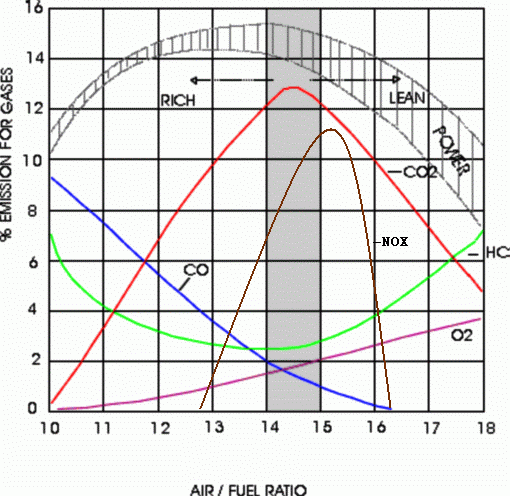
Was it ever addressed what stops the ECU from adjusting the fuel to get the Air/fuel ration back were Toyota programed it by using the feedback from the O2 sensors?
Its been along time since I rehashed this thread but my recollection was, spacer for MAF causes the ECU to think the engine is getting less air then it actually is, therefore it runs lean however presumably the ECU is also getting Feedback from the O2 sensors to keep the A/F ratio where it wants - what keeps it from adding more fuel to get the A/F ratio it wants from the factory?
Last this left off no one had provided any sort of scientific testing to prove this device actually works as advertised, random people saying their fuel mileage increase by single digits % is laughable considering all the unknowns and lack of controls.
Last thought out loud here, how was the thickness of spacer determined? Assuming there was some data collected there to be shared.
I'll give you my take on it.. I've been wondering about these MAF tune devices (this and the URD maf tuner) and what people claim in terms of MPG gains... There seems to be enough positive experiences that I think there is something to it.
Here is what i have come up with..
There are basically two things impact mpg and power on a given setup (fuel and spark).
Like you said, in closed loop the ECU is constantly using o2 feedback to adjust fuel trims, but there are times when the o2 feedback has little value.
1. WOT/Open loop.
2. Throttle transitions
But these would still not account for much of an MPG gain.
So, the other big factor is timing. And it turns out the MAF is also very much used to calculate engine load. So the ECU comes up with the timing based on 3 things.
RPM, MAF, Knock Learn. Most have a target timing table based on Load and RPM.
So, by messing with the maf (mainly lowering the readings) the o2 feedback will bring the fueling back in line with 14.7, but the timing would still be more aggressive since the load will read as lower.
If you drive around at cruising speeds in 5th gear. you should see timing drop quite a bit as hills come up.. Just a small change in load has a big impact on timing at low RPM.
This is my theory on how these things have the potential to increase power and MPG. Obviously if you increase timing too much.. knock will start and the ECU will start getting knock feedback/learn. This is also how you get more power and MPG with higher octane fuel, but I think the factory cal leaves a lot of areas in the calibration with less than ideal timing even on lower octane fuel.
Anyway, that is my theory at the moment. No proof at this point, but If someone with a stock rig near me wants to try one.. I think we could prove it with some data logging. My truck is too far from stock to do anything with.