Crawford Eco Block

If I could multi-dislike your post I would.

This thread is one of the best we've got on this forum, full of information, inter-linked with a tacomaworld thread, intelligent discussion (even engineers chimed in), and on top of that, the owner of the companie that makes the ecobkocks had a talk with us.

Hope you have fun in the tire size threads.

Still have my EB installed, clearly made a small difference (around 5%+), I just didn't collect "scientific evidences" to show up here.

At $3 a gallon for gas you have been saving 15c per gallon, sounds like your Eco Block paid for itself long ago.

Thanks for the kind words!
Quirt
 
[MENTION=121742]Quirt[/MENTION] I'm glad you came back.

I just wanted to share my experience using the Eco Block Q2 and Crawford performance customer service. I'd like to preface this with the fact that I realize it isn't the end of the world, and I'm only out ~$46.

The hardware in the kit wasn't a good fit and ended up disconnecting the MAF and Eco Block from the intake tube a couple months after installation. For about a week, the truck would die around corners and throw codes. Surprisingly took me a little while to spot the issue as the MAF assembly would somehow find it's way directly back into the intake tube. When I finally saw it after going through many other options I was relieved the issue wasn't much worse, so I called your shop directly to get some replacement hardware and gaskets. I gave your employee my email for invoice and never received one. I called back about 2 weeks later and was told they would send me invoice, but again I never received one. I ended up using the OEM hardware and placed the Eco Block on top of my toolbox, which likely migrated into a corner or crevice that someday might be unearthed by our descendants, or worse yet, aliens.
 
[MENTION=121742]Quirt[/MENTION] I'm glad you came back.

I just wanted to share my experience using the Eco Block Q2 and Crawford performance customer service. I'd like to preface this with the fact that I realize it isn't the end of the world, and I'm only out ~$46.

The hardware in the kit wasn't a good fit and ended up disconnecting the MAF and Eco Block from the intake tube a couple months after installation. For about a week, the truck would die around corners and throw codes. Surprisingly took me a little while to spot the issue as the MAF assembly would somehow find it's way directly back into the intake tube. When I finally saw it after going through many other options I was relieved the issue wasn't much worse, so I called your shop directly to get some replacement hardware and gaskets. I gave your employee my email for invoice and never received one. I called back about 2 weeks later and was told they would send me invoice, but again I never received one. I ended up using the OEM hardware and placed the Eco Block on top of my toolbox, which likely migrated into a corner or crevice that someday might be unearthed by our descendants, or worse yet, aliens.

Please send an email to [email protected] and we will send you a new kit.

Take care,
Quirt
 
Just an aside when ordering I had ordered 2 of same for 5th thinking (or not) would fit 05' nope ordered correct one & instant reply that I couldn't get discount & I said but I'm ordering another one for 4th gen & right away no problem coming to ya ! Just saying !
 
Just an aside when ordering I had ordered 2 of same for 5th thinking (or not) would fit 05' nope ordered correct one & instant reply that I couldn't get discount & I said but I'm ordering another one for 4th gen & right away no problem coming to ya ! Just saying !

I'll give one a shot if I can get a discount.
 
Don't forget that you have to upgrade your muffler bearing if you get the Eco-block. Otherwise you'll have cross-catalysation issues and good luck troubleshooting that. Try to get one made in Taiwan or Singapore. My buddy and I spent weeks diagnosing that on his WRX. Frickin cheap Chinese muffler bearing the whole time....
 
Last edited:
Did [MENTION=66316]1engineer[/MENTION] ever get data to do an analysis?

Has anyone after 3 years put a T4R on the dyno with this?
 
The truth is we don't know. I find it very dubious to make a claim that the emissions are reduced when chemistry predicts otherwise. The nice thing about chemistry is that laws of physics remain constant and therefore the reactions are very predictable. The reactions that occur in various states happen whether you believe it or not. However it would be reasonable to test this in a lab to confirm which of us is in fact correct.

Passing emissions with OBD2 means you computer doesn't "think" it's failing. Unless your emissions test measures exhaust pipe emissions it means nothing.

The EPA has a voluntary review program for emission devices that claim to improve emissions over what the factory EPA approved levels are. Possibly I should buy one and send it in? Might be worth testing just to see how it shakes out. Of course if it makes it worse it's likely to be labeled "tampering." It is my understanding that generally the EPA frowns upon selling devices that "tamper" with emissions systems.

Maybe this has been addressed already, but can you have both? Can you reduce overall emissions by reducing fuel consumption, even when emissions are chemically "dirtier?"

Otherwise I'm not getting into the engineering dynamics of this thread, except to say that the lean vs rich argument is an old argument in terms of engine performance in airplanes, and there seems to be no settling the issue with pilots and aircraft owners (even with better engine measurements/equipment).
 
Maybe this has been addressed already, but can you have both? Can you reduce overall emissions by reducing fuel consumption, even when emissions are chemically "dirtier?"

Otherwise I'm not getting into the engineering dynamics of this thread, except to say that the lean vs rich argument is an old argument in terms of engine performance in airplanes, and there seems to be no settling the issue with pilots and aircraft owners (even with better engine measurements/equipment).

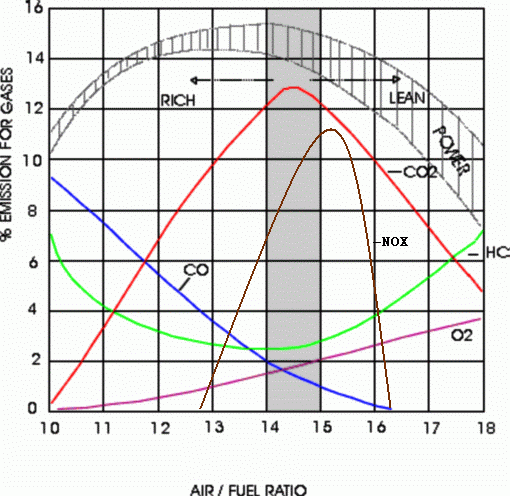
airfuelratio5big.GIF


From this emissions / air fuel ratio diagram I can see that our Eco Block Fuel Saver raises the CO2 as well as the 02, while lowering the HC and CO.

Look closely at this diagram. It represents the Exhaust Gases relationship to the Air/Fuel ratio that enters the engine and the Power output of the engine. As they say a picture says a thousand words. Ideal Air/Fuel Ratio is 14.71/1 (for petrol) and not consequently this is where the CO2 is at about it's highest percentage and the HC at it's lowest. The Power graph highest point is also almost there, so these should be your guide lines. Also notice that the CO and O2 have almost the same (low) values at the "ideal" point ( the gray area on the diagram). Don't forget that all gases relate to one another so if one is out of range it will reflect on the others too.

So to recap: The highest CO2 with CO and O2 with same low values and the lowest HC you can get and you have almost the perfect picture...pardon, engine combustion! Enjoy!
 
Was it ever addressed what stops the ECU from adjusting the fuel to get the Air/fuel ration back were Toyota programed it by using the feedback from the O2 sensors?

Its been along time since I rehashed this thread but my recollection was, spacer for MAF causes the ECU to think the engine is getting less air then it actually is, therefore it runs lean however presumably the ECU is also getting Feedback from the O2 sensors to keep the A/F ratio where it wants - what keeps it from adding more fuel to get the A/F ratio it wants from the factory?

Last this left off no one had provided any sort of scientific testing to prove this device actually works as advertised, random people saying their fuel mileage increase by single digits % is laughable considering all the unknowns and lack of controls.

Last thought out loud here, how was the thickness of spacer determined? Assuming there was some data collected there to be shared.
 
Was it ever addressed what stops the ECU from adjusting the fuel to get the Air/fuel ration back were Toyota programed it by using the feedback from the O2 sensors?

Its been along time since I rehashed this thread but my recollection was, spacer for MAF causes the ECU to think the engine is getting less air then it actually is, therefore it runs lean however presumably the ECU is also getting Feedback from the O2 sensors to keep the A/F ratio where it wants - what keeps it from adding more fuel to get the A/F ratio it wants from the factory?

Last this left off no one had provided any sort of scientific testing to prove this device actually works as advertised, random people saying their fuel mileage increase by single digits % is laughable considering all the unknowns and lack of controls.

Last thought out loud here, how was the thickness of spacer determined? Assuming there was some data collected there to be shared.

I think most everything was discussed in this thread, especially the closed loop function of the ECU. But to answer your question again, the ECU keeps the air fuel ratio at 14.7 to 1 while in closed loop regardless of our Eco Block. Although the ignition advance is still there during closed loop fueling.

As for sharing my tuning information / data.... I quit doing that almost 20 years ago now.

Quirt
 
Was it ever addressed what stops the ECU from adjusting the fuel to get the Air/fuel ration back were Toyota programed it by using the feedback from the O2 sensors?

Its been along time since I rehashed this thread but my recollection was, spacer for MAF causes the ECU to think the engine is getting less air then it actually is, therefore it runs lean however presumably the ECU is also getting Feedback from the O2 sensors to keep the A/F ratio where it wants - what keeps it from adding more fuel to get the A/F ratio it wants from the factory?

Last this left off no one had provided any sort of scientific testing to prove this device actually works as advertised, random people saying their fuel mileage increase by single digits % is laughable considering all the unknowns and lack of controls.

Last thought out loud here, how was the thickness of spacer determined? Assuming there was some data collected there to be shared.

I'll give you my take on it.. I've been wondering about these MAF tune devices (this and the URD maf tuner) and what people claim in terms of MPG gains... There seems to be enough positive experiences that I think there is something to it.

Here is what i have come up with..

There are basically two things impact mpg and power on a given setup (fuel and spark).

Like you said, in closed loop the ECU is constantly using o2 feedback to adjust fuel trims, but there are times when the o2 feedback has little value.

1. WOT/Open loop.
2. Throttle transitions

But these would still not account for much of an MPG gain.

So, the other big factor is timing. And it turns out the MAF is also very much used to calculate engine load. So the ECU comes up with the timing based on 3 things.

RPM, MAF, Knock Learn. Most have a target timing table based on Load and RPM.

So, by messing with the maf (mainly lowering the readings) the o2 feedback will bring the fueling back in line with 14.7, but the timing would still be more aggressive since the load will read as lower.

If you drive around at cruising speeds in 5th gear. you should see timing drop quite a bit as hills come up.. Just a small change in load has a big impact on timing at low RPM.

This is my theory on how these things have the potential to increase power and MPG. Obviously if you increase timing too much.. knock will start and the ECU will start getting knock feedback/learn. This is also how you get more power and MPG with higher octane fuel, but I think the factory cal leaves a lot of areas in the calibration with less than ideal timing even on lower octane fuel.

Anyway, that is my theory at the moment. No proof at this point, but If someone with a stock rig near me wants to try one.. I think we could prove it with some data logging. My truck is too far from stock to do anything with.

 
Last edited:

Members online

Forum statistics

Threads
278,312
Messages
3,554,089
Members
248,016
Latest member
Advally Service

Trending content

Back
Top