Crawford Eco Block

So the FJ came with the same VVTI, compression ratio, and 270HP as the 4Runner?.........:ohwell: A 270hp FJ would have been cool........
 
So the FJ came with the same VVTI, compression ratio, and 270HP as the 4Runner?.........:ohwell: A 270hp FJ would have been cool........

I have a 08 FJ and have driven a 10+. Trust me the older ones with the single VVTi are way better in terms of general drivability... they feel powerful. Same crap calibration plagues the 2010+ FJ that plagues the 5th gen 4runner. It has power, but it requires you to mash it to get into power enrichment and make any torque....

THE FJ and the 4runner are the exact same platform... The Tacoma did not get the dual vvti in 2010 for some strange reason. Not sure what that was all about
 
Last edited:
Third party testing of a 2018 Duramax Diesel with and without an Eco Block

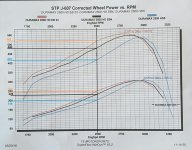
View attachment 290892Toyota of Escondido did some "Third party" dyno testing with their in-house dyno on a 2018 Chevy Duramax Diesel with our stage 1 and stage 2 Torque Block by Eco Block. Their results were better than expected... at 2500rpm our stage 1 Torque Block increased the torque by 64 pound feet while the stage 2 Torque Block increased the torque by 104 pound feet. This was measured at the wheels. The owner of the truck also is seeing a 4mpg increase without a tow which is +30%... and will soon have us the MPG increase towing his loaded trailer.

The Blue line is stock, Black like is stage 1 and the Red line is stage 2
 

Attachments

  • 2018 duramax.jpg
    2018 duramax.jpg
    136.7 KB · Views: 415
Last edited:
OK, now where's the beef?

I've struggled through this whole friggin thread. Several posters were keeping records of long term gas mileage data and someone was going to compile the results in chart or graph form. It's been three years. Where's the results?
Or am I so bleary-eyed that I missed it?
 
The way I understand it, any benefit would be temporary only, and vanish to near zero as the ECU learns and adjusts based on targets and knock.

Running leaner sounds great but will make transitional throttle inputs cause knock sooner when there's less coolish gas and leaner AFR, and that detected knock ought to make the ECU pull timing.

Could be wrong but it seems like an inelegant way to cause leaner AFRs across the board.
 
The way I understand it, any benefit would be temporary only, and vanish to near zero as the ECU learns and adjusts based on targets and knock.

Running leaner sounds great but will make transitional throttle inputs cause knock sooner when there's less coolish gas and leaner AFR, and that detected knock ought to make the ECU pull timing.

Could be wrong but it seems like an inelegant way to cause leaner AFRs across the board.

You are correct, the ECU knows the air fuel ratio is different the moment the engine starts up and adjusts accordingly until the air fuel ratio is the same as what the closed loop fuel table demands. This is not a learning mode for the ECU but common sense based on its internal math.

Our Eco Block Fuel Saver only saves fuel when the ECU is in open loop fueling. During open loop fueling there is no compensations to the open loop fuel table from the Lambda sensor, nor are there any long term trims to this table. The ECU will only let a compensation to the air fuel ratio happen when the Lambda sensor is part of the decision making.

So if you understand the concept of open and closed loop fueling, you can also understand that there will be no "transitional throttle inputs cause knock sooner when there's less coolish gas and leaner AFR, and that detected knock ought to make the ECU pull timing" because the air fuel ratio during this period is still at factory settings.

When you drive around like the kockblockers on the highway, you will be in the closed loop fueling mode. When you drive normal and use the throttle for what it was designed for you will be in the open loop fueling mode. So you can use this visual as a guide to know if the Eco Block Fuel Saver will work for you.

Forgot to mention that our Eco Block does not cause the motor to run lean as the Lambda sensor prevents any lean situations.

Quirt

 
Last edited:
The engine power specs are slightly different between the 4runner and the FJ, but parts wise I believe they are pretty much interchangeable. The manual FJs also came with Full Time 4WD so a 2 axle dyno would be needed unless someone is pulling axles.

There are a few videos on youtube of 5th gen 4runners doing dyno runs, so it is possible:
https://www.youtube.com/watch?v=7_jLihMNYyc
https://www.youtube.com/watch?v=WgtZqO7X95Q

The last one is on both axles but the first two are on the rear axle only. Where there is a will, there is a way!

my 2007 rav4 was full time AWD and I was able to disconnect the 4wd ecu. I made a trip out to california on 2wd limp mode. THe 4wd light stayed on indicating a malfunction. Torque steer w/o the 4wd was very obvious. I may have even gained 1mpg or 2 during this trip. I had no issues driving around w/o the 4wd ecu.
 
You are correct, the ECU knows the air fuel ratio is different the moment the engine starts up and adjusts accordingly until the air fuel ratio is the same as what the closed loop fuel table demands. This is not a learning mode for the ECU but common sense based on its internal math.

Our Eco Block Fuel Saver only saves fuel when the ECU is in open loop fueling. During open loop fueling there is no compensations to the open loop fuel table from the Lambda sensor, nor are there any long term trims to this table. The ECU will only let a compensation to the air fuel ratio happen when the Lambda sensor is part of the decision making.

So if you understand the concept of open and closed loop fueling, you can also understand that there will be no "transitional throttle inputs cause knock sooner when there's less coolish gas and leaner AFR, and that detected knock ought to make the ECU pull timing" because the air fuel ratio during this period is still at factory settings.

When you drive around like the kockblockers on the highway, you will be in the closed loop fueling mode. When you drive normal and use the throttle for what it was designed for you will be in the open loop fueling mode. So you can use this visual as a guide to know if the Eco Block Fuel Saver will work for you.

Forgot to mention that our Eco Block does not cause the motor to run lean as the Lambda sensor prevents any lean situations.

Quirt

That makes sense. Can you show some data for a non-diesel application?
 
Why does your fitment list only go up to 2014?

Because I have been very busy with my main company, and a little lazy. That being said, the Fuel Saver is becoming my main focus for the rest of the year.

Most vehicle manufactures have maintained the same MAF sensor so most fitments move forward, but there have been three new sensor designs in the last year so we are manufacturing three more Q's as well.

If there is a particular vehicle you have in mind I would be happy to give you the correct fitment for it.

Quirt
 
Help me understand how it's saving fuel. If it only has an effect in open loop operation - are you then claiming that most people do enough driving in open loop mode that it makes a measurable difference in fuel economy?
 
Because I have been very busy with my main company, and a little lazy. That being said, the Fuel Saver is becoming my main focus for the rest of the year.

Most vehicle manufactures have maintained the same MAF sensor so most fitments move forward, but there have been three new sensor designs in the last year so we are manufacturing three more Q's as well.

If there is a particular vehicle you have in mind I would be happy to give you the correct fitment for it.

Quirt

Hi Quirt, hope your doing well, i would like to order one of the fuel savers for my 2017 SR5 it has the 4.0, can you tell me the correct one to order, thanks.
 
Help me understand how it's saving fuel. If it only has an effect in open loop operation - are you then claiming that most people do enough driving in open loop mode that it makes a measurable difference in fuel economy?

That is very easy to visualize while driving down the road... Are most drivers crawling down the road blocking the normal flow of traffic, or are most drivers packed up behind and trying to get around the ones doing the blocking?

It's also very easy to get into the open loop fueling mode, while staying in the closed loop fueling mode is much much harder.

I do have customers return their Eco Block Fuel Saver because they do not see a savings in fuel mileage. The fact that these returns are less than 1% of the total sales tells me that most people do drive in the open loop fueling mode, and do see a measurable difference in their fuel consumption.

Quirt
 
Hi Quirt, hope your doing well, i would like to order one of the fuel savers for my 2017 SR5 it has the 4.0, can you tell me the correct one to order, thanks.

Toyota has gone to the newer / smaller MAF sensor on your 2017 SR5 so the correct fitment will be our Q2.

I'm doing well, thanks for asking. I hope you are in the same boat :)
 
That is very easy to visualize while driving down the road... Are most drivers crawling down the road blocking the normal flow of traffic, or are most drivers packed up behind and trying to get around the ones doing the blocking?

It's also very easy to get into the open loop fueling mode, while staying in the closed loop fueling mode is much much harder.

I do have customers return their Eco Block Fuel Saver because they do not see a savings in fuel mileage. The fact that these returns are less than 1% of the total sales tells me that most people do drive in the open loop fueling mode, and do see a measurable difference in their fuel consumption.

Quirt

I think most driving miles are steady state cruising. I think with modern wide band o2 systems 90%+ of fuel is used during closed loop operation.

Typically it requires almost full throttle to get into open loop on the 4runner. I don't know if it ever goes into OL below 3k rpms - I don't know what circumstances would cause it. I haven't seen it happen and I can't create a scenario where it will happen that I'm aware of. The other OL condition is deceleration or downshifting down hills. So.. it's pretty rare for most of us in normal use.
 
Toyota has gone to the newer / smaller MAF sensor on your 2017 SR5 so the correct fitment will be our Q2.

I'm doing well, thanks for asking. I hope you are in the same boat :)

Thanks, so far so good, order sent, have a good day.
 

Members online

Forum statistics

Threads
278,312
Messages
3,554,083
Members
248,016
Latest member
Advally Service

Trending content

Back
Top