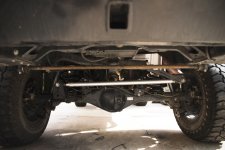
Designing a PCK for the 5th Gen, need some input..

I have ordered and received the Panhard correction kit seen here for my 5th gen with KDSS. When I initially installed my lift (Icon with extended travel) my Panhard bar would contact my KDSS track bar at full droop. I since added the adjustable Panhard bar by Icon with the 5 degree bend in it (seen in the 1st picture). This helped some but occasionally at full extension the Panhard bar will contact the KDSS system. Therefore the solution was to try this kit out or go with the sonoran steel Panhard bar that is designed with the bends in it (2nd picture). With the correction kit being <100$ and the new Panhard bar being nearly 400$ I decided to go this route. Plus would also be to restore normal geometry. My question for this thread is this. Will I be ok using the Panhard bar with the slight 5 degree bend in it (it can be made stock length) or should I replace it with a stock length straight (no bend) Panhard bar (OEM vs. ICON vs other brand).

I think you need both. The PCK is meant to fix your roll center on lifted vehicles, not help with clearance. The Sonoran is meant to fix clearance issues with KDSS.

If you're just trying to fix clearance issues, get the panhard bar.
 
As far as function goes, the bar doesn't know it is/is not straight; I'm assuming the 5 degree bend is to clear some KDSS component, or the crossmember above? In either case, I like how it retains a fixed bushing at one end to fight twisting motion.

I'd say give it a shot - and let us know how it goes! It'll be good data.

Random but related question about sagitta:

How much sagitta does the stock setup have and how much does a 3 inch lift introduce without correcting the geometry so that the panhard bar mount points are parallel? Do the aftermarket bars (like the Icon one) help to correct any of the sagitta that results from a lift or are they just beefier?
 
Last edited:
Random but related question about sagitta:

How much sagitta does the stock setup have and how much does a 3 inch lift introduce without correcting the geometry so that the panhard bar mount points are parallel? Do the aftermarket bars (like the Icon one) help to correct this or are they just beefier?

I did some cad on those arcs in my original PCK thread on the 3rd gen forums - having the bar parallel halves that side to side travel, of course.

If the c2c length of the 5th gen bar is known, I wouldn't take long to draw all that up and get those measurements.

That said, I'm not sure how an aftermarket bar can correct for that - if it isn't parallel to the axle/horizon at rest, it is going to have greater total side-to-side travel as it arcs.

(not sure that's sagitta though - isn't that measured relative to the midpoint of the distance between the ends of an arc? - not relative to a fixed vertical plane?)
 
Random but related question about sagitta:

How much sagitta does the stock setup have and how much does a 3 inch lift introduce without correcting the geometry so that the panhard bar mount points are parallel? Do the aftermarket bars (like the Icon one) help to correct this or are they just beefier?

Lifting alone doesn't affect sagitta unless you increase or decrease the limits of up travel and down travel. So 3" lift springs alone don't change anything.

Usually you need extended bump stops after the lift, so that decreases up travel and decreases sagitta.

The lift kits usually come with a little more down travel I believe, so that does increase sagitta if you're able to use it without something binding.

The net effect should be within fractions of an inch though.

The adjustable bars are used to adjust the side to side position of the rear wheels at the ride height. However, doing that does impact sagitta. Increasing the length decreases sagitta and decreasing the length increases sagitta.

You shouldn't need an adjustable panhard bar with a PCK. At ride height, it will put the rear wheels at the same side to side position they were stock assuming your lift height matches the PCK correction.
 
I did some cad on those arcs in my original PCK thread on the 3rd gen forums - having the bar parallel halves that side to side travel, of course.

If the c2c length of the 5th gen bar is known, I wouldn't take long to draw all that up and get those measurements.

That said, I'm not sure how an aftermarket bar can correct for that - if it isn't parallel to the axle/horizon at rest, it is going to have greater total side-to-side travel as it arcs.

(not sure that's sagitta though - isn't that measured relative to the midpoint of the distance between the ends of an arc? - not relative to a fixed vertical plane?)

The C2C length is the distance between the axle and the bump stops at full droop, no? The value will vary from setup to setup of course.
But yeah, sagitta =/= total side to side travel unless the bar is parallel to the axle at the midpoint of the available up and down travel, which in all likeliness probably isn't at ride height.

If your suspension at ride height has more available up travel than down travel, you would actually want the panhard bar axle end to sit a bit lower to minimize the total side to side travel.
 

Attachments

  • Screen Shot 2019-04-18 at 6.48.14 PM.jpg
    Screen Shot 2019-04-18 at 6.48.14 PM.jpg
    105 KB · Views: 1,767
The C2C length is the distance between the axle and the bump stops at full droop, no? The value will vary from setup to setup of course.
I meant the length of the panhard bar from center to center of the eyelets - If I have that dimension I can do a quick sketch and measure the sid-to-side travel at different heights.

I have a 4th gen at the shop right now, I'll measure the bar today.

If your suspension at ride height has more available up travel than down travel, you would actually want the panhard bar axle end to sit a bit lower to minimize the total side to side travel.

Well, you want the bar level to minimize that travel; but if you lower the bar you lower the roll center, which negatively impacts handling. Higher roll center is also an objective of the PCK.
 
Well, you want the bar level to minimize that travel; but if you lower the bar you lower the roll center, which negatively impacts handling. Higher roll center is also an objective of the PCK.

Is the bar level at ride height from the factory? I was under the impression it was at a small angle like in the picture JSparky shared above.
 
Is the bar level at ride height from the factory? I was under the impression it was at a small angle like in the picture JSparky shared above.

The way the stock springs sag? Who could know? LOL.

That slight angle is just fine, level is fine, a slight angle the other way isn't a great idea as it would get worse on acceleration & bumps.

I got some measurements, btw - I'm going to sketch them out in a minute.
 
If your suspension at ride height has more available up travel than down travel, you would actually want the panhard bar axle end to sit a bit lower to minimize the total side to side travel.

I just re-read this and understood it correctly. You're absolutely right - knowing your range of travel vs. ride height is very useful. Great point. Thanks!

BTW, it looks like the stock bar length is 1015mm. On the 4th gen I just measured, there's a delta of 101mm between the axle and frame mounts at rest. I'm going to assume that particular truck can manage 4 inches of travel in either direction (I didn't think to measure that, but I'm all about it after thinking about the point you made above) simply for comparison purposes.

Assuming that scenario, a level panhard bar will move the axle side-to-side 5mm through that range of travel. This particular truck, as it is (angled factory bar) would see a side-to-side shift of 20mm through that range. If an aftermarket bar were used on this truck to recenter the axle (it would be 1020.1mm total length), then the axle would see side-to-side movement of 20.2mm.
 
Last edited:
Just installed my PCK. My axle was 1” offset with 3” lift. Now it’s centered. I have long travel shocks and coils so hopefully with will help with flex also? Either way I’m excited to hit the road and see how she rides.

2a29835dfd4ef4f2299dc9091d454e01.jpg


ea6b3e78d40a11c845809f021ef71e56.jpg


d5962fa8b6968823c14e9cab0a175240.jpg


fbd3355d28a9c5502c58c143b9484641.jpg


Sent from my iPhone using Tapatalk
 
I just re-read this and understood it correctly. You're absolutely right - knowing your range of travel vs. ride height is very useful. Great point. Thanks!

BTW, it looks like the stock bar length is 1015mm. On the 4th gen I just measured, there's a delta of 101mm between the axle and frame mounts at rest. I'm going to assume that particular truck can manage 4 inches of travel in either direction (I didn't think to measure that, but I'm all about it after thinking about the point you made above) simply for comparison purposes.

Assuming that scenario, a level panhard bar will move the axle side-to-side 5mm through that range of travel. This particular truck, as it is (angled factory bar) would see a side-to-side shift of 20mm through that range. If an aftermarket bar were used on this truck to recenter the axle (it would be 1020.1mm total length), then the axle would see side-to-side movement of 20.2mm.

Thanks for the measurements!

I think you may have a rounding error somewhere. The side to side travel should decrease if the panhard bar length increases.

I sketched it out in Creo using a 101 mm vertical distance between the frame pivot and axle pivot(comes out to 5.7 degree angle down at ride height), and 4" of travel in each direction from ride height. I got 20.4 mm side to side with 1015 mm length and 20.3 mm at 1020.1 mm bar length.

What I find odd is the bar only reaches parallel to the axle at full up travel(assuming your 4" guess is accurate), so something is off about the set up. Is it lifted without your PCK correction?

Maybe the 4" travel assumptions are bad? It would help to have actual cord measurements(bump stop to axle) at ride height and at full droop.
 
Thanks for the measurements!

I think you may have a rounding error somewhere. The side to side travel should decrease if the panhard bar length increases.

I sketched it out in Creo using a 101 mm vertical distance between the frame pivot and axle pivot(comes out to 5.7 degree angle down at ride height), and 4" of travel in each direction from ride height. I got 20.4 mm side to side with 1015 mm length and 20.3 mm at 1020.1 mm bar length.

I double checked, and it was a typo - the 1015 bar angled I actually got 20.289 (20.3) and at 1020 it was 20.189 (20.2) Editing my post got me.

What I find odd is the bar only reaches parallel to the axle at full up travel(assuming your 4" guess is accurate), so something is off about the set up. Is it lifted without your PCK correction?

Maybe the 4" travel assumptions are bad? It would help to have actual cord measurements(bump stop to axle) at ride height and at full droop.

The sample truck IS lifted W/O panhard correction (yet) - and the 4" up/4"down travel was just a random scenario for comparison purposes. As you noted, knowing more accurate up/down distances would be helpful to get an accurate representation of what happens on a specific truck.

That said, the sample numbers illustrate why these trucks need panhard correction when lifted, and why adjustable bars aren't a great solution.. :)
 
I double checked, and it was a typo - the 1015 bar angled I actually got 20.289 (20.3) and at 1020 it was 20.189 (20.2) Editing my post got me.


The sample truck IS lifted W/O panhard correction (yet) - and the 4" up/4"down travel was just a random scenario for comparison purposes. As you noted, knowing more accurate up/down distances would be helpful to get an accurate representation of what happens on a specific truck.

That said, the sample numbers illustrate why these trucks need panhard correction when lifted, and why adjustable bars aren't a great solution..

That truck is actually right at the borderline.

The maximum recommend rake is 10% of the bar length, so 101 mm distance is actually still acceptable for a 1015 mm bar.

Also, after giving it more thought and doing some more reading on panhard tuning, I'm pretty certain you wouldn't want the bar level at unloaded ride height. Loading the rear would put the frame mount below the axle mount and you'd get a lot of body roll and the body roll would partially unload the rear axle for a moment when you turn. In fact, you probably want to avoid the frame mount dropping below the axle mount during normal operation on the road, but it should be okay if it dips a little below on bottom out events since those usually happen at speed in a straight line. A little downward rake is good for heavy cars to reduce body roll anyway. Handling is more important than keeping side to side travel to the absolute minimum.

Also, having more rake(up to the 10% max) actually helps reduce body roll, so people may like it, but it could have some adverse handling impact, so returning it back to the OE rake with an axle side correction kit is probably a good idea. Might not be the greatest idea to move up to the 3.5" correction hole if you only have 2.5" lift or less just to chase a level bar though.
 
That truck is actually right at the borderline.

The maximum recommend rake is 10% of the bar length, so 101 mm distance is actually still acceptable for a 1015 mm bar.

Also, after giving it more thought and doing some more reading on panhard tuning, I'm pretty certain you wouldn't want the bar level at unloaded ride height. Loading the rear would put the frame mount below the axle mount and you'd get a lot of body roll and the body roll would partially unload the rear axle for a moment when you turn. In fact, you probably want to avoid the frame mount dropping below the axle mount during normal operation on the road, but it should be okay if it dips a little below on bottom out events since those usually happen at speed in a straight line. A little downward rake is good for heavy cars to reduce body roll anyway. Handling is more important than keeping side to side travel to the absolute minimum.

Also, having more rake(up to the 10% max) actually helps reduce body roll, so people may like it, but it could have some adverse handling impact, so returning it back to the OE rake with an axle side correction kit is probably a good idea. Might not be the greatest idea to move up to the 3.5" correction hole if you only have 2.5" lift or less just to chase a level bar though.

yeah, you definitely want to tune your suspension with your load setup. And what's even better is that I don't make these irreversible (although I try to make them scalable); you can even go back to the stock hole if you ever need to.
 
Last edited:
This thread has been an interesting read. I feel a bit more educated now. I have been doing small projects to improve post lift handling and decided to order a PCK for my 5th gen-3” lifted. Im hoping that i will experience less of the tail end of the truck wagging when im offroading on rocky trails as a more parallel angle of the bar should provide strength to combat that. Nice product!
 
I installed my PCK bracket yesterday. There was no fitting adjustment required. We just cleaned the paint off the oem bracket at the joint and welded it up.

i-HgKsFgc-M.jpg


i-XD6T74S-M.jpg
 

Members online

Forum statistics

Threads
278,316
Messages
3,554,113
Members
248,016
Latest member
Advally Service

Trending content

Back
Top