Ethanol-free Gas Challenge!

Here in Central Wisconsin Cenex sell oxygenated 91 octane pure gas. Does this fuel burn more completely than non-oxygenated fuel? Honestly asking as I didn't know what "oxygenated" meant or did.

I believe oxygenated means ethanol but I believe you are seeing 91 Octane non-oxygenated at Cenex.

Here in MPLS we only get 91 or 93 E Free petrol at a select few stations. Here in MN we have a warning on the pump to only put in a collector car or small engines, blah blah blah. I certainly use it in my mower, leaf blower and snow blower and my 4Runner when available and when not stupid % more than e10 91 octane.
 
LOL!!!

Get over yourself.

Its tough arguing with someone who laughs out loud so much but here is one more try.

Soot (PAHs) and Carbon Monoxide are harmful pollutants. Oxygenates (Ethanol) reduce these outputs. YES you burn more volume of fuel mixture when mixed w/ ethanol. However the real pollutants are being reduced. Again its not about efficiency, MPG or total volume of emissions its about a changing the reaction and "cleaning" your emissions.

Lets pose another identical question involving your catalytic converter. The Cat adds weight to your vehicle making it less efficient but it cleans your emissions. Now would you cut off your cat just to get more MPGs? This is the same scenario as removing ethanol from your fuel.

Also consider the CO2 you output from your engine is partially re-captured by the corn or sugar being grown to produce ethanol, reducing your carbon footprint. The use of ethanol also slows down our consumption of fossil fuels and will prolong the limited supply we have underground until SCIENCE advances us beyond burning dead dinosaurs.

Anyway this is probably a waste of energy....
 
it's actually not clear that corn based ethanol has a net negative footprint and depends heavily on things like if land use is changed for production
 
pure-gas.org shows where to find stations around you


I have their app on my phone. It works great as does pure 100% dino juice. We have plenty of stations around us that have anywhere from 87 to 91 ethanol free fuel. I have been using in my small engines for years every since I had to replace my carburetor on my Stihl chainsaw. The ethanol is hard on the o-rings, seals etc on small engines. I use it in Polaris Sportsman 550 and now that I bought a used 2012 4runner I use it in that too. My mileage in the stock configuration was between 21.6 to 24.2 mpg. Now that I lifted it and put 255 75R17 mud tires on it has dropped to 19.2 to 20.8 mpg.

I am not a fan of corn anything. Has anyone seen the documentary "King Corn"? I highly recommend it.

Biodiesel makes more sense to me as we used to have it here locally and I ran B20 in my 2002 Ford PowerStroke and my 2006 Dodge Ram Cummins. I got better mileage with it and the motor seemed to be a little quieter.

Did I win??
 
Last edited:
LOL!!!

Get over yourself.

Do you not understand that because the crappy performance that ethanol causes, it makes vehicles less efficient, and therefor makes them consume MORE gas to go the same distance, therefore INCREASING the total amount of pollution.

A less efficient engine produces MORE pollution. It's very simple.

if you think it really makes a positive difference, you would be clamoring for methanol use.

And if it REALLY matters, why are you driving a 4Runner? Shouldn't you be walking or riding a horse? oh wait... horses pass methane, and that's bad...

Unfortunately it's not as simple as you are.

This age of 'whoever can land the sickest burn wins the argument' is disgusting. Missing the days when we still respected science, intelligence and general competence.
 
Unfortunately it's not as simple as you are.

This age of 'whoever can land the sickest burn wins the argument' is disgusting. Missing the days when we still respected science, intelligence and general competence.

And another person who doesn't grasp the simple concept of science as it pertains to the combustion engine.

Less efficient engines will end up producing more emissions.
You must burn MORE fuel that is mixed with ethanol to get the same mileage as gas without it. Therefore you increase the amount of pollution over the life of the vehicle.
It's a simple concept.

Once again, for those who cannot grasp the fact that ethanol, especially corn based ethanol, is a net loser for transportation: If ethanol was a viable alternative fuel source that made actual sense, both from an environmental aspect, and a financial one, the federal government wouldn't have to mandate it's use. But because it's a complete net loser, it must be propped up by government mandate. It negatively affects the efficiency of vehicles,
increases pollution by requiring more fuel to do the same task, it artificially increases the price of corn, which in turn increases the price of products that we get from livestock (beef, chicken, pork, dairy, eggs).
The best source we currently could harvest to make ethanol is sugarcane, as it's not used in much agriculture, and it's not used to feed livestock.
But because it's a net energy loser, it still would require government subsidies, and it would still result in overall higher emission over the lifetime of vehicles burning ethanol blended gas dues to the loss of efficiency.
There is a reason that E-85, and flex fuel vehicles that can burn it, are not found everywhere.
Sorry you can't figure out why.

As for you lamenting about "Missing the days when we still respected science, intelligence and general competence", you seem to be missing all 3.

 
Soot (PAHs) ...The Cat adds weight to your vehicle making it less efficient but it cleans your emissions. Now would you cut off your cat just to get more MPGs? This is the same scenario as removing ethanol from your fuel...

You can't be serious, even remotely. Just admit that this was bad analogy.
 
You can't be serious, even remotely. Just admit that this was bad analogy.

How about using your word to defend your argument instead of just pointing fingers.

Both items in my analogy clean emissions, Both items also reduce your efficiency when used / installed....
 
Less efficient engines will end up producing more emissions.
You must burn MORE fuel that is mixed with ethanol to get the same mileage as gas without it. Therefore you increase the amount of pollution over the life of the vehicle.
It's a simple concept.

After repeating the same argument three times in a row, I think its safe to say you are oversimplifying the chemistry here.
 
Not sure if it’s worth diving into this dumpster fire of posturing and misinformation since several people have already attempted to clarify this point without success, but here’s one more try:

The purpose of oxygenated fuels (such as gasoline with ethanol) is to promote more complete burning of a fuel/air mixture that is richer than stoichiometric. The pollutants these oxygenated fuels were designed to reduce have nothing to do with carbon dioxide (CO2), or engine efficiency, or the engine’s specific fuel consumption and thus its lifetime output of CO2. In the context of air quality, CO2 is not considered a “pollutant.”

Rather, oxygenated fuels reduce emission of actual threats to air quality such as unburned hydrocarbons (HC) and carbon monoxide (CO). These components of pollution result from the partial burning of fuel when the air/fuel ratio is richer than stoichiometric. Oxygenated fuels encourage more complete combustion of richer mixtures. In older cars with less precise control over air/fuel mixture, oxygenated fuels could help reduce emissions of smog-forming HC and CO over the life of the engine.

In modern EFI closed-loop engines, the air/fuel mixture is more precisely controlled, resulting in fewer circumstances under which the oxygenated fuels would provide any benefit. Thus, because of the lower energy density of the oxygenated fuel, the net result of its use over the lifetime of a modern engine is often simply greater emissions of CO2, as one poster keeps emphatically pointing out. The confusion arises in conflating CO2 with actual pollutants such as CO and HC.

Hope that sheds a little light on the distinction and defuses the need for any more insulting arrogant posturing.
 
Last edited:
"The energy content of ethanol is about 33% less than pure gasoline. The impact of fuel ethanol on vehicle fuel economy varies depending on the amount of denaturant that is added to the ethanol." U.S. Energy Information

(U.S. Energy Information Administration (EIA)

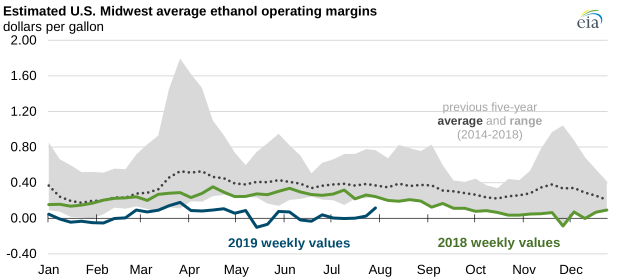
Check out this article while you there: August 8, 2019. Rising corn prices and oversupply push ethanol operating margins to multiyear lows.

Rising corn prices and oversupply push ethanol operating margins to multiyear lows - Today in Energy - U.S. Energy Information Administration (EIA)
main.svg


It's simple economics in the fact that there is more supply than demand for E10, E15 and E85 fuel. I'm going to take a wild guess that non blended gas is hugely popular where it is available and that is why Quick Trip, Casey's, Phillips 66 and many other chains carry it in multiple grades on all pumps. Again, this is just a crazy wild guess and personal opinion.
 
Last edited:
Here in Canada, most gas is 10% ethanol including Premium. Unless your going to get Shell Premium 91. Which is ethanol free. Haven't seen enough gas milage increase to spend the extra .30cents/litre to fill up using Shell 91.
 
I've got a Casey's just a few miles from the house and they have a pump that's all non-ethanol in 87, 90, 91...priced $2.44 - 2.97 today. I just filled up with the 91...pushed the button before I realized the 90 was $2.44! Anyway, I can't tell a difference but if it's available, I'll use it.
 
And another person who doesn't grasp the simple concept of science as it pertains to the combustion engine.

Less efficient engines will end up producing more emissions.
You must burn MORE fuel that is mixed with ethanol to get the same mileage as gas without it. Therefore you increase the amount of pollution over the life of the vehicle.
It's a simple concept.

Once again, for those who cannot grasp the fact that ethanol, especially corn based ethanol, is a net loser for transportation: If ethanol was a viable alternative fuel source that made actual sense, both from an environmental aspect, and a financial one, the federal government wouldn't have to mandate it's use. But because it's a complete net loser, it must be propped up by government mandate. It negatively affects the efficiency of vehicles,
increases pollution by requiring more fuel to do the same task, it artificially increases the price of corn, which in turn increases the price of products that we get from livestock (beef, chicken, pork, dairy, eggs).
The best source we currently could harvest to make ethanol is sugarcane, as it's not used in much agriculture, and it's not used to feed livestock.
But because it's a net energy loser, it still would require government subsidies, and it would still result in overall higher emission over the lifetime of vehicles burning ethanol blended gas dues to the loss of efficiency.
There is a reason that E-85, and flex fuel vehicles that can burn it, are not found everywhere.
Sorry you can't figure out why.

As for you lamenting about "Missing the days when we still respected science, intelligence and general competence", you seem to be missing all 3.

Hilarious you think you're making a scientific argument that starts and ends with Burn More = Bad, Burn Less = Good.

As several have pointed out, it's FAR more complicated than that. The actual CONTENTS of the emissions are the crux of the issue. While your theories about economics and lobbyists are certainly founded, your argument about ethanol mixed fuels being bad, period... is just wrong.
 
In modern EFI closed-loop engines, the air/fuel mixture is more precisely controlled, resulting in fewer circumstances under which the oxygenated fuels would provide any benefit. Thus, because of the lower energy density of the oxygenated fuel, the net result of its use over the lifetime of a modern engine is often simply greater emissions of CO2, as one poster keeps emphatically pointing out. The confusion arises in conflating CO2 with actual pollutants such as CO and HC.

You make an interesting point about AFR of modern engines, and in steady-state, you are correct. However, forced induction engines (which have become incredibly popular to meet EPA emissions guidelines), become extremely rich in the moments just off-throttle. Which, if not for ethanol content in modern fuels and catalytic converters, would result in horrendous emissions. As it is, we know that small turbo-charged engines are in many cases worse polluters because of this, yet they pass the EPA tests because the testing includes lots of steady-state operation.
 
Hilarious you think you're making a scientific argument that starts and ends with Burn More = Bad, Burn Less = Good.

As several have pointed out, it's FAR more complicated than that. The actual CONTENTS of the emissions are the crux of the issue. While your theories about economics and lobbyists are certainly founded, your argument about ethanol mixed fuels being bad, period... is just wrong.


LOL!! Yea, burns more = more emissions long term.

My 4Runner is lucky to get 19.8 running e10 87 on stock dunlop HTs. Running e10 93 with an ethanol removing enzyme I get about 20.6 Running non-ethanol 93, I got 21.2 with 265 GY Duratracks. Probably would be over 21.5 with the Dunlop HTs, which is almost 2 MPG, which is 40 more miles per tank than the crap gas. 40 miles every fill up of 'lower' emissions is still MORE emissions, and it only grows exponentially from there.
You cannot change the FACT that using more fuel=more pollution. yes, the contents will be somewhat different, but the overall amount of pollution will be increased, including the contaminates that ethanol reduces, which means that you will cause more pollution running ethanol blends.
You still cannot refute the fact that if ethanol was actually a good thing, it wouldn't require a federal mandate to be put into gas.

And as I said earlier, if the end goal is JUST pollution reduction, why are you driving a vehicle like a 4Runner? There are other vehicles in the midsized SUV class that get better mileage, and larger ones that get BETTER gas mileage (GM with cylinder deactivation for instance).

And methanol burns cleaner than ethanol, but I don't see you spouting off about it. And I'm not advocating it's use either.

And yes. running ethanol blended gas IS bad for the internal combustion engine. The fuel systems don't last as long running ethanol. There is more water introduced into the fuel system because ethanol attracts water, which further reduces fuel system longevity, and can damage your engine.

The list of reasons, including the minor pollution gains in the short run, to use ethanol are far outweighed by the negatives.
 
Last edited:
Third tank of 87 E-free 17.8 MPG all city driving compared to 16.7 MPG on 87 Regular (with E). I'd say it's pretty good for 2013 running 33 inch tires with added weight of steel skid plates and heavy rock sliders. Funny thing is that it doesn't matter to me it is just a parameter I can measure. What matters the most is the way this truck drives now: that under powered feeling we all got driving off dealers lot-gone, passing on the highway-engine doesn't rev up to 5K RPM without notable increase in velocity but just smoothly picks up and accelerate at lower RPM (about 3.5K), cruising in traffic is just above idle while need to pass achieved by little gas input. What I'm saying is that you got immediate response where there wasn't with regular E-10 before. Non believers can call it placebo effect or whatever but the difference is notable and it is not subtle. Try it if you have access to Non-E and you will not ever want to burn corn again. Let them eat it:

happycows-herobg-new.jpg
 
A 10% gain in fuel efficiency over E10 is impressive but unlikely. 2-3% would be more believable.
I agree that corn ethanol is a debacle and has done little to reduce pollution over alternatives. . If you want to avoid ethanol for that reason fine but don’t fool yourself that it’s not costing you.
 

Members online

Forum statistics

Threads
278,315
Messages
3,554,102
Members
248,016
Latest member
Advally Service

Trending content

Back
Top