gas smell under hood -- fixed itself?

222222miles

New member
1997 4runner, 330,000 miles.

I got a strong gas smell under the hood and through the air vents. Had it towed to the garage; they confirmed the smell. When they got around to checking it a couple days later, they couldn]t replicate the problem, even after running the engine for over 30 minutes.

Has anybody had that experience? Where to look?

Thanks,
222,222miles
 
Register to hide this ad
Also check the fuel pressure regulator. Pull the vacuum line and see if gas spills out or the line even smells like gas.
 
I can't say I heard of a leak fixing itself. Keep an eye on it. It will most likely present itself again.

Unless, you were parked next to vehicle that was leaking gas and the fumes just went into your engine compartment. That's about the only scenario that I can think of to have gas fumes go away.

Sent from my SM-J337V using Tapatalk
 
Gen 2, 3VZ-E T4R raw gas odor

I've had a similar experience with the 3VZ-E engine in my '92 T4R.

Strong gas odor seemingly coming from the passenger side of the motor.

When it first happened, looked around and decided the "pressure damper" on the passenger side fuel rail was the culprit. Unfortunately, the upper half of the air intake manifold completely covers the passenger side fuel rail. I had the local Toyota dealer replace the fuel damper for $400. Unfortunately, this did not fix the problem.

The T4R is spare car, so mostly stopped driving it for a while. Then started driving it frequently over the summer. No fuel odor. About two weeks ago we got a few cold days, and guess what... the odor returned.

I'm pretty sure the odor is related to low temperature. I've also noticed I'll smell it when I first get in the car, and then it goes away once its thoroughly warmed up.

I've been investigating this and here are some things I've learned.

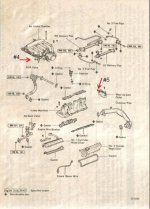
See the attached diagram (ignore the numbers and arrows) of the top of the engine. The fuel pump is located in the gas tank. It maintains a pressure of around 50-60 psi in the fuel system. This pressurized fuel system is quite complicated with 20-30 joints.

Each side of the engine has a fuel rail that feeds the injectors. The top end of the injectors inserts into the fuel rail. The bottom end of the injectors squirt into the intake manifold.

One symptom of a leaky fuel system, is hard starting. If fuel leaks out of the fuel system, it takes a while for the fuel pump to build up pressure. I have not noticed this symptom on my T4R.

For my T4R, my best guess is there is a cold temperature induced leak at one of the fuel rail to injector joints. I think these joints are made with O-Rings. The fuel rail is bolted down. I think there is some downward pressure on the injectors to make this joint seal. I think its the only place in the system where a joint is dependent on an element with some significant length. A joint consisting of an element with some length is most likely to exhibit a thermal effect.

My plan of attack is to try some thermal excursions and see if I can "lightswitch" the fuel odor. If I can cause the odor on demand, then I'll do it a few times and look for evidence of fuel around the parts of the system I can see. I don't expect to see puddles of fuel under the car. Best case is I find evidence of a fuel leak on the drivers side and fix it. Worst case is I have to assume its on the passenger side under the top part of the intake manifold. Which means I have to take the manifold off without knowing for sure if that's where the leak is.

I'm generally nervous about blindly removing and reinstalling the injector rail. It would be easy to start with one leak and end up with three. Also, on the web, there are some stories about guys breaking the injector electrical connectors. You really don't want to do that because its nearly impossible to repair.

Maybe this information will help you. Good luck.

 

Attachments

  • 3vzewaterby-passhose5.jpg
    3vzewaterby-passhose5.jpg
    96.6 KB · Views: 1,455
I'm pretty sure the odor is related to low temperature. I've also noticed I'll smell it when I first get in the car, and then it goes away once its thoroughly warmed up.
This is what I was going to suggest. The early WRX's had a recall for this issue - a slightly under-torqued fuel line fitting would leak when cold (like, below freezing cold) but not under most other circumstances.

Has any work been done recently to the vehicle?

-Charlie
 
Gas smell

Thanks everybody for all the replies! I like the cold weather explanation, as we had a couple frosty mornings when it happened. No problems since then; low temperatures have been in the 40s this week. I will pay attention when the morning temperatures dip down again and see -- or smell -- if the problem shows up again.
 
I have the same exact problem . when its cold outside i leak gas for about 15 min untill i reach operating temps. I finally was able to see it as it would drip down the steering rack. And its def coming from the fpr or the injectors on the driver side rear.
Im going to replace the o rings on the driver side injectors and on the fpr and hopefully it goes away
Will keep this thread updated
 
Yes, the smell came back last night at ±32°F temperature; I noticed it when stopped at a traffic light after a 2.4 mile drive. After the rest of the trip, uninterrupted 4.4 miles, there was only a residual smell under the hood, no fresh gas fumes.
 
What I find interesting is that this only happens to you guys when it's cold below freezing. See I would think that once it starts leaking, it would leak until fixed.


The fuel pressure would be fairly constant in pressure.

I be watching to see the solution as this on to me just seems odd.


Sent from my SM-J337V using Tapatalk
 
Would it make sense to turn the ignition on [without starting the engine] to see if the tank pressure pressure alone creates the leak?
 
Would it make sense to turn the ignition on [without starting the engine] to see if the tank pressure pressure alone creates the leak?
Sure. I am also curious what your fuel pressure is at the rail.

You could energize the fuel pump separately as the connector is under a plate in your rear passenger seat for testing too. :)

Sent from my SM-J337V using Tapatalk
 
For all that's battling a fuel leaking problem, for now at least, carry a good size fire extinguisher in your rig. If the worst happens you can have at least a fighting chance to save it.
 
For all that's battling a fuel leaking problem, for now at least, carry a good size fire extinguisher in your rig. If the worst happens you can have at least a fighting chance to save it.
Very good point HiLife. Very cheap way to save your 3rd gen. :)

Sent from my SM-J337V using Tapatalk
 
I had a similar issue, but when it was hot. After lots of investigating, never finding a leak (even using the UV dye),a buddy suggested that I replace the fuel cap: problem solved!

This was after paying a shop to look for the source! I was pretty sure that the smell was coming from the charcoal evap unit, so that was a clue. Never a single obdII code either.

Hope this helps someone some day.
 
I had a similar issue, but when it was hot. After lots of investigating, never finding a leak (even using the UV dye),a buddy suggested that I replace the fuel cap: problem solved!


This was after paying a shop to look for the source! I was pretty sure that the smell was coming from the charcoal evap unit, so that was a clue. Never a single obdII code either.


Hope this helps someone some day.
Very possible the gas cap isnt sealing. I am just surprised it wouldn't throw an evap code if the cap is bad.

Sent from my SM-J337V using Tapatalk
 
I am also wondering what years these rigs are? I could see the older federal evap systems not having too much in the way of codes on the evap.

The later ones have that evap box by the spare tire. I could see the later ones throwing the evap code were the older ones probably dont have much there as they are so much a simpler system.

Sent from my SM-J337V using Tapatalk
 
I always listen for the hissing when the tank is about empty. That's a dead giveaway of an evap issue if you dont have it.

Sent from my SM-J337V using Tapatalk
 
Also, if your rigs live in the rust belt. I be checking your lines in the evap system and that charcoal canister in the front driver side. Lots of rubber lines and steel lines there that can be cracked or rotted. :(

Sent from my SM-J337V using Tapatalk
 

Members online

Forum statistics

Threads
278,312
Messages
3,554,089
Members
248,016
Latest member
Advally Service

Trending content

Back
Top