Gen 4, V-8/4.7 liter issues?

jrose

New member
Hey, I've owned three generations of 4Runners, an '89, a '95 and a '98. The first one may have been the best vehicle I've ever owned, the 2nd Gen was a real dog, power-wise, though still dependable, and the '98 rivals the '89 in my heart.

But I'm beginning to think about a 4th generation. Typically, I buy them used, with less than 100K miles, drive them into the mid-200s, begin to get tired of the color or whatever, and move on.

So I'm approaching 230K on my '98 and I'm beginning to have a few problems that I'd rather not mess with, and I can feel the itch for change coming on.

95% of my miles are as a daily driver; however, I use it essentially as a truck, hauling around lumber and tools, and I do have a little cabin in the mountains of east Tennessee that's off-road, and requires 4WD, as well as a couple of creek crossings, and often involves pulling around a utility trailer, so we're not talking about a 20 mile commute to the mall.

And then, there's my wife's cabin in northern Michigan which involves several 1500 mile round trips, each year, often pulling a U-haul.

So in looking around, it seems there's a disproportionate number of Gen 4 V-8s for sale.

Is that because there are more on the road (vs. the 4.0-liter) than I'd expect, or because of the price of a gallon of gas? Or something else?

As for the mileage issue, given an average of 16 mpg for the V-8 and 18 mpg for the V-6, it looks like you'd be spending an additional $300-500/year on gas. But if you can buy the vehicle for less, to start with, then it all evens out. Sort of.

So have the 4.7-liter engines proven to be reliable or are there known issues? Anything else I'm missing or should be wary of?

Any features that I should look for?

Or as it sounds like the torque/horsepower differences would be a toss-up for my use, should I just stick with the 4.0-liter engine?

Sorry if this has already been gone over a hundred times, but I did do a search, and didn't really find my answer. So if I missed something, please direct me there.

Thanks,

Jack
 
Register to hide this ad
I had a 1990 3.0 slow 4runner and you're right the power terrible but very reliable. I now have a 2005 limited v8 4x4 and i love it it has tons of power I've been averaging 18 mpg mixed driving. I have 107k on the clock right now. But I've been reading through the tundra forums and they have 4.7l reach 400k+, and 200k on the original timing belt. so to answer your question the 4.7 is very reliable juts change the oil and timing belt when needed and you shouldnt have any problems. The v8 4runner is full time AWD , if its a 4x4, so its safer in the ice and rain
 
Known T4R 4.7 issues are pretty few. Here is a list that anyone who wishes can add to. Keep in mind I own 2 and have about 330k miles on the clock between the two.

-Exhaust manifold flange crack causing ticking noise
-Heat shield on cat converter cracking and making a rattle noise.
-Early model 4th gen have bad plastic in the dash and can crack badly.
-Full time 4x4 on V8 leads to premature t-case actuator leak (common on all 4th gens)

The v8 is a strong and as always reliable rig. When gas prices are up people must trade out of them, I picked up my limited V8 when gas was over 4 bucks a gallon a few years ago, it had 90k on it and I paid 11. I would think that the influx of v8 4th gens on the market is due in part to fuel prices.
 
I think the reason you're seeing a larger number of the V8 4Runners popping up is for a multitude of social, economic, and cultural reasons rather than anything being wrong with the vehicles themselves. Between the Economy, fuel prices, the majority of Americans believing newer is always better, and the hard to let go beliefs that most cars don't last after 100k (For Toyota, that seems to be the break-in period lol!)

The 4.7L 2UZ-FE engine is a strong dependable workhorse, designed for low end torque and truck use in mind. Our 4th gens use the 4.7L manufactured in Japan that also goes in the Land Cruisers/LX470, this engine is slightly better than the American made 4.7L that goes in the Tundras due to a slightly different manufactuering process of the connection rods. (They have a tendancy to break under mild boost from what I've seen in our dealership and on the Tundra Forums from owners who ran the TRD SC kit.)

One of the main concerns on the 4.7L are the timing belt;recommended by Toyota to be replaced every 90k, (I personally would say 120k is about the max I would feel comfortable letting it sit, though it has been mentioned by other members that 200k has been achieved.) the timing belt is the #1 service item that if not addressed properly will cause engine damage if the belt snaps because of the interference design of the engine. Another issue is that usually after about 100k the water pumps start seeping, (Why a lot of times its recommended they be replaced with the timing belt.) As for valve adjustments, barring unusual circumstances, most of the time by around 150k the shims are still within specification, so I wouldn't worry unless you start hearing valvetrain ticking. (Not to be confused with exhuast tick caused by a cracked exhaust manifold which is not common, but not rare for these Engines.)

I personally own a 2004 Sport Edition V8 4WD with a lift, SW bumper, 33's, and so on; I drive my truck hard and take it on trails and its got close to 100k on it with no engine issues. The 4.7L is a great engine and is for the most part as reliable as the 4.0L 1GR-FE and most other Toyota engines.
 
Last edited:
Think about the extra you pay on gas as one beer per week. If you are driving it everyday would you want to pay a few more dollars for comfort?

I originally was going to go for the V6 for the slightly improved gas mileage. After I test drove both it was a no brainer for me to pay for a little extra fuel and have the extra HP with the quieter ride. Going up hills with cruise control on is a breeze and effortless.

The 4Runner is our comfort vehicle. We have a 2 door Cobalt in the drive way if we ever wanted to save on fuel. Guess which car we jump in to 99% of the time when we have to go out somewhere :)
 
I just bought my 2006 V8 about a month ago with 109,500 miles and did not hesitate or think twice because of the mileage (Even with the lack of maintenance records). I looked at it, drove it, listened to it (all while mentally comparing it to the 2003 V8 I owned before it) and I didn't think there was anything wrong with it. I had it looked over by my local trusted Toyota dealer and everything but minor things checked out (minor things meaning bulbs). First thing I did when I bought the truck was get the timing belt and water pump changed, along with all the internals in that part of the engine. This truck runs like new, has plenty of power, and considering it is a V8 4x4, I can't complain about the gas mileage.
 
To expand on these points:

-Exhaust manifold flange crack causing ticking noise.

It should be pointed out that the difficult direct observation of this causes some diagnostic uncertainty, and there have been other (harmless) causes cited for ticking sounds (fuel line pulsing). In any event, it throws no codes and doesn't affect performance. It is not easily heard in normal driving and is classifiable as a potential annoyance only.

-Heat shield on cat converter cracking and making a rattle noise.

I haven't heard of this (cracking). When mine has made noise, it was simply because it was loose as were the many others I've read about.

-Full time 4x4 on V8 leads to premature t-case actuator leak (common on all 4th gens)

The full-time 4wd (V8) seems to have nothing to do with transfer case leaks. Consensus is that lack of exercise of the actuator motors is the main culprit. Since exercising them is easier in the V8, it could be argued that V8s, as a group, are less susceptible to leaks.
 
To expand on these points:

-Full time 4x4 on V8 leads to premature t-case actuator leak (common on all 4th gens)

The full-time 4wd (V8) seems to have nothing to do with transfer case leaks. Consensus is that lack of exercise of the actuator motors is the main culprit. Since exercising them is easier in the V8, it could be argued that V8s, as a group, are less susceptible to leaks.

has toyota resolved this? if so, which year? I have a 2006, no sure if this is something i should worry about.
 
has toyota resolved this? if so, which year? I have a 2006, no sure if this is something i should worry about.

I don't think its as much a design issue as a lack of proper owner care. The owner's manual states to occasionally use the 4WD system to prevent that type of thing from happening... But many owners do not do that or even know about that and so the issue tends to persist.
 
Thanks

Hey, this is all great, exactly the kind of thing I had hoped to hear. And don't you love it when you can tell your wife that the best advice supports what you wanted to do to start with?

So I'm guessing that I'll end up buying the one with the lowest price and the lowest miles, regardless of the engine, but this sets my mind at ease over the V-8 being an engine I've had no experience with. And I do like the sound of a quieter ride on those 1500 mile interstate trips.

So anything else I should be wary of? Or any options I should look for?

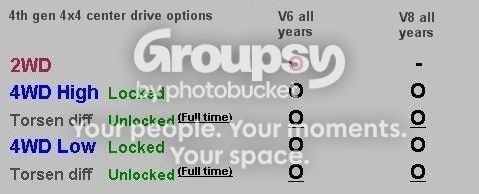
And I'm not sure I understand the AWD thing. So its default mode is AWD unless you switch it to 2WD? Is there an option for locking the rear differential? I'm sure that's been answered, elsewhere, so I'll do a search.

Thanks again,

Jack
 
I don't think its as much a design issue as a lack of proper owner care. The owner's manual states to occasionally use the 4WD system to prevent that type of thing from happening... But many owners do not do that or even know about that and so the issue tends to persist.

I bought it used. The previous owner stated that he only used 4Lo once to get out of deep snow.
If occasional use can reduce this type of thing from happening, how often should it be used? Once a week?
 
I bought it used. The previous owner stated that he only used 4Lo once to get out of deep snow.
If occasional use can reduce this type of thing from happening, how often should it be used? Once a week?

At least once a month. You can't really over use them and if they haven't been used much I would engage them frequently for a while.

It's real easy on the V8. Anytime you think of it and you're on a straight stretch of road, you can hit the center diff lock button. Should be just 1 or 2 seconds ON and even less for OFF. If it seems to be slow, you can feather the gas pedal to help it along. For low range, since you're already in 4wd in the V8, anytime you think of it when idling in a parking lot or something, you can put it in neutral and turn the switch (if starting up, I'd let the rpms get under 1k first).
 
And I'm not sure I understand the AWD thing. So its default mode is AWD unless you switch it to 2WD? Is there an option for locking the rear differential?

No locking rear except the 2009 TE.

Here's a chart that might help.

4Runnercenterdrivetrains4thgenfinal.jpg~original
 
At least once a month. You can't really over use them and if they haven't been used much I would engage them frequently for a while.

It's real easy on the V8. Anytime you think of it and you're on a straight stretch of road, you can hit the center diff lock button. Should be just 1 or 2 seconds ON and even less for OFF. If it seems to be slow, you can feather the gas pedal to help it along. For low range, since you're already in 4wd in the V8, anytime you think of it when idling in a parking lot or something, you can put it in neutral and turn the switch (if starting up, I'd let the rpms get under 1k first).

thx! JB.
definitely gonna do this, dont wanna lose it.
 
Hey thanks all. I'm on the search. But then, as my '98 still has another 100K or so, I have the luxury of time, just depends on how quickly I tire of the color, which is why we all love our 4Runners.

Jack
 
Hey, this is all great, exactly the kind of thing I had hoped to hear. And don't you love it when you can tell your wife that the best advice supports what you wanted to do to start with?

So I'm guessing that I'll end up buying the one with the lowest price and the lowest miles, regardless of the engine, but this sets my mind at ease over the V-8 being an engine I've had no experience with. And I do like the sound of a quieter ride on those 1500 mile interstate trips.

So anything else I should be wary of? Or any options I should look for?

And I'm not sure I understand the AWD thing. So its default mode is AWD unless you switch it to 2WD? Is there an option for locking the rear differential? I'm sure that's been answered, elsewhere, so I'll do a search.

Thanks again,

Jack

For some reason the 4WD V8 equipped 4Runners do not have the option to go into 2WD (there is no real mechanical difference in the transfer case between V6 & V8 so why they didn't just use 2WD I'm not sure.) But you won't miss it, it drives like an AWD vehicle, all 4 wheels provide power and you can run the truck up to max speed if you want (Toyota's Modern 4WD systems have no problem if you leave them in 4Hi and just drive around like that.) You also have the option of putting the vehicle into 4Lo, and if you're really stuck, there is the Center Differential Lock button that locks the central Torsen differential to provide 50/50 power to front and rear axle regardless of slippage, ect.

I bought it used. The previous owner stated that he only used 4Lo once to get out of deep snow.
If occasional use can reduce this type of thing from happening, how often should it be used? Once a week?

Once a month is about the best idea, just toss it in all the ranges (4HI, 4LO, and 4LO w/ Diff Lock) as was stated, just find a straight piece of street or dirt and drive about a couple hundred feet with the center diff lock on to exercise it. (Don't turn if you can avoid it with the central lock on as it does cause stress to the system.)

The lack of use causes the actuators to become sticky, unlubricated, and this probably allows the seals to shrink or dry out and start seeping.
 
Ticking noise

Can you tell the difference between hearing a valvetrain ticking and exhuast tick caused by a cracked exhaust manifold?

I think the reason you're seeing a larger number of the V8 4Runners popping up is for a multitude of social, economic, and cultural reasons rather than anything being wrong with the vehicles themselves. Between the Economy, fuel prices, the majority of Americans believing newer is always better, and the hard to let go beliefs that most cars don't last after 100k (For Toyota, that seems to be the break-in period lol!)

The 4.7L 2UZ-FE engine is a strong dependable workhorse, designed for low end torque and truck use in mind. Our 4th gens use the 4.7L manufactured in Japan that also goes in the Land Cruisers/LX470, this engine is slightly better than the American made 4.7L that goes in the Tundras due to a slightly different manufactuering process of the connection rods. (They have a tendancy to break under mild boost from what I've seen in our dealership and on the Tundra Forums from owners who ran the TRD SC kit.)

One of the main concerns on the 4.7L are the timing belt;recommended by Toyota to be replaced every 90k, (I personally would say 120k is about the max I would feel comfortable letting it sit, though it has been mentioned by other members that 200k has been achieved.) the timing belt is the #1 service item that if not addressed properly will cause engine damage if the belt snaps because of the interference design of the engine. Another issue is that usually after about 100k the water pumps start seeping, (Why a lot of times its recommended they be replaced with the timing belt.) As for valve adjustments, barring unusual circumstances, most of the time by around 150k the shims are still within specification, so I wouldn't worry unless you start hearing valvetrain ticking. (Not to be confused with exhuast tick caused by a cracked exhaust manifold which is not common, but not rare for these Engines.)

I personally own a 2004 Sport Edition V8 4WD with a lift, SW bumper, 33's, and so on; I drive my truck hard and take it on trails and its got close to 100k on it with no engine issues. The 4.7L is a great engine and is for the most part as reliable as the 4.0L 1GR-FE and most other Toyota engines.
 
You revived an old thread, but one way to try and tell the two apart is if the noise goes away once the car is hot. Usually the small cracks in the manifold will seal themselves up as the metal expands. Mine currently tick fairly loudly when I first drive the car, but if I drive somewhere for 10 minutes the noise is gone the next time I try to listen for it. Mine is easiest to hear under light load around 1000-1500 rpm....especially in a parking lot where the sound can bounce back off of other cars etc.
 
Can you tell the difference between hearing a valvetrain ticking and exhuast tick caused by a cracked exhaust manifold?

Of course. cracked manifold gives different noise than valves. If the crack is small noise goes away after couple minutes driving . If your manifold is really bad ypu will hear most annoying sound ever..Every time you accelerate you will notice thick thick thick :) if you going to fix that in a shop you will spend big $$$
I replaced mine using informations from this forum. Took me whole day but I'm not a mechanic.
 

Members online

Forum statistics

Threads
278,310
Messages
3,554,079
Members
248,016
Latest member
Advally Service

Trending content

Back
Top