Hardmounted Air Compressor - Which one? and Where?

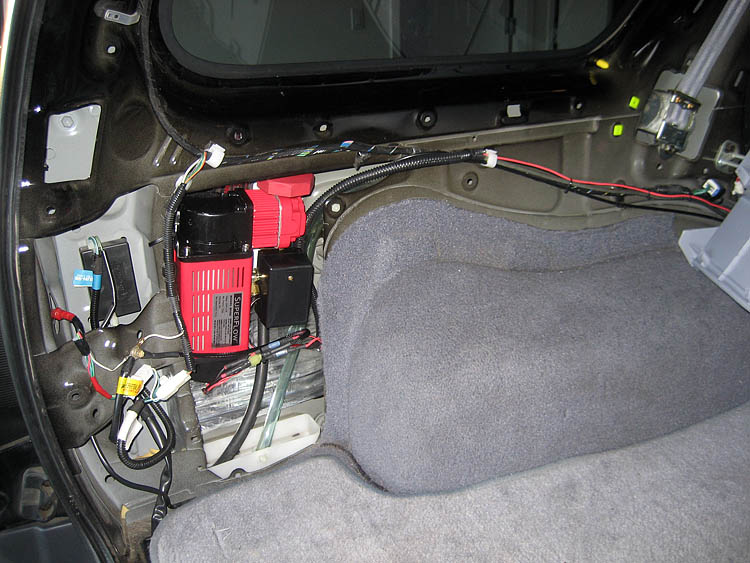
I mounted the compressor on some rubber isolators and have had no issue with rattling. When I first posted pictures of the setup quite a few people expressed concerns that it would overheat, but it's been there for 2+ years and has been used on many trips and I've had no issues.

- Matt

Awesome, it sounds like this is the way to go then.

I decided on the Viair 400H compressor and I will mount it similarly to the way Matt did, or maybe on the other side in the small storage compartment, I haven't exactly figured that out yet. But here is what I have in my Amazon shopping cart:
Viair 400H hardmount air compressor: Amazon.com: VIAIR 400H Hardmount Compressor: Automotive
Viair braided coil hose with 60PSI pressure gauge: Amazon.com: Viair 60 PSI gauge w/ braided coil hose: Automotive

I am planning on hardmounting it and running a switch to the dash like Matt did but I am relatively new to air compressors so my question is, do I need anything else? Do I need a pressure switch if I am not using a tank? Here is one I found that would work: Amazon.com: Viair 90111 Pressure Switch with Relay: Automotive

I honestly don't know what purpose a pressure switch serves so can someone edumicate me. Also, does anyone know if any fittings are included? If the fittings aren't included, can I find them at a local hardware store or will I have to order them from a specialty store?
 
I have a pressure switch, 120off, 90on. with no tank its take all of 3 seconds to turn off and fill up all my hose with 120psi. If there was no switch the compressor would eventually blow up due to being over max pressure.
 
how noisy is it inside like that?

It's definitely not quiet and I wouldn't want to leave it running for a long time, but for intermittent use it is not a problem.

Awesome, it sounds like this is the way to go then.

I decided on the Viair 400H compressor and I will mount it similarly to the way Matt did, or maybe on the other side in the small storage compartment, I haven't exactly figured that out yet. But here is what I have in my Amazon shopping cart:
Viair 400H hardmount air compressor: Amazon.com: VIAIR 400H Hardmount Compressor: Automotive
Viair braided coil hose with 60PSI pressure gauge: Amazon.com: Viair 60 PSI gauge w/ braided coil hose: Automotive

I am planning on hardmounting it and running a switch to the dash like Matt did but I am relatively new to air compressors so my question is, do I need anything else? Do I need a pressure switch if I am not using a tank? Here is one I found that would work: Amazon.com: Viair 90111 Pressure Switch with Relay: Automotive

I honestly don't know what purpose a pressure switch serves so can someone edumicate me. Also, does anyone know if any fittings are included? If the fittings aren't included, can I find them at a local hardware store or will I have to order them from a specialty store?

It's hard to tell what comes with the compressor, but based on what I can see for the 12v power you'll need enough 8 gauge (or larger) cable to reach from the battery to the compressor, a 40A fuse for that wire, a relay to switch power to the compressor, and a power switch. This assumes you want to hard mount the compressor similar to how I did. Alternatively you could just setup the fuse on the +12v line (as close to the battery as possible) and wire that into the switch on the compressor if it has one. To turn it on you would need access to the compressor.

You might need a pressure switch depending on how you use the compressor. If it has a built in power switch and you use a non-sealing air line then you can simply turn the compressor on and off to fill the tires. By non-sealing air line I mean one that will continue to flow air if you disconnect it from the tire. If your air line seals then the compressor will build up pressure in the air line and cause a dangerous situation. In that case you would need a pressure switch to turn off the compressor when it reaches a set PSI, usually around 110-150 psi. The pressure switch goes on the +12v wire and turns the compressor on and off at set pressure levels.

Check out Surplus Center - Hydraulics, Engines, Electrical and More for reasonable prices on pressure switches and fittings. You can also get air fittings (probably 1/4" NPT in your case) at local hardware stores like Home Depot or Lowes.

Pressurized air can be very dangerous, so I would recommend doing some reading to make sure you understand how compressors and pressure switches work before you buy anything. Feel free to post up your system ideas here and we can give you feedback.

- Matt
 
It's hard to tell what comes with the compressor, but based on what I can see for the 12v power you'll need enough 8 gauge (or larger) cable to reach from the battery to the compressor, a 40A fuse for that wire, a relay to switch power to the compressor, and a power switch. This assumes you want to hard mount the compressor similar to how I did. Alternatively you could just setup the fuse on the +12v line (as close to the battery as possible) and wire that into the switch on the compressor if it has one. To turn it on you would need access to the compressor.

You might need a pressure switch depending on how you use the compressor. If it has a built in power switch and you use a non-sealing air line then you can simply turn the compressor on and off to fill the tires. By non-sealing air line I mean one that will continue to flow air if you disconnect it from the tire. If your air line seals then the compressor will build up pressure in the air line and cause a dangerous situation. In that case you would need a pressure switch to turn off the compressor when it reaches a set PSI, usually around 110-150 psi. The pressure switch goes on the +12v wire and turns the compressor on and off at set pressure levels.

Check out Surplus Center - Hydraulics, Engines, Electrical and More for reasonable prices on pressure switches and fittings. You can also get air fittings (probably 1/4" NPT in your case) at local hardware stores like Home Depot or Lowes.

Pressurized air can be very dangerous, so I would recommend doing some reading to make sure you understand how compressors and pressure switches work before you buy anything. Feel free to post up your system ideas here and we can give you feedback.

- Matt

Thanks for all your help Matt! You are really helping me piece everything together and I really appreciate it.

So I did some more research as was able to find a list of parts that are included with the compressor:
- Installation instructions
- Mounting hardware (nuts, bolts, locking washers)
- Vibration isolators
- Remote mount air filter assembly
- Two replacement air filter elements
- Air line for remote mount air filter installation
- Stainless steel braided leader hose
- Check valve
- 1/4" quick connect stud

I will still need some wire and fittings, but it looks like most of the necessary parts are included so that is a definite plus.

I was also able to find that the 400H does have a built in power switch and is simply wired with a 12V+ wire (with inline fuse) that goes to the battery and a ground wire. However, the problem is that I still want to mount the compressor out of sight and use a Contura II switch that is mounted by the dash to control the ON/OFF function. I am also planning on running a sealed air hose and will need a pressure switch. The good news is that Viair actually sells a relay with a built in pressure switch which is really cool!
VIAIR Corporation - Pressure Switch with Relay

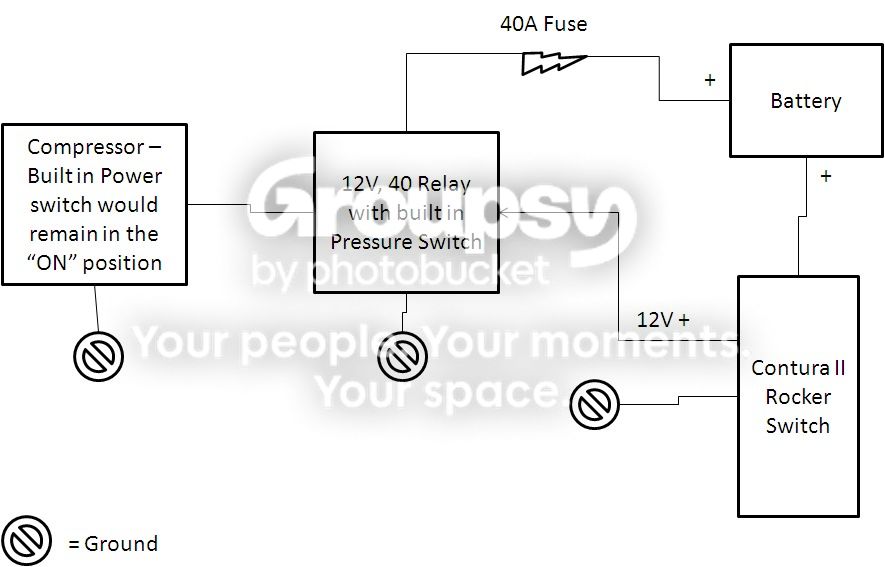
So after looking at some of Viairs wiring diagrams, here is what I came up with. Keep in mind that this is just an electrical wiring diagram:
CompressorWiringDiagram.jpg~original
.

So my question is, will this setup work?

I also found a similar model, the 400C, that does not have a built in power switch and as far as I can tell, that is the only difference between the two models. Viair's website does say that the 400C is designed to fill a tank for an OBA system, while the 400H is designed to fill tires. But, is there really a difference or do you think I can use the 400C to fill my tires?

Ultimately, I think the 400C would be a better setup because it is a little smaller and it doesn't have the built in power switch which leaves me the option to use my own. I would wire it up the exact same way that is pictured above. The only problem is that I don't know if it will work for just inflating tires so any help/thoughts are appreciated.

For reference, here are links to the two different models:
400H - VIAIR Corporation - 400H Part No. 40042
400C - VIAIR Corporation - 400C Part No. 40040
 
No problem, glad to be of help.

As far as I can tell the 400H and 400C are the same compressor with just slightly different accessories such as the switch. My assumption is that they say the 400H is for filling tires simply because it has an on-off switch so you can control the pressure.

Overall your wiring diagram looks fine, but you should add a fuse on the +12v lead going into the switch. In general every accessory wire coming off the positive terminal of your battery should go through a fuse as close to the battery as possible. If you want to save a fuse you could simply get the +12v for the switch after the 40A fuse you already have shown in the +12v high-current wire going to the relay.

Another good rule of thumb for automotive wiring, especially in offroad vehicles, is to make sure all of your connections are properly crimped, your wires are all protected in wiring loom, and everything is firmly held in place and not able to flop around. If a wire is loose and/or unprotected the vibrations in the truck can eventually wear through the insulation and cause a short, in theory your fuse should prevent this from starting a fire but better safe than sorry.

- Matt
 
Last edited:
That's what I was thinking too.

Yeah I will definitely have a fuse on the wire leading into the switch. Actually, I will probably just end up tapping into an existing 12+ power wire that powers my fog lights that already has an inline fuse.

I have a decent amount of experience with automotive wiring and have installed my lighting and other powered components myself and I always make sure that everything is covered with wire conduit and is properly secured.

I just have one more question: Since the 12+ wire that runs from the Contura II switch to the relay does not have to carry any heavy loads, I should be okay using a smaller 14 or 16 gauge wire right?
 
I keep reading that CO2 tanks are the cheapest, quickest way to re-air after wheeling. I am sure someone has the link to that one Jeep article.

heres a great compairison: Tire Inflator Comparison

Oh BTW, Ive had the cheap MV50, an Oasis, the ExtremeAire, a 20# CO2, and now running the ARB..
The CO2 is by far the fastest.
 
Last edited:
I just have one more question: Since the 12+ wire that runs from the Contura II switch to the relay does not have to carry any heavy loads, I should be okay using a smaller 14 or 16 gauge wire right?

Yup, I think you'd be fine with a 14 or 16 gauge wire since it's just driving the relay's coil.

- Matt
 
how noisy is it inside like that?

I mounted my Viair 450c above the wheel well behind the trim panel on the right and it is actually alot quieter than I thought it was going to be ... had it running a few times while I was driving and with the radio on medium it really wasnt that noticeable probably about as loud as a blender running ... but mine is bolted down so it cant rattle so that probably takes most of the noise out of it

... OP did you get yours mounted yet? you may have said this before and I just missed it but what are you going to do about the airline fitting?

 
heres a great compairison: Tire Inflator Comparison

Oh BTW, Ive had the cheap MV50, an Oasis, the ExtremeAire, a 20# CO2, and now running the ARB..
The CO2 is by far the fastest.

Thanks for the info! That article/writeup just confirmed my choice to go with the Viair.

I know some guys running CO2 and they swear by it, but I am going to go with a compressor for a couple of reasons:
1) I just can't justify the initial cost of a CO2 setup
2) I don't like the fact that I could possibly run out of CO2 and not be able to fill my tire(s)
3) CO2 bottles are really heavy and take up much more space than a compressor
4) I like the fact that I can mount the compressor behind on of the trim panels so I don't lose any cargo space.

I know the main advantage of CO2 is that it is much faster, but in the long run, I think a compressor is best for my application.

Yup, I think you'd be fine with a 14 or 16 gauge wire since it's just driving the relay's coil.

- Matt

Sounds good! Thanks!

I mounted my Viair 450c above the wheel well behind the trim panel on the right and it is actually alot quieter than I thought it was going to be ... had it running a few times while I was driving and with the radio on medium it really wasnt that noticeable probably about as loud as a blender running ... but mine is bolted down so it cant rattle so that probably takes most of the noise out of it

... OP did you get yours mounted yet? you may have said this before and I just missed it but what are you going to do about the airline fitting?

That is good to know. Do you have any pics of how/where you mounted yours?

I haven't gotten mine mounted; I actually haven't even ordered anything yet. I wanted to make sure that the setup I am thinking about will work and I wanted to wait until I know exactly what I need before I ordered. I will probably place my order in the next couple days.

Sorry but what do you mean by airline fitting?

If you are asking how I will route the compressor hose to the exterior of the truck: it will depend on which side I end up mounting the compressor on. That is actually part of the reason that I am interested to see what you did with yours. I actually may end up using an existing hole that I already drilled for my CB radio coax to run the hose to the exterior of the truck by the bumper.
IMG_0458.jpg~original


I may have to enlarge the hole a little bit and I will definitely have to get a rubber grommet, but right now I think this is the best location. Matt, do you have any more detailed pictures of how you ran your hose to the exterior? Also, what type and size of hose did you use?
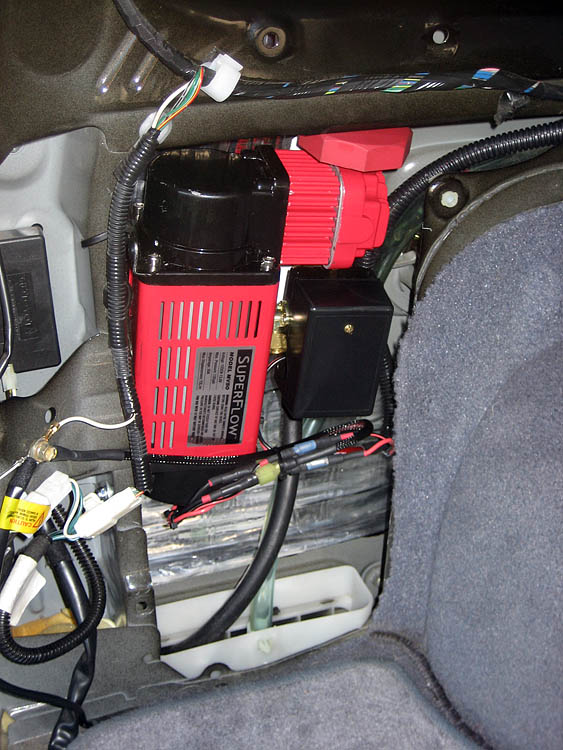
 
Matt,is that the trailer converter module to the left of the compressor (next to the taillight)? Do you recall how thick some of the wiring is? The converter is powered by a dedicated 25 amp circuit,I wouldn't use it to power the compressor but I may utilize it to power an auxiliary HID reverse light that draws 10 amps at most.

Unfortunately I don't remember off hand how large the wiring was or what specifically the other wiring there was, I just found a place for my ground connection and didn't look too closely.

Matt, do you have any more detailed pictures of how you ran your hose to the exterior? Also, what type and size of hose did you use?

The cabin vent is on the drivers side so I just ran my air line out of the vent. The air line is just standard 1/4" line for Harbor Freight. Here's a picture of the vent and the air line.

IMG_2441.jpg


The vent exits into the rear bumper cover.
IMG_2410.jpg


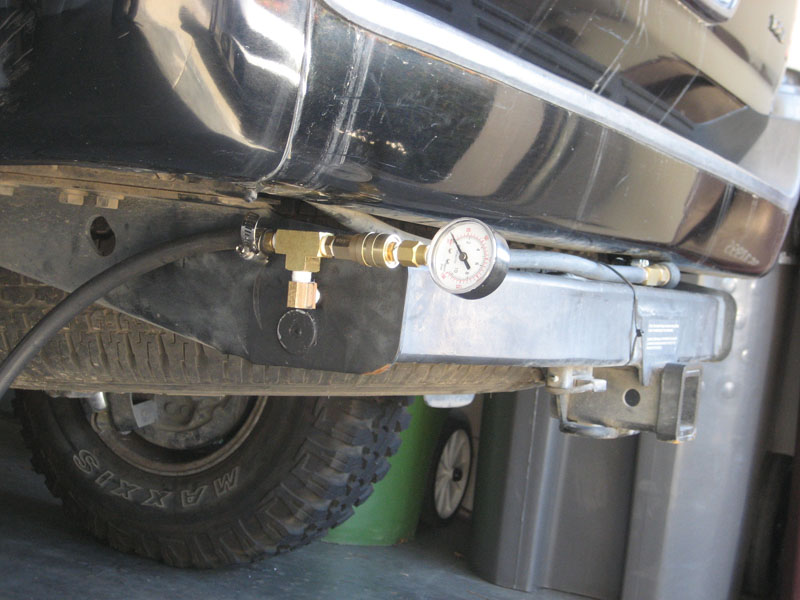
One thing I didn't include in my writeup is that I've since converted my rear tow hitch into a ~1 gallon air tank. Here's a picture of when I was pressure testing the system.
IMG_2859.jpg


- Matt
 
Thats a similar idea to what I have for an air tank, but I plan on using some 4' lengths of 1"-2" pipe with capped and sealed ends. With mounting hardware and all, should be able to do the entire set up for under 125$.
 
The cabin vent is on the drivers side so I just ran my air line out of the vent. The air line is just standard 1/4" line for Harbor Freight. Here's a picture of the vent and the air line.

IMG_2441.jpg


The vent exits into the rear bumper cover.
IMG_2410.jpg


One thing I didn't include in my writeup is that I've since converted my rear tow hitch into a ~1 gallon air tank. Here's a picture of when I was pressure testing the system.
IMG_2859.jpg


- Matt

Sweet idea with just running it down the existing vent. I may have to steal that idea too...in addition to all the other million ideas I am going to steal from you that is haha.

That is pretty cool that you can use your tow hitch as a makeshift air tank. That is one idea I can't steal from you because I have a round one that is open on either end.
 
Thanks for the writeup slomatt! I think I'm going to copy your whole setup except maybe plumb in a bigger tank where the spare goes (once I make a tire-carrier, that is). I'm buying that compressor right now :)
 
Just a question for those running with this mounting location any over heating at all? on a scale of 1 to 10, 10 being as loud as the engine 1 being silent, how would you rate the noise level inside the cab?
 
Just a question for those running with this mounting location any over heating at all? on a scale of 1 to 10, 10 being as loud as the engine 1 being silent, how would you rate the noise level inside the cab?

I have the ARB compressor mounted in the engine bay and it is far louder that the engine itself. I hook my airline directly to the compressor when inflating tires, so my hood is open, and there's air moving in there from the fans. I'm not worried about overheating at all.

Another thing to consider is that if you're using the compressor for air lockers and have it mounted inside the cabin is that oil sprays from the solenoids when you disengage the locker. I'd rather have that in the engine bay than inside the cabin. The next step is to run exhaust lines from the solenoids themselves, but thats more work than I see necessary.
 
I have the ARB compressor mounted in the engine bay and it is far louder that the engine itself. I hook my airline directly to the compressor when inflating tires, so my hood is open, and there's air moving in there from the fans. I'm not worried about overheating at all.

Another thing to consider is that if you're using the compressor for air lockers and have it mounted inside the cabin is that oil sprays from the solenoids when you disengage the locker. I'd rather have that in the engine bay than inside the cabin. The next step is to run exhaust lines from the solenoids themselves, but thats more work than I see necessary.

Each solenoid for the lockers has a breather/filter, also My TJM rear locker has a solenoid actuator setup that prevents oil entering the air lines, the front however is the ARB locker I can't speak for it to know how it will turn out. I wouldnt think there should be oil getting into the air lines I would believe that would not allow your locker to engage properly?

My situation is I've purchased the massive ARB twin compressor and its size certainly limits its mounting locations. I'd like to have it in the engine bay but the only location is where I'd like to mount a dual battery(behind the air box in between it and the fire wall, I'd rather not have in under the truck as i do enjoy a water crossing from time to time. the cargo area seems safest for it but I'd rather not hear it lol, I'm deciding on weather or not to have my cake or eat it haha cause you cant have both dang it
 

Members online

Forum statistics

Threads
278,312
Messages
3,554,089
Members
248,016
Latest member
Advally Service

Trending content

Back
Top