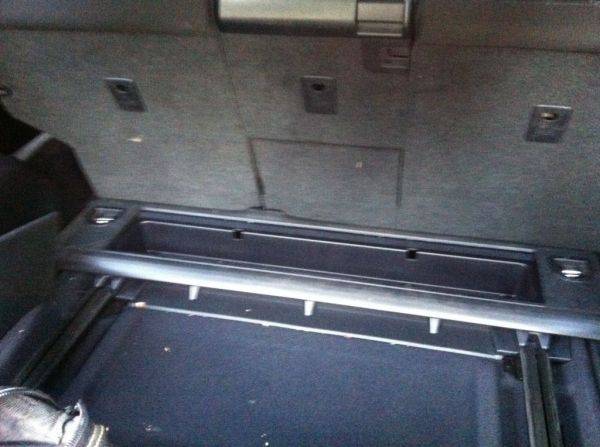
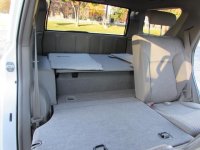
Yeah, but those without the slide out tray have much more storage than that little compartment. Think lengthXwidthXdepth of actual cargo tray vs that little compartment.
But, but, but.....I like my slide-out tray! Quit picking on it.....you mean, mean engineer.LOL :repuke:
Now, let's look at the real (approx) gain of not having it. Just for the sake of clarity and knowing that I am posting this in front of folks who need, want and work with absolutes (and I do not mean Vodka), my figures are NOT exact. Measuring the tray AND the hidden compartment unit, gives us an approx. of 3 inches height and 40 x 43 length and width.(or visa versa), Which I think works out to about 5.2 cubic feet in used space. Now below, I have copied and pasted an excerpt from US NEWS (auto section) off the web, which would suggest that with the rear seats DOWN, there is a total of 88.8 cubic feet of total cargo space. The problem here is that the US News article says "2 and 3rd row" seats down.....well, the decking with a 3 row seat is different then the decking with just the normal 2nd row seats so I am not sure of the correct cubic feet and I do not have the time to keep searching....go figure, the absolute is calling my name. So, out of 88.8, 5.1 or just approx 5.7% of cargo space is lost by having the tray. That's it. 5 or 6% for the benefit of having an option that NOBODY else offers which by looking on this forum, most folks have found real value by keeping their tray.
OK, I am off my soap box now. Be safe.
Edit, can one get a sliding tray AND 3row seats? If not, all the figures above are out the window. Note to self, search longer..........
Cargo
The Toyota 4Runner provides 9.0 cubic feet with its optional third row in use, which isn't likely to even accommodate a big grocery trip. With just the first and second rows in use, it provides 46.3 cubic feet. That expands to 88.8 cubic feet with the second and third rows folded down. A sliding rear cargo deck with under-floor storage box is standard on Limited and Trail models and optional on SR5 models.
The 4Runner's cargo dimensions are just average for a midsize SUV. However, they compare well against other off-roaders. The Jeep Grand Cherokee, for example, provides only a maximum of 67.4 cubic feet. On the other hand, the GMC Acadia (a crossover without off-road abilities) provides a whopping 116.9 cubic feet max and a much more practical 24.1 cubic feet behind its third row.
To see how the 4Runner handles cargo, check out our 4Runner video.
"The interior volume is enhanced by the rear seats that fold flat without having to remove the headrests, and the rear liftgate opens wide. That allowed us to load the 4Runner with our son's dresser, mountain bike, computer, chair, guitar and amp -- plus boxes, clothes and groceries -- to bring to his college quarters in a single trip." -- Cars.com
"Pass on the third row (it's available only on SR5 and Limited trims, as Toyota figures Trail buyers aren't looking for seven-passenger capacity), and the 4Runner offers a sliding cargo deck that doubles as a tailgate tray -- as the latter, it can support 440 pounds." -- Truck Trend
Read More: Specs | Performance | Safety | Reliability | Photos