RAD4Runner
Senior Member
Hi guys, I thought this may help some fellow members, especially this time of the year...
From 1986 schematic...
Positive side of CSI gets +12V fr starter relay or neutral safety switch ONLY during cranking. At the same time, STA also gets 12V while cranking (starter relay contact is closed).
When cold, CSI contact closes, connecting STJ to ground, and therefore, providing ground to negative side of CSI causing it to spray fuel. At this time, resistance ("R" below) from STJ to ground should be very low. Unfortunately, Toyota does not mention the value of this resistance. I will update as soon as I get the chance to actually measure that.

When coolant gets hot, contact opens and disconnects STJ and CSI from ground. When coils get hot after prolonged cranking, contact also opens.

On 1988 22R-E, and quite possibly on later engines, ECU also takes part in grounding STJ when it senses cold coolant. Note the additional wiring (in orange) between STJ of CSI timer and STJ of ECU below.

Owners of 1987's, when you get a chance, pls check is you have a wire connected to STJ pin of your ECU and let us know what color.

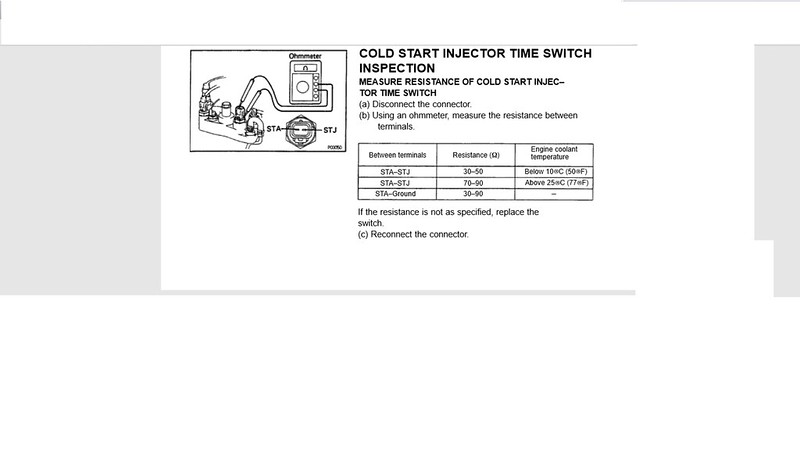
Test specs are here:

UNFORTUNATELY, THIS IS MISSING THE MOST CRITICAL SPEC: RESISTANCE BETWEEN STJ AND GROUND. This determines whether CSI gets ground or not. When cold STJ-GND should be low. When hot, STJ-GND should be high. I'll update this post the next time I get the chance to measure actual RESISTANCE BETWEEN STJ AND GROUND.
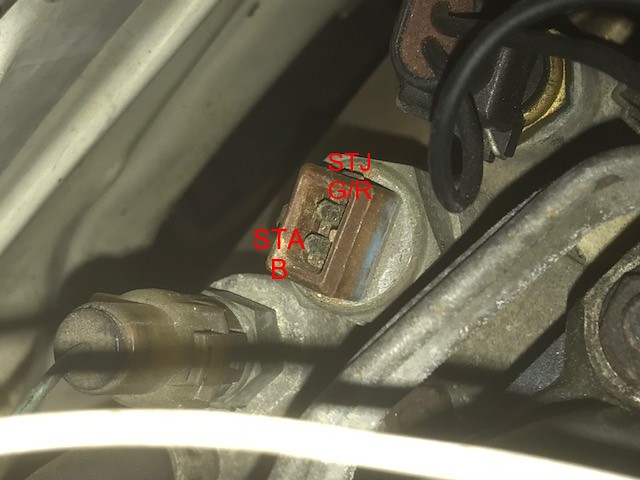
VERY critical but often overlooked is good electrical connection between metal body of CSI timer switch and engine block because this is how it gets grounded. Therefore, threads of CSI timer switch and mounting port should be cleaned to bare, shiny metal.
This is not good. I cleaned mine with vinegar and battery terminal steel-brush.


keywords: cooling system, fuel delivery, fuel injection
From 1986 schematic...
Positive side of CSI gets +12V fr starter relay or neutral safety switch ONLY during cranking. At the same time, STA also gets 12V while cranking (starter relay contact is closed).
When cold, CSI contact closes, connecting STJ to ground, and therefore, providing ground to negative side of CSI causing it to spray fuel. At this time, resistance ("R" below) from STJ to ground should be very low. Unfortunately, Toyota does not mention the value of this resistance. I will update as soon as I get the chance to actually measure that.
When coolant gets hot, contact opens and disconnects STJ and CSI from ground. When coils get hot after prolonged cranking, contact also opens.
On 1988 22R-E, and quite possibly on later engines, ECU also takes part in grounding STJ when it senses cold coolant. Note the additional wiring (in orange) between STJ of CSI timer and STJ of ECU below.
Owners of 1987's, when you get a chance, pls check is you have a wire connected to STJ pin of your ECU and let us know what color.
Test specs are here:
UNFORTUNATELY, THIS IS MISSING THE MOST CRITICAL SPEC: RESISTANCE BETWEEN STJ AND GROUND. This determines whether CSI gets ground or not. When cold STJ-GND should be low. When hot, STJ-GND should be high. I'll update this post the next time I get the chance to measure actual RESISTANCE BETWEEN STJ AND GROUND.
VERY critical but often overlooked is good electrical connection between metal body of CSI timer switch and engine block because this is how it gets grounded. Therefore, threads of CSI timer switch and mounting port should be cleaned to bare, shiny metal.
This is not good. I cleaned mine with vinegar and battery terminal steel-brush.
keywords: cooling system, fuel delivery, fuel injection
Last edited: