Ironman Foam Cell Pro

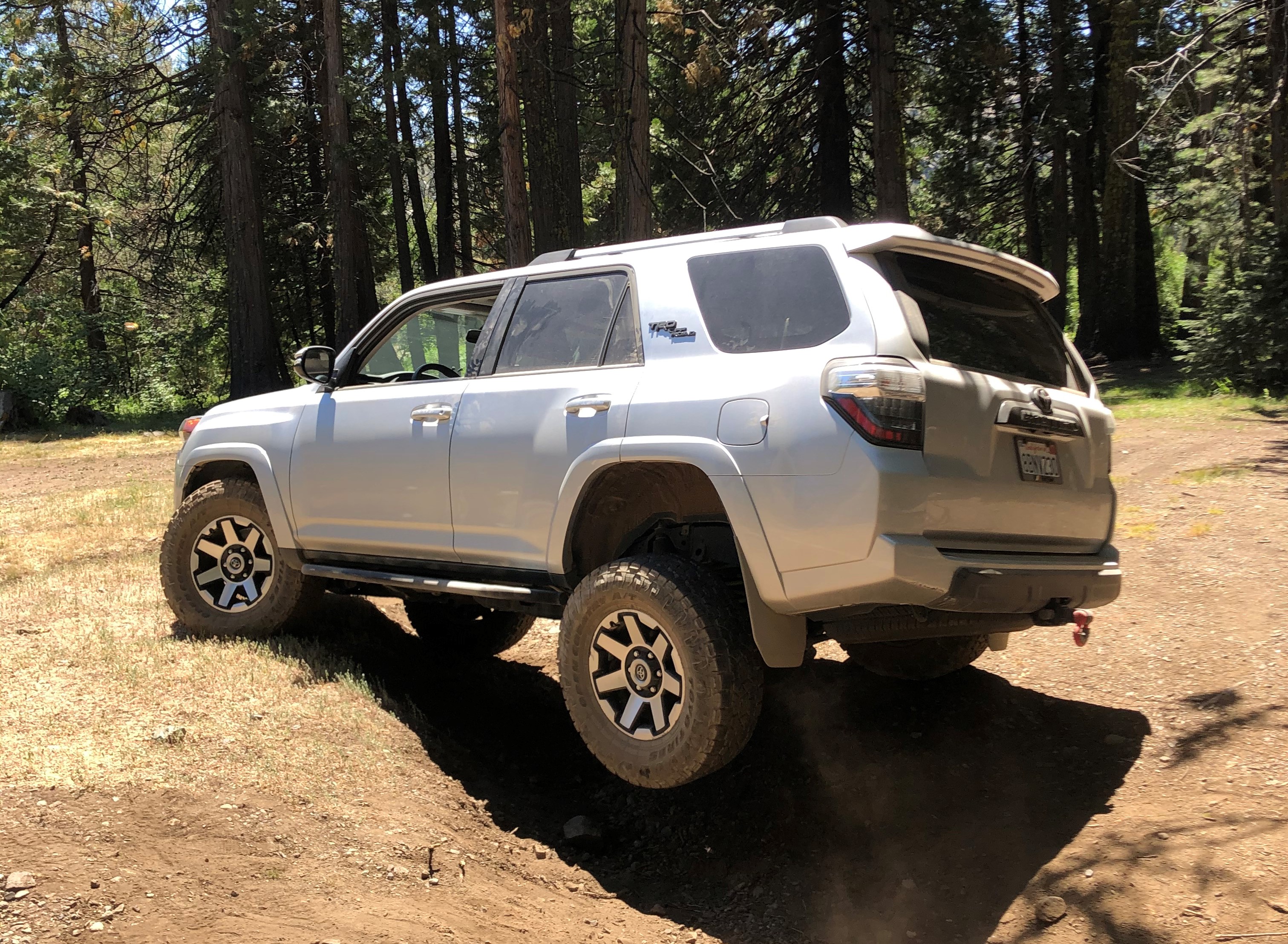
I've put around 8000 miles on my Foamcell pros with KDSS, no issues with lean. Initially I got 3.5 inch in front and 3 in the back, the front settled to 3 inches now. I did have to do zero point calibration after the lift, my dash was a Christmas tree and had no traction on.

The performance springs (3inch front) have 827lbs/in spring rate, it makes more sense on a V8 GX, but usually this only effects hitting a speedbump with both tires at same time.. you get very little compression. Once skids, bumper, winch come on, it will hopefully be little more squishy.

Off road they have been great. Overall, aside from the spring rate, I'm happy

323113.jpg
 
Ironman suspension. 70K miles

Love this Australian product. 70K miles and counting
 

Attachments

  • 37DF605C-1A05-4F20-9AD1-3091EF062F86.jpeg
    37DF605C-1A05-4F20-9AD1-3091EF062F86.jpeg
    109 KB · Views: 1,431
Does anyone have KDSS Lean after installation along with 5,000+ miles? Mine leans to the passenger side pretty bad. I have tried to do the documented KDSS fix per the manual but I cannot get it better than the 7/8th tolerance level. After a while, it goes outside of that which is causing tire rubbing issues. That can be fixed pretty easily but I would like to fix the lean! With so many different suspensions I thought I would ask if anyone else with the Ironman Foam Cell is experiencing this. No need to talk about other setups in this thread. I will be adding some more general questions to a specific KDSS Lean thread.

Thanks!


I have a GX and I lean towards the driver’s side which is normal with the battery and KDSS weight.

I’m looking into adjusting the front driver’s side front shock. I have maybe 1/2” difference but it’s enough that it’s definitely noticeable.


Sent from my iPhone using Tapatalk
 
I've put around 8000 miles on my Foamcell pros with KDSS, no issues with lean. Initially I got 3.5 inch in front and 3 in the back, the front settled to 3 inches now. I did have to do zero point calibration after the lift, my dash was a Christmas tree and had no traction on.

The performance springs (3inch front) have 827lbs/in spring rate, it makes more sense on a V8 GX, but usually this only effects hitting a speedbump with both tires at same time.. you get very little compression. Once skids, bumper, winch come on, it will hopefully be little more squishy.

Off road they have been great. Overall, aside from the spring rate, I'm happy

323113.jpg


Did you extend your rear brake lines? I have the same setup on my GX but haven’t extended the lines yet. It seems like there’s not a ton of people doing it.


Sent from my iPhone using Tapatalk
 
10k mile review:
Ironman Foam Cell Pro "Stage 2":
Stock load springs
with UCAs
no new trackbar or KDSS spacers (wasn't offered at the time, not sure I need them as my 'lean' is the same as stock 3/8~1/2" depending upon gas tank etc).
I do have some 'armor' as far as full aluminum skids and steel sliders (mostly front suspension weight).
It was under $1400 bucks shipped at the start of the pandemic... not sure I'd pay the current pandemic pricing for these or others (availability is non-existent across the board it would seem).

The on road ride has been good. Not too rough or too soft. Nice and controlled. Washboards have been excellent compared to stock. No noticeable fade where as stock I could feel things get soft quite quickly. Alignment tracks very well.

Rear springs have settled out at 1.75" of lift. Front coilovers are adjusted to the same lift over stock.

I've seen discussion here and some youtube videos about if the coilovers are adjustable on the vehicle. I can tell you that I have adjusted them using the following tools and steps.
Tools:
1) Ironman spanner wrench (7mm pin with a 17, 18, and 19mm hex cutouts [outside to inside of spanner], also note that this tool is beefy but I don't think they cut the hex cutouts to proper specs as I had to 'press-fit' my sockets and tap them out... tight)
2) 17mm allen socket (maximum leverage)
3) "breaker bar" (I used an 3/8" torque wrench)
4) Adapter for 17mm allen to breaker bar
5) Oil / lube (NOT WD-40)
6) 3mm allen wrench

Steps:
1) Measure height of fender to center of hub distance.
2) Subtract target height of fender to center of hub distance from measurement of 1.
3) Multiply value from step 2 by .69. This is the amount you will want to move the adjustment collar up or down.
4) Put on your PPE (glasses, gloves, etc.)
5) Make vehicle safe to work on (chalk tires etc.)
6) Loosen lug nuts (do not remove) with vehicle on the ground (remove center caps if required)
7) Jack up vehicle safely to lift wheel assembly off the ground
8) Place vehicle on appropriate jack stands and remove vehicle weight from jack
9) Remove lug nuts and wheel assembly
10) Lube threads of shock body above and below adjustment and locking collar along with joint of upper adjustment collar and spring seat collar.
11) Loosen (and remove if you'd like) set screws of adjustment and locking collar using a 3mm allen wrench
12) Loosen locking collar using the Ironman spanner wrench, 17mm allen socket, and breaker bar by turning counterclockwise a minimal amount (if reducing height, move collar down by the value in step 3).
13) Raise/lower adjustment collar by the value in step 3 using the Ironman spanner wrench, 17mm allen socket, and breaker bar by turning clockwise/counterCW (this will not be easy and will require lots of elbow grease and positioning but it can be done)
14) Reverse order of disassembly.
15) Drive around, verify you are happy with the setting, adjust as needed, go get alignment.

No spring compressor or removal of coilover required. The only thing removed from the vehicle is the appropriate wheels. No suspension (LCA, Steering Knuckle ball joints, KDSS, etc) hardware needs to be touched.

Now to address some concerns people have had over the 'foam cell pro' designs.
1) Foam! It's not oil that is foamed, it is closed cell foam (like a yoga mat or a wetsuit material)
2) Since the bubbles are encased in the closed cell foam, they don't mix with the oil
3) Since the foam is compressible (flexible rubber/nitrile/etc like o-ring material with compressible gas), thermal expansion / contraction is easily managed without the complexity of external accumulators (remote reservoirs), extra seals, etc.
4) The oil capacity is near 100% and the oil will surround the foam providing a high level of convection to the outer body (gas in an external reservoir is unlikely to convect a large amount of heat away from the oil since they are only connected through a small hose and gasses are generally poor at transferring heat)
5) As the oil heats up, the foam will compress and the system will build some pressure. Without getting into True Vapor Pressure / Reid / Vapor over Liquid ratios, it's unlikely that cavitation is a concern. The piston acts as a pump and creates a 'high' pressure side that pushes fluid to the 'low' pressure side.
6) The eyelets and other connections being rubber instead of metal to metal like heim joints (spherical bearings) provides an OEM level of noise vibration harness characteristics with high reliability.

Foam Cell Pro Testing - Ironman 4x4
Looks like they tested their setup on a shock dyno on a 200 series. While there is subjectivity to valving such as progressive, linear, and digressive, if you're not planning on the running the Baja 10 million, then these are probably a good option presuming the price is right.

 
10k mile review:
Ironman Foam Cell Pro "Stage 2":
Stock load springs
with UCAs
no new trackbar or KDSS spacers (wasn't offered at the time, not sure I need them as my 'lean' is the same as stock 3/8~1/2" depending upon gas tank etc).
I do have some 'armor' as far as full aluminum skids and steel sliders (mostly front suspension weight).
It was under $1400 bucks shipped at the start of the pandemic... not sure I'd pay the current pandemic pricing for these or others (availability is non-existent across the board it would seem).

The on road ride has been good. Not too rough or too soft. Nice and controlled. Washboards have been excellent compared to stock. No noticeable fade where as stock I could feel things get soft quite quickly. Alignment tracks very well.

Rear springs have settled out at 1.75" of lift. Front coilovers are adjusted to the same lift over stock.

I've seen discussion here and some youtube videos about if the coilovers are adjustable on the vehicle. I can tell you that I have adjusted them using the following tools and steps.
Tools:
1) Ironman spanner wrench (7mm pin with a 17, 18, and 19mm hex cutouts [outside to inside of spanner], also note that this tool is beefy but I don't think they cut the hex cutouts to proper specs as I had to 'press-fit' my sockets and tap them out... tight)
2) 17mm allen socket (maximum leverage)
3) "breaker bar" (I used an 3/8" torque wrench)
4) Adapter for 17mm allen to breaker bar
5) Oil / lube (NOT WD-40)
6) 3mm allen wrench

Steps:
1) Measure height of fender to center of hub distance.
2) Subtract target height of fender to center of hub distance from measurement of 1.
3) Multiply value from step 2 by .69. This is the amount you will want to move the adjustment collar up or down.
4) Put on your PPE (glasses, gloves, etc.)
5) Make vehicle safe to work on (chalk tires etc.)
6) Loosen lug nuts (do not remove) with vehicle on the ground (remove center caps if required)
7) Jack up vehicle safely to lift wheel assembly off the ground
8) Place vehicle on appropriate jack stands and remove vehicle weight from jack
9) Remove lug nuts and wheel assembly
10) Lube threads of shock body above and below adjustment and locking collar along with joint of upper adjustment collar and spring seat collar.
11) Loosen (and remove if you'd like) set screws of adjustment and locking collar using a 3mm allen wrench
12) Loosen locking collar using the Ironman spanner wrench, 17mm allen socket, and breaker bar by turning counterclockwise a minimal amount (if reducing height, move collar down by the value in step 3).
13) Raise/lower adjustment collar by the value in step 3 using the Ironman spanner wrench, 17mm allen socket, and breaker bar by turning clockwise/counterCW (this will not be easy and will require lots of elbow grease and positioning but it can be done)
14) Reverse order of disassembly.
15) Drive around, verify you are happy with the setting, adjust as needed, go get alignment.

No spring compressor or removal of coilover required. The only thing removed from the vehicle is the appropriate wheels. No suspension (LCA, Steering Knuckle ball joints, KDSS, etc) hardware needs to be touched.

Now to address some concerns people have had over the 'foam cell pro' designs.
1) Foam! It's not oil that is foamed, it is closed cell foam (like a yoga mat or a wetsuit material)
2) Since the bubbles are encased in the closed cell foam, they don't mix with the oil
3) Since the foam is compressible (flexible rubber/nitrile/etc like o-ring material with compressible gas), thermal expansion / contraction is easily managed without the complexity of external accumulators (remote reservoirs), extra seals, etc.
4) The oil capacity is near 100% and the oil will surround the foam providing a high level of convection to the outer body (gas in an external reservoir is unlikely to convect a large amount of heat away from the oil since they are only connected through a small hose and gasses are generally poor at transferring heat)
5) As the oil heats up, the foam will compress and the system will build some pressure. Without getting into True Vapor Pressure / Reid / Vapor over Liquid ratios, it's unlikely that cavitation is a concern. The piston acts as a pump and creates a 'high' pressure side that pushes fluid to the 'low' pressure side.
6) The eyelets and other connections being rubber instead of metal to metal like heim joints (spherical bearings) provides an OEM level of noise vibration harness characteristics with high reliability.

Foam Cell Pro Testing - Ironman 4x4
Looks like they tested their setup on a shock dyno on a 200 series. While there is subjectivity to valving such as progressive, linear, and digressive, if you're not planning on the running the Baja 10 million, then these are probably a good option presuming the price is right.

What height and type of spring did you go with?
 
Whiplash? Or too high of expectations?

I’ve been running the FCP’s for about 20k miles now on my 17 TRDORP without KDSS. 3.0/2.5” with stock weight springs in the struts and 600lb springs in the back (drawers/roof rack/moles and some other goodies in the back) On the road the ride is decent. Some dips and bumps are a little harsh. Taken at a 45* side angle they’ll smash your head into the window. Off-road they are downright harsh. People talk of washboard roads and I just avoid those. The truck will start walking sideways over 25mph. Off-road I run 16-18psi. After running Fins N Things, Hells Revenge, and Poison Spider trails in Moab I Nearly felt like I had whiplash. All of my Jeep people were smooth and easy the whole time and I felt like if I went over 2-3mph I was going to break something. I’ve got no leaks. And it’s all installed and adjusted properly. I’m honestly looking into other suspension at this point as I cannot enjoy the truck off-road, which is where I bought it to go.
 
I’ve been running the FCP’s for about 20k miles now on my 17 TRDORP without KDSS. 3.0/2.5” with stock weight springs in the struts and 600lb springs in the back (drawers/roof rack/moles and some other goodies in the back) On the road the ride is decent. Some dips and bumps are a little harsh. Taken at a 45* side angle they’ll smash your head into the window. Off-road they are downright harsh. People talk of washboard roads and I just avoid those. The truck will start walking sideways over 25mph. Off-road I run 16-18psi. After running Fins N Things, Hells Revenge, and Poison Spider trails in Moab I Nearly felt like I had whiplash. All of my Jeep people were smooth and easy the whole time and I felt like if I went over 2-3mph I was going to break something. I’ve got no leaks. And it’s all installed and adjusted properly. I’m honestly looking into other suspension at this point as I cannot enjoy the truck off-road, which is where I bought it to go.

So you have the HD rear springs? I do as well and they are indeed super stiff. I initially ran them with Bilstein 5160's, but those are valved for closer to stock spring rates, so tried Ironman's FCP and they do better overall, but going fast off road proves to be frustrating as the shocks just can't control those springs enough. However, when I'm fully loaded (fam of 5, packed to the gills with camping stuff, and even a cargo tray with weight on it) they come in handy to not bottom out all day long.

There are two things I'd say could improve our situations with the rear susp: 1) install actual performance shocks like Kings, Fox's, etc. that can be valved to control the stronger springs better or 2) go with progressive springs that are lighter rates until compressed into their travel.

Also, do you have progressive bump stops all around? I run DuroBumps and they make a big difference off road. An essential thing for those that actually put their trucks through rough stuff.
 
So you have the HD rear springs? I do as well and they are indeed super stiff. I initially ran them with Bilstein 5160's, but those are valved for closer to stock spring rates, so tried Ironman's FCP and they do better overall, but going fast off road proves to be frustrating as the shocks just can't control those springs enough. However, when I'm fully loaded (fam of 5, packed to the gills with camping stuff, and even a cargo tray with weight on it) they come in handy to not bottom out all day long.

There are two things I'd say could improve our situations with the rear susp: 1) install actual performance shocks like Kings, Fox's, etc. that can be valved to control the stronger springs better or 2) go with progressive springs that are lighter rates until compressed into their travel.

Also, do you have progressive bump stops all around? I run DuroBumps and they make a big difference off road. An essential thing for those that actually put their trucks through rough stuff.
As I understood it I got the medium springs. Looking again, perhaps I did get the heavy? I only have the stock bump stops at this time. Until I got on the forums I never gave bump stops a second thought. The truck feels incredibly harsh/tight as much in the front end as much as the rear. Could just be the package as a whole. The front springs are stock load.

I appreciate the reply. I’ve definitely got my research cut out for me. ��������

Edit: just saw my front springs are rated 827 lbs/in and the rears are 280 lbs/in. That might have something to do with the harsh ride. IMO that’s insanely high for the front springs that we’re rated as “stock front weight up to 110 lbs static”
I have no other front weight.
 
Last edited:
As I understood it I got the medium springs. Looking again, perhaps I did get the heavy? I only have the stock bump stops at this time. Until I got on the forums I never gave bump stops a second thought. The truck feels incredibly harsh/tight as much in the front end as much as the rear. Could just be the package as a whole. The front springs are stock load.

I appreciate the reply. I’ve definitely got my research cut out for me. ��������

Edit: just saw my front springs are rated 827 lbs/in and the rears are 280 lbs/in. That might have something to do with the harsh ride. IMO that’s insanely high for the front springs that we’re rated as “stock front weight up to 110 lbs static”
I have no other front weight.

So both your front and rear springs are the Heavy Load options. The good thing here is you can get the lighter load springs and it'll solve your problems.

Here are all of the spring options: Coil Springs
 
So both your front and rear springs are the Heavy Load options. The good thing here is you can get the lighter load springs and it'll solve your problems.

Here are all of the spring options: Coil Springs

Appreciate the link. Their lightest spring rate is still 720 lb/in front and 234 lb/in rear, which IMO is still quite high for the ‘Runner. The springs I have, in spite of their rating are still listed as medium springs (TOYO65B and TOYO56B)
 

I may be biased, but I think Tinkerer missed a vital piece of the pie. It is true that cavitation is more likely under low pressure systems. Considering the shock is assembled while full of oil with the only expansion volume remaining being the foam, as soon as the oil heats up, the limited volume of the pressure cylinder will restrict the oil expansion, thereby generating pressure and limiting cavitation potential at high temperatures.
 
FWIW, I just picked up a stage 2 FCP kit. I'm excited about it, but I get to stare at it for the next month or so. I'm just too busy ATM to get time to install it. Oh well, at least I took advantage of the sale.

Sent from my SM-N975U1 using Tapatalk
 
I ordered the stage 2 and it will be here Thursday. I hope to get installed on my 2016 PRO in the next week or so. I will post pics when done.
 
Foam or Foam Pro?

I'm working through the process of which one to get. My requirements are no lift on 10 ply stock size tires, ability to handle max towing loads, 10% forest service roads and 5% heavy off road.

From my reading it appears the kit Toyo55BKF is a minimum 2 inch lift using the foam cell pro and medium springs so it is a non starter.

The medium duty Foam Cell (not comfort and not performance) shock that appears to fit the bill is the 24710FE with either the 24682c (comfort) or 24682p (performance). I do not know if the FE is stock height.

The adjustable height Foam Cell Pro that appears to fit is the 45710E it matches up with the rear 45682c (comfort) or 4568p (performance).

Does anyone have feedback on NON lifted applications of these shocks?

Thanks in advance for any replies.
 
Quick update after almost 2 years of Ironman FCPs. Just FYI, I got the stage 2 at a steal, $1800 to the door. I was going to use this until I got all the weight I wanted and then go into tuned kings or foxes with extra/long travel.

The Good:
Super comfy on-road, minimal nose dive
Great articulation for no ressies
Completely level side to side without any modification on my KDSS
Zero fade off road
Back springs and shocks are perfect
Higher spring rate upfront is a plus when coming off big rocks, less compression, less likely to smack something
Zero issues so far

The Bad:
Height adjusters are a joke, pretty sure you need to compress the springs to move (this might be just me)
Front 800+ lbs spring rate is overkill, make fast off road driving not so great, plus I was at 3.5in until I added 200lbs of weight upfront
They weight quite a bit more then your standard aluminum 2 inch shocks

If I could change few things, I'd go with the 3" spring in the back instead of 2", I finally pulled the trigger on their KDSS spacer/trackbar, wish I had that sooner.

In the end I'm super happy with them, they work for my application, huge value at that price

IMG-0980-2.jpg
 

Members online

Forum statistics

Threads
278,311
Messages
3,554,082
Members
248,016
Latest member
Advally Service

Trending content

Back
Top