Is running a relay before a fuse block possible? What relay would you use?

MightyP

New member
My apologies if this has already been asked and answered. My searches didn't turn up anything definitive and I know just enough about electrical to be dangerous.

Real Goal: I want to safely and cleanly run moderate power accessories on my rig.
Bonus Question: How do higher consumption things (winch, air compressor, power inverter, etc) integrate? Will a fuse block work?

Background: I currently have a dash cam and ditch lights hardwired into my 4runner. I want to add backup lights, a Ham radio and possibly a CB. With what I have now, the wires are messier than I would like, so I want to add a fuse block and clean everything up. As I thought about it though, everything I want on the fuse block, I want tied to the ignition. Rather than use 5 standard relays and the associated power, switch and ground wires on top of the other wiring, can I use a big relay before the fuse block and cut down on all the excess?

I linked to a relay that, in theory, seems like it should work. However, since burning down my rig is a possibility here, I'd like a bit of input. If my very limited knowledge/understanding is right, it would go: Pos battery terminal, 100 amp circuit breaker/inline fuse, big ass relay, fuse block.

https://www.amazon.com/Solenoid-Prestolite-Applications-Continuous-Terminal/dp/B004V3R5BO/

Thanks,
P
 
Register to hide this ad
I love electrical...

You asked if its possible... yes, anything is possible...

Its a question of control... if you put a large relay to feed the block, then you dont have individual control of each circuit that block feeds... In addition to that, you have a big relay, breaker, and fuses... more connections to make on large gauge mains sized line... more things to fail... keep it simple.

In addition to a breaker, you would still need an in-line fuse.

Its really important that people understand that a breaker isn't a fuse. I cant stress this enough, DO NOT USE A BREAKER AS A REPLACEMENT FOR A FUSE.

A dead short on a large main line with a breaker can cause it to weld itself open with enough amperage. Where a breaker would fail, a fuse would not.

So down to business...

The first item off the positive post using mains cable should be a fuse as close to the battery as possible... I highly recommend the Mega fuse and holder... can be found on Amazon. Solid connections, good stuff, no crappy car audio stuff here...
https://www.amazon.com/gp/product/B...fl_title_119?ie=UTF8&psc=1&smid=ATVPDKIKX0DER

Fuseholder-MEGA-Bolt-Down.jpg


Note that fusing is there to protect the cable... so size it accordingly for the gauge wire, and length of run.

From there you can add a breaker, big relay, fuse block, whatever you want.

Personally I would skip the breaker and big relay, and go directly to a good quality fuse block, like the ones made by Blue Sea.

30A max per circuit. I like these because they have a bus for ground connections too, keeping things clean.
https://www.amazon.com/gp/product/B...fl_title_181?ie=UTF8&psc=1&smid=ATVPDKIKX0DER

Regarding your question about higher amperage applications... every fuse distribution block has a spec... so look at that and make a decision if you need a more robust distribution block.

For example the above block has a MAX of 100A per block, and a max of 30A per circuit. All the information is clear cut and can be found on the website.
https://www.bluesea.com/products/5026/ST_Blade_Fuse_Block_-_12_Circuits_with_Negative_Bus_and_Cover

For higher amp applications... you have quality options like this.
https://www.amazon.com/gp/product/B...fl_title_121?ie=UTF8&psc=1&smid=ATVPDKIKX0DER

If you really wanted a breaker, add it before the block in a convenient location as it acts as a convenient way to shut off power for service and maintenance, but you could just pull fuses and call it a day...

If you really dont need control of each circuit, you can add a large relay... I need individual control for lighting, so I use a Bosch relay. For circuits feeding my ham radio the built in on/off on the radio is more that sufficient.

Keep in mind that if you want to run small loads inside the truck when the car is off, like a USB outlets, phone chargers, 12v fridge, then every load connected to that block would be switched on or off together if the "big ass relay" was the only control.

Its not that difficult to wire up a small Bosch relay per circuit... and just put them where you need em. You can easily "rack" them into a clean organised configuration... Then you can just run small AWG control wire into the cab for switches...

2360770916_c9587d8622.jpg

This one has fusing in it too, but I like it as a visual example...
RelayCenter_med2.jpg


Regarding sizing circuits... it really helps to have a DC clamp meter... The right tools would make this task a breeze. Here I was testing/measuring the load on various circuits and the max load on the fuse panel with everything on...

OFC43MF.jpg


I used a lot of the stuff mentioned here when I did mine... I know its not that cheap, but its really good hardware. In the picture I have the same block mentioned here, it has a LVD (Low Voltage Disconnect) in the background that is feeding the block... This protects the battery from over-discharge so I can feel free to leave certain items on, like chargers, fridge, radio communications... I never have to worry about causing damage to the battery. While this is connected to a 2nd battery on my rig, it would be even more valuable on the starter as you can make sure you have enough power to start the rig. The LVD disconnect voltage is also user programmable...

d7pdJEF.jpg

f10ARDO.jpg


I know its a long winded post, but hope that helps. Electrical is a lot of fun and it's rewarding getting a really nice usable end result when you put a little extra effort into the design of a system or circuit. I added more information as an example to get the creative juices flowing because you can really approach this with a lot of creative freedom for whatever you are trying to achieve... My way isn't the only way, or the right way, but its just one way, and one that works perfectly for my needs.
 
Last edited:
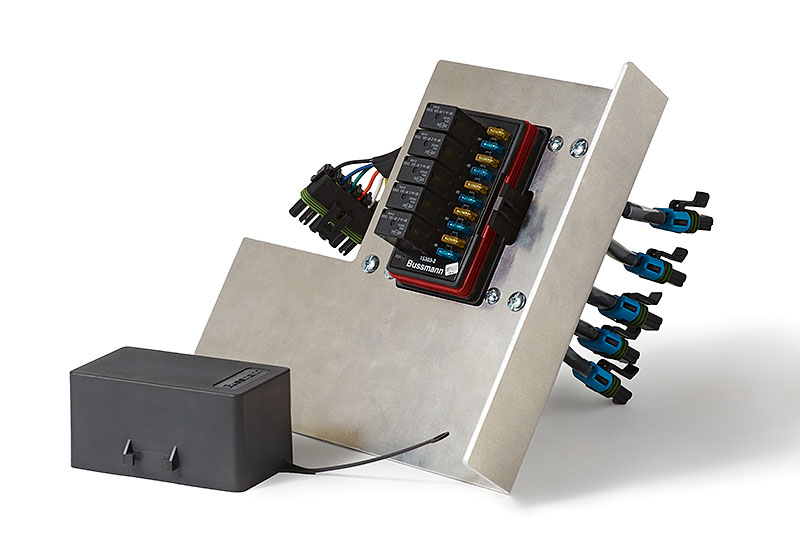
I am doing something similar and decided to to use this guide to build and install a relay/fuse block. I have already ordered the parts and weathertek crimpers. I also plan on using these switches to put in the 4 blank slots I have in the dash to make all look semi factory.

2015-06-12_BussmannRTMR_Z2A2646_web800.jpg


I did not like the size, look and weather proofing of the blue sea one pictured above.

My brother works with sheet metal and is going to make the mounting panel for me to mount behind the battery.

I also plan on eventually putting in a 31-AGM house battery and using one of the smart VSR's like this, or this.
 
Last edited:
Good recommendation... the Bussmann fuse / relay blocks are pretty awesome as well. With an integral relay rack, you can produce a very clean install.

Good recommendation on the ACR as well... I like that model since it has force manual control and its big enough to jump start though the ACR.

I went with its simpler smaller brother, the SI ACR and mounted it to the side of the dual battery tray. It matched up pretty well with my needs, stock alternator size, and really a great tamper proof configuration.

KwgMhC1.jpg


I also have a Blue Sea m-LVD which is feeding the fuse block... with its control switch wired into the center console for monitoring, control, programming.
y8TAqKm.jpg


One of the features I like about the BlueSea ACR is the Lockout... if you actually have a bad battery, over discharged cell... its intelligent enough not to combine... protecting both cells from each other.

They have some good features for an Overland Expo rig as they make some good mission critical marine hardware.
 
Last edited:

Members online

Forum statistics

Threads
278,316
Messages
3,554,120
Members
248,016
Latest member
Advally Service

Trending content

Back
Top