KDSS vs Good Aftermarket Suspension

that's the part i don't understand. does this involve installing a new reservoir to dump pressure so that it's inactive below a certain speed/pressure? if this is a mechanical/pressure system, where's the electric pump or is there a driveline driven pump? if there's no pump, then it's a sealed system, right? that's the part that makes me scratch my head.

seriously, watch the video

there is no pump, basically just a valve

 
Last edited:
seriously, watch the video

there is no pump, basically just a valve


yes, I've watched the video 4 times...

I'll start with the simple, which gets back to my first point: it's a closed system, a passive system. I don't see how you can "switch" it on and off without manipulating pressure, which would require additional equipment.

I'll step back from my "similar to XREAS" comments. While the systems do have similarities, there are enough differences (and enough confusion on each) that it's not worth spelling out.

So, KDSS uses pressure to keep sway bars stiff, and allows extra travel by pressure balancing the pistons at low speed? Ok, simple enough.

It optimally adjusts front and rear stabilizers based on a set of interconnected hydraulic cylinders. The interconnection is made up of hydraulic piping and a control cylinder which is located at the frame rail.[2] KDSS, which is fully mechanical, can disengage the stabilizer bars (the bars are jointed, allowing movement independent of one another).[2] This system will not engage during normal driving conditions, when hydraulic pressure is equal. In off-road conditions, KDSS activates when it senses that a wheel has dropped.[2]

I disagree with "activates" above, which imports some level of intelligence to the system. But it is always actively balancing pressure. So... how do you "switch" it off?

UnselfishFoolhardyBoilweevil-max-1mb.gif
 
yes, I've watched the video 4 times...

I'll start with the simple, which gets back to my first point: it's a closed system, a passive system. I don't see how you can "switch" it on and off without manipulating pressure, which would require additional equipment.

I'll step back from my "similar to XREAS" comments. While the systems do have similarities, there are enough differences (and enough confusion on each) that it's not worth spelling out.

So, KDSS uses pressure to keep sway bars stiff, and allows extra travel by pressure balancing the pistons at low speed? Ok, simple enough.


I disagree with "activates" above, which imports some level of intelligence to the system. But it is always actively balancing pressure. So... how do you "switch" it off?

UnselfishFoolhardyBoilweevil-max-1mb.gif

Closing the valves does 2 things. First it eliminates any issues with an imbalance front to rear. If the leverage was different on the front vs rear it could lead to some odd handling. Particularly under something like heavy braking into a corner. The front force may slightly overcome the rear essentially relax the front sway bar when you want it most. It's also asymmetric - when it's fixed it's symmetric in handling. I'd guess that the 200 series is better in left/right symmetry at speed.

The second reason is probably to reduce wear. If you lock the pistons in place, they don't wear on the seals.

The 200 series are rebuildable. I'd bet the 4runner are too - but it's so rare that no one has done it yet. The insides of the one I saw from the 200 looked just like what you'd see in a high end shock.

There certainly are better ways to build this type of system, but this design probably has the least possible number of parts - and as a result is the most reliable. My first choice would at least be to use double ended cylinders with a balanced volume system. Also, I think Toyota should seriously consider offering a lighter flex bar set for the same system. If it were the same spring rate as the normal sway bars - (too soft IMO) - it would handle just like the normal models, but still have all the benefits of KDSS in slow speed use. The front bar would be easy enough to makeup a softer one aftermarket. The rear - not so much.

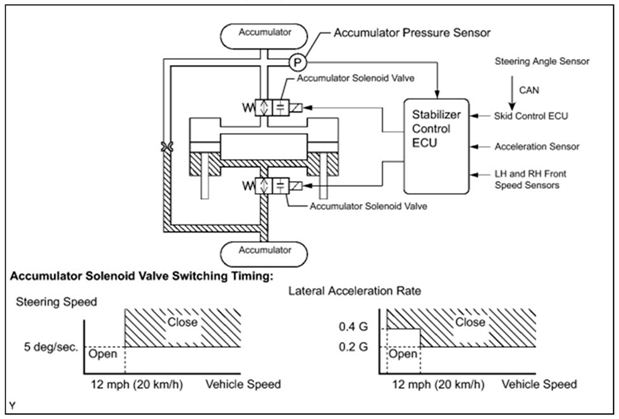
Also there's more to the timing of open and closing the shutter valves than just 12mph. It also takes input from the skid control ECU and left and right speed sensors to calculate cornering force. There's a range of speeds and cornering that determine open/closed function.

167132d1268351767-does-the-gx-tilt-kdss3.jpg
 
Last edited:
Closing the valves does 2 things. First it eliminates any issues with an imbalance front to rear. If the leverage was different on the front vs rear it could lead to some odd handling. Particularly under something like heavy braking into a corner. The front force may slightly overcome the rear essentially relax the front sway bar when you want it most. It's also asymmetric - when it's fixed it's symmetric in handling. I'd guess that the 200 series is better in left/right symmetry at speed.

The second reason is probably to reduce wear. If you lock the pistons in place, they don't wear on the seals.

The 200 series are rebuildable. I'd bet the 4runner are too - but it's so rare that no one has done it yet. The insides of the one I saw from the 200 looked just like what you'd see in a high end shock.

There certainly are better ways to build this type of system, but this design probably has the least possible number of parts - and as a result is the most reliable. My first choice would at least be to use double ended cylinders with a balanced volume system. Also, I think Toyota should seriously consider offering a lighter flex bar set for the same system. If it were the same spring rate as the normal sway bars - (too soft IMO) - it would handle just like the normal models, but still have all the benefits of KDSS in slow speed use. The front bar would be easy enough to makeup a softer one aftermarket. The rear - not so much.

This is where my mechanical knowledge starts to lag--wouldn't closing the valve keep it stiffer? I thought the open valve allowed longer travel at low speeds?

Or does he want to close the valve when he wanted (at higher speeds) only?

*also, to your first point, doesn't the higher pressure at speed keep the front to rear and side-to-side motion under control? Not that I've driven a KDSS equipped 4R, but I've watched that video like 4 times, so I'm almost an expert.
 
Yes. Closing the valve fixes the length of the cylinders - and the result is that the sway bars are used just like normal ones. They are very stiff. So when closed, it's just like having 1 ton truck sway bars on a much lighter vehicle. What they're *really* doing that a lot of people might not recognize is transferring spring force from the other side of the vehicle. So when you put heavier aftermarket springs on - the antisway effect is even greater. And when you have heavy preloaded springs - it's even moreso. The normal sway bar lacks the spring rate to effectively transfer that additional force to the other side, but the KDSS bar can and does.


The goal of the switch was to manually open the valves above 12mph. So that you would have the full effect of the sway bars moving through their range at higher speeds. The problem that he was trying to solve is that KDSS sway bars are too stiff for moguls at medium speeds. The ride is harsh in that type of terrain with uneven bumps side to side. It's effectively like having maybe 1000lb spring rate at each corner instead of 600 when you hit a bump at only one corner. I'm not sure opening the valve would really help much with that. The solution to that issue is either having softer sway bars, or a sway bar disconnect. There's no solution that uses the KDSS pistons because they can move some, but he reaction speeds are too slow even if the valves were open.

Softer shock valving should go a long way toward helping - but no one is making shocks valved for KDSS systems that I'm aware of. In the spring I'll be sending my shocks in for a full rebuild internally. I can't do it until I can ride my motorcycle for a week or two while they're out at the shop. But I suspect a custom tune can solve a bunch of the issues.

IMO the best solution would be to make the passenger side fixed link a disconnect. The problem is that it may be difficult to get back into place because of the asymmetry of the hydraulic system with high pressure accumulators. It won't naturally self-return to lock the disconnect in place. I don't know what the answer would be to solve that short of having a disconnect and using a jack to push it back into place. That's not a great design IMO. It needs to happen with the flip of a switch. And I don't know of any way to do that in a simple way.

For now it's probably an all or nothing system.
 
Last edited:
Yes. Closing the valve fixes the length of the cylinders - and the result is that the sway bars are used just like normal ones. They are very stiff. So when closed, it's just like having 1 ton truck sway bars on a much lighter vehicle. What they're *really* doing that a lot of people might not recognize is transferring spring force from the other side of the vehicle. So when you put heavier aftermarket springs on - the antisway effect is even greater. And when you have heavy preloaded springs - it's even moreso. The normal sway bar lacks the spring rate to effectively transfer that additional force to the other side, but the KDSS bar can and does.


The goal of the switch was to manually open the valves above 12mph. So that you would have the full effect of the sway bars moving through their range at higher speeds. The problem that he was trying to solve is that KDSS sway bars are too stiff for moguls at medium speeds. The ride is harsh in that type of terrain with uneven bumps side to side. It's effectively like having maybe 1000lb spring rate at each corner instead of 600 when you hit a bump at only one corner. I'm not sure opening the valve would really help much with that. The solution to that issue is either having softer sway bars, or a sway bar disconnect. There's no solution that uses the KDSS pistons because they can move some, but he reaction speeds are too slow even if the valves were open.

Softer shock valving should go a long way toward helping - but no one is making shocks valved for KDSS systems that I'm aware of. In the spring I'll be sending my shocks in for a full rebuild internally. I can't do it until I can ride my motorcycle for a week or two while they're out at the shop. But I suspect a custom tune can solve a bunch of the issues.

IMO the best solution would be to make the passenger side fixed link a disconnect. The problem is that it may be difficult to get back into place because of the asymmetry of the hydraulic system with high pressure accumulators. It won't naturally self-return to lock the disconnect in place. I don't know what the answer would be to solve that short of having a disconnect and using a jack to push it back into place. That's not a great design IMO. It needs to happen with the flip of a switch. And I don't know of any way to do that in a simple way.

For now it's probably an all or nothing system.

have you pulled the fuse to see how it rides above 12mph offroad? That would simulate the valves being open, no?

For the "fixed link" just unbolt the sway bar from the LCA:spam2::spam2:
 
I don't know if the valves would stay open or not. I think so. I don't usually have an issue with it. I usually just drive faster.

After thinking about it - I would want a switch to manually CLOSE the valves. Then you could use a disconnect and self return. Using the passenger side link would be about as easy as you could possibly build a disconnect.
 
That's what the person did that i was talking about, they disconnected the control module for the KDSS and the ride was soft (KDSS is then not active, allowing fluid to move which means swaybars aren't tranfering force)

They were going to add a switch so they didnt have to completely unplug the mpdule, which is what I'm interested in doing

The only downside is you'll get warning lights on your dash when it's disconnected, but when they tested everything else still worked so it didn't seem to be an issue.

I love KDSS, I love how it handles at speed and how well it articulates off road, but I want a switch for the in between time

Sent from my SM-G930V using Tapatalk
 
. Also, I think Toyota should seriously consider offering a lighter flex bar set for the same system. If it were the same spring rate as the normal sway bars - (too soft IMO) - it would handle just like the normal models, but still have all the benefits of KDSS in slow speed use. The front bar would be easy enough to makeup a softer one aftermarket. The rear - not so much.

the huge swaybars are why it handles so much better than without KDSS
 
I don't think opening the valves does what you're thinking it does. Open valves should be very similar to closed valves in almost all situations except cornering during heavy braking. I don't think it will help in mid speed offroad use. Drive 11mph and then 13mph. I doubt you can tell the difference. The pistons aren't like shocks. They only work as master/slave front to rear. So unless the rear is articulating opposite of the front at the same time - that bump you hit will feel the same whether it's open or closed. And the fluid has so many restrictions along the way that I don't think the pistons can move fast enough to have any meaningful effect at higher speeds.

The softer sway bar would be just the same as the normal model but better in slow speed for folks who want that.
 
Last edited:
I don't think opening the valves does what you're thinking it does. Open valves should be very similar to closed valves in almost all situations except cornering during heavy braking. I don't think it will help in mid speed offroad use. Drive 11mph and then 13mph. I doubt you can tell the difference. The pistons aren't like shocks. They only work as master/slave front to rear. So unless the rear is articulating opposite of the front at the same time - that bump you hit will feel the same whether it's open or closed. And the fluid has so many restrictions along the way that I don't think the pistons can move fast enough to have any meaningful effect at higher speeds.

The softer sway bar would be just the same as the normal model but better in slow speed for folks who want that.
it will effectively soften the sway bar by not allowing it to transfer as much force across it which will be a more comfortable ride. putting a fluid link in there will absolutely be softer.
 
Last edited:
I was wondering if somebody could chime in with the reliabilty of the KDSS on the 2018 models.

I have searched this forum extensively and it seems a lot of people have reported problems/leaks with KDSS, but mostly on the 2014 model.

Not sure if this has been resolved by now...

Is KDSS a system that could last 250k miles and more, or will it likely need replacement and/or expensive maintenance by that time?
 
From what I've read, 99% of KDSS systems should be fine for 150K+ miles. Only thing I was wondering is if I should pre-emptively replace the hydraulic fluid in there at some interval.. the same way I might for power steering, etc.

No clue what fluid is used, or how it'd be drained, but for now I'm not really thinking about it.
 
Simply put, KDSS is an automatic proxy of a "sway bar removal."

Some 4x4's actually have kits they install where the driver can get out, quickly disconnect the sway bars, do their offroading, then as they get ready to back to highway driving, quickly reconnect the sways.

As covered exhaustively, the sway bars simply improve body roll by "linking" both sides of the vehicle.

Soft and accommodating suspensions are great for soaking up bumps and irregular driving surfaces, but unfortunately, they're not so great for turning corners. Sway bars help this issue, but can limit travel (there's limitations to the geometry).

The next evolution in a suspension is a magnetorheological suspension (aka "magnetic suspension" aka "magnaride") which basically uses a fluid that behaves differently under magnetic field, allowing the shocks to perform differently based on different inputs/field values.

This allows the vehicle (and computer and user) to determine how stiff or soft they'd like the ride to be and also for more sophisticated applications like virtually instantly adjusting shock rates and rebounds for variously changing driving conditions and even do this independently for each wheel.

The disadvantages are cost, system complexity (aka computing) etc.

It has much more benefits to track racing than offroading, where a vehicle needs to maintain grip (in order to maintain speed, shed speed, stay in a turn, etc) but I would think eventually the benefits of having a flexible/variable suspension stiffness (that can be almost instantly changed) would find their way into offroad applications.

As of right now, they're using mechanical/physical design to change the characteristics of shock rates based on different travel lengths (with ports and valves and such) but that's inherently limited.

To wrap it up, I think a feature allowing the driver to turn on/off the KDSS would be preferable to a simple low speed setting (like 12mph) but I'm sure Toyota had their reasons for not allowing this (safety, cost, amenity/capability return for effort/cost, etc).
 
Who told you this? This is the BS people are spreading about KDSS. I have KDSS, a 3" lift, and am running 35" tires. No issues whatsoever. Stop spreading this bullshit about KDSS. I had no issues with suspension lifts of any kind.


hey man what lift kit did you use for your setup of 3'' while having kdss and what tires got you to 35 ?

inbox me plz
 

Members online

Forum statistics

Threads
278,316
Messages
3,554,120
Members
248,016
Latest member
Advally Service

Trending content

Back
Top