J.A.
Senior Member
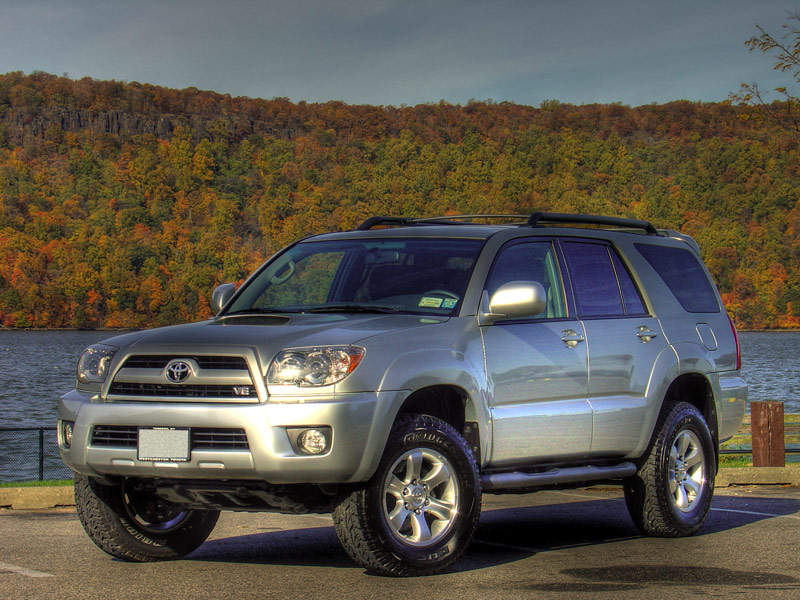
The following is a walkthrough of the process, products and results of a fairly thorough detailing I performed on each of my two 4Runner vehicles recently. <br>
Prior to this detailing session, and at least for a few years straight, I had been hand polishing and waxing using a variety of the the <a href="http://www.griotsgarage.com/" target="_blank">Griot's Garage</a> line of products...most notably their Fine Hand Polish and Best Of Show Liquid Carnauba Wax. While I do like these product alot and can recommend them, I wanted to try my hand at machine polishing and to try a synthetic liquid sealant finish rather than a wax based product. <br>
Polishing the paint, or more accurately the clear coat, of a vehicle is the primary means to eliminate swirl marks and obtain maximum gloss out of the vehicle's finish. I would have to say that this polishing step is more important than which last step product (lsp), e.g., the wax or sealer, that you use. You will see this is the case in the pictures below whereas after the final machine polishing step is completed, the gloss is at such a level you would be hard pressed to tell weather there is wax or sealer on the vehicle or not. The lsp can then be used for it's primarily purpose which is to protect the paintwork. While there are lsp's out there that include fillers to hide or mask swirl marks, I have not chosen to use such a product. They may make your swirls
disappear in the short run, but after a number of washes you can expect them to return. Correcting them through polishing is the way to go. <br>
As always, I performed an imense amount of research before deciding on which products to purchase. In the end, I chose to go with Flex-Elektrowerkzeuge Power Tools for the machine polisher and Zaino for the sealant.
<table class="caption">
<tr>
<td><img src="http://www.top4runners.com/ja/2007/detailing/DSC03158.jpg" border="2"><br>Flex XC 3401 VRG<br>Dual Action Polisher</td>
</tr>
</table><br>
<b>Machine Polisher / Buffer:</b> <br>
I knew right away that for machine polishing duties I wanted a dual-action polisher rather than a circular type rotary buffer. While a circular rotary offers superior paint correction ability, it comes with a few drawbacks. The rotarys high power and direct drive motor create much heat and if not in an experienced hand can easily burn the paint. Holograms and buffer trials are other effects that may be experienced by the unexperienced user. Like mentioned above, I take good care of the paintwork and the level of correction available via a rotary buffer is not what my particular vehicles would need by any means. <br>
So a dual action random orbital machine polisher is what I wanted. There a few good choices out there. The Porter Cable (PC) 7336/7424 at 3.7 amps, is the most used by far. It started out as a woodworking sander and gained popularity in the automotive world of detailing about 10 years ago. Other choices
include the Ultimate Detailing Machine (UDM), at 4.2 amps, is currently just an upgraded PC. The Griot's Garage Random Orbital includes a lifetime guarantee but uses some proprietary parts. The Meguiars G-110 Dual-Action Machine Polisher at 4.2 amps has 14% more power than the original PC and is about that
much more in cost as well. The Megs G110 would be my choice if it were not for the relatively new Flex product. <br>
The <a href="http://www.flexnorthamerica.com/XC3410VRG.html" target="_blank">Flex XC 3401 VRG Dual-Action Polisher</a> is what I ultimately went with. While the above four products are typically described as dual-action (DA) machines, in reality they are simply just random orbital (oscillating) only type products. While they appear to both rotate and oscillate (two / dual actions), the rotation is of the free-rotating type and not the forced rotation type like the Flex XC 3401 VRG. They won't
rotate while under load. The Flex is a true dual action machine. It has a forced circular motion combined with random orbiting oscillations which are said to provide 90% of a true rotary machines cutting ability while nearly eliminating the side effects of burn through, holograms and buffer trails. Cost wise the Flex machine is double the price of a PC but I feel it is well worth it. <br>
Some features of the Flex product that helped my decision were the: <br>
<li>7.5 amps / 900 watts of power. Can handle extreme loads without bogging down.
<li>True dual action, forced rotation and random orbital oscillation.
<li>Bale-style handle which provides an easy to control, natural hand positioning.
<li>Variable speed trigger, while all the machines mentioned above including the Flex include a multi selection speed switch, the Flex product additionally
offers a variable speed trigger which allows a controled gradual ramp up acceleration of speed to the desired max selector setting thereby avoiding splatter of polish.
<li>13 foot power cord, eliminates the need for extension cords.
<li>Pre-installed 5.5 inch padded velcro backing plate which is soft and cushioned for uniform pressure distribution.
<li>8mm of orbital movement.
<li>FLEX seven-fold microprocessor electronics. with consistent speed control by tachometer generator, soft start, accelerator trigger switch,
restart protection after power interruption, overload protection, temperature monitoring, and speed selection.
<li>Spindle lock for easy removal of backing plate.
<li>Quality shut-off carbon brushes: if the carbon brushes wear down, the motor will be automatically switched off and thus protected from damage.
<li>Removable, ergonomic SoftVib side handle knob grip. Isolated from the machine housing by damping elements, noticeably reducing vibration. <br>
The PC type machines can bog down under significant load and virtually stop oscillating all together. This is touted as a safety feature and makes it so that you cannot burn your paint at all. The Flex however, with its significant power increase and forced rotation does not bog down and can perform significantly greater paint correction as a result. You should treat this power with the respect it deserves but by the same token need not fear it nearly as much as a true circular only type buffing machine. <br>
<table class="caption">
<tr>
<td><img src="http://www.top4runners.com/ja/2007/detailing/DSC03187.jpg" border="2"><br>Lake Country<br>buffing pads</td>
</tr>
</table><br>
<b>Buffing Pads:</b> <br>
<a href="http://www.lakecountrymfg.com/ccsfoampads.html" target="_blank">Lake Country</a> Collapsed Cell Structure (CCS) High Performance (HP) DA Buffing/Polishing Pads.<br>
These particular pads are sized at 6.50"x 1.25". This is a nice fit on the 5.50" backing plate as it allows a 0.50" of pad overlap around the velcro backing plate. These pads improve polish performance by slowing and controlling the rate of polish absorbtion. The pads are created with a beveled edge to allow user more control when polishing at an angle. They feature a 3/8" setback of velcro material which helps to center the pad and provides extra flexibility when polishing in curved body panels. <br>
The pads are color coded which indicates the level of "cut" they provide. I chose to go with the following colors: <br>
<li>Yellow for Cutting - Applying compounds or polishes to remove severe oxidation, swirls, and scratches.
<li>Orange for Light Cutting - Firm, high density foam for scratch and defect removal.
<li>White for Polishing - light cutting power for fine polishes and pre-wax cleaners.
<li>Black for Finessing - No cut for final jeweling or even applying waxes or sealers. <br>
They do make other colors as well and here is what they would be used for: <br>
<li>Purple: This is a foamed wool pad for the most serious cut possible before turning to wet sanding.
<li>Green: for heavy polishing
<li>Blue: for finessing, zero cut.
<li>Red: for finishing, zero cut. <br>
<table class="caption">
<tr>
<td><img src="http://www.top4runners.com/ja/2007/detailing/DSC03180.jpg" border="2"><br>polishing products</td>
</tr>
</table><br>
<b>Polishing products:</b> <br>
Here are the polishing compounds from coarsest to finest that I will be using. This will be my first opportunity to try the Menzerna and Zaino products. <br>
<li><a href="http://products3.3m.com/catalog/us/en001/home_leisure/-/node_2NGTQH0G1Gbe/root_GS2MT8MCQBgv/vroot_BWFLZ648DFge/gvel_V81136SWNHgl/theme_us_chimpartnersupport_3_0/command_AbcPageHandler/output_html" target="_blank">3M 39002</a> Perfect-It ll Rubbing Compound Fine Cut 3M-39002<br>
This is the most coarse compound that I will have on hand for this detail. I plan on using it in combination with the Yellow polishing pad. It is marketed to safely and effectively remove grade 1200 or finer sand scratches, other fine scratches, medium oxidation, coarse swirl marks or water spots, while leaving a fine finish. This is not a new purchase and I had it already as it is excellent for hand compounding applications. If I didn't already have this product I would have went with Menzerna Powergloss POS34A which would have had one step more cut or more like 3M's Perfect-It III Extra Cut rubbing compound 05936. All three of these products dictate using a follow up product to bring out the highest level of shine after their more agressive level of compounding. <br>
<li><a href="http://www.menzerna.de/27.html?&L=1" target="_blank">Menzerna PO91E</a> Intensive Polish (IP)<br>
This polish removes grade 2000 grit sanding scratches. I intend on combining this product with the orange polishing pad.
Though it is said that no follow up polishing is necessary after using IP, I intend on following up the application of IP with FPII for even
more refinement and shine. <br>
<li><a href="http://www.menzerna.de/27.html?&L=1" target="_blank">Menzerna Micro Polish PO87MC</a> Final Polish II (FPII)<br>
This finishing polish removes grade 2500 grit and finer sanding scratches. I intend on using this product with the white polishing pad. Some people report that following up FPII with Menzerna's PO85RD (removes grade 3000 grit and finer sanding scratches) will bring out an even finer level of shine, and maybe if I had a black colored vehicle I would try this final jeweling step, but for now I will just finish up with FPII. <br>
<li><a href="http://www.zainostore.com/Merchant2/merchant.mvc?Screen=PROD&Product_Code=Z-PC&Category_Code=Zaino&Product_Count=6" target="_blank">Zaino ZPC</a> Z-PC Fusion Dual Action Paint Cleaner Swirl Remover<br>
While I plan on using the above three products on my 1999 Imperial Jade Mica 4Runner, which as of this writing is 9 years old, I do not intend on using this Zaino ZPC product in conjunction with the above polishes. Rather is going to be used on my one year old 2007 4Runner as a one step polish and paint cleaner. I intend on using this product with the white polishing pad, but may use it with the black if it appears to agressive on white. This product, as with the others, uses a diminishing abrasive system. This means that them polish acts more agressive at first then breaks down finer and finer to finish off with no further steps needed. It is water based and contains no fillers or oils. The Mezerna products are oil based. Beacuse ZPC is water based and contains no oils it may/will turn to a powder and dust the vehicle. <br>
<li><a href="http://www.griotsgarage.com/product/car+care/car+polishing/car+polishes/griot%27s+garage+fine+hand+polish.do" target="_blank">Griot's Garage</a> Fine Hand Polish <br> I had this product on hand already as it what I primarily used before machine polishing. This will be used for hard to reach areas of the vehicle such as under the hood, the liftgate and door jambs, the gas filler cap area, wheels and door handle areas that will still need to be hand polished. <br>
Prior to this detailing session, and at least for a few years straight, I had been hand polishing and waxing using a variety of the the <a href="http://www.griotsgarage.com/" target="_blank">Griot's Garage</a> line of products...most notably their Fine Hand Polish and Best Of Show Liquid Carnauba Wax. While I do like these product alot and can recommend them, I wanted to try my hand at machine polishing and to try a synthetic liquid sealant finish rather than a wax based product. <br>
Polishing the paint, or more accurately the clear coat, of a vehicle is the primary means to eliminate swirl marks and obtain maximum gloss out of the vehicle's finish. I would have to say that this polishing step is more important than which last step product (lsp), e.g., the wax or sealer, that you use. You will see this is the case in the pictures below whereas after the final machine polishing step is completed, the gloss is at such a level you would be hard pressed to tell weather there is wax or sealer on the vehicle or not. The lsp can then be used for it's primarily purpose which is to protect the paintwork. While there are lsp's out there that include fillers to hide or mask swirl marks, I have not chosen to use such a product. They may make your swirls
disappear in the short run, but after a number of washes you can expect them to return. Correcting them through polishing is the way to go. <br>
As always, I performed an imense amount of research before deciding on which products to purchase. In the end, I chose to go with Flex-Elektrowerkzeuge Power Tools for the machine polisher and Zaino for the sealant.
<table class="caption">
<tr>
<td><img src="http://www.top4runners.com/ja/2007/detailing/DSC03158.jpg" border="2"><br>Flex XC 3401 VRG<br>Dual Action Polisher</td>
</tr>
</table><br>
<b>Machine Polisher / Buffer:</b> <br>
I knew right away that for machine polishing duties I wanted a dual-action polisher rather than a circular type rotary buffer. While a circular rotary offers superior paint correction ability, it comes with a few drawbacks. The rotarys high power and direct drive motor create much heat and if not in an experienced hand can easily burn the paint. Holograms and buffer trials are other effects that may be experienced by the unexperienced user. Like mentioned above, I take good care of the paintwork and the level of correction available via a rotary buffer is not what my particular vehicles would need by any means. <br>
So a dual action random orbital machine polisher is what I wanted. There a few good choices out there. The Porter Cable (PC) 7336/7424 at 3.7 amps, is the most used by far. It started out as a woodworking sander and gained popularity in the automotive world of detailing about 10 years ago. Other choices
include the Ultimate Detailing Machine (UDM), at 4.2 amps, is currently just an upgraded PC. The Griot's Garage Random Orbital includes a lifetime guarantee but uses some proprietary parts. The Meguiars G-110 Dual-Action Machine Polisher at 4.2 amps has 14% more power than the original PC and is about that
much more in cost as well. The Megs G110 would be my choice if it were not for the relatively new Flex product. <br>
The <a href="http://www.flexnorthamerica.com/XC3410VRG.html" target="_blank">Flex XC 3401 VRG Dual-Action Polisher</a> is what I ultimately went with. While the above four products are typically described as dual-action (DA) machines, in reality they are simply just random orbital (oscillating) only type products. While they appear to both rotate and oscillate (two / dual actions), the rotation is of the free-rotating type and not the forced rotation type like the Flex XC 3401 VRG. They won't
rotate while under load. The Flex is a true dual action machine. It has a forced circular motion combined with random orbiting oscillations which are said to provide 90% of a true rotary machines cutting ability while nearly eliminating the side effects of burn through, holograms and buffer trails. Cost wise the Flex machine is double the price of a PC but I feel it is well worth it. <br>
Some features of the Flex product that helped my decision were the: <br>
<li>7.5 amps / 900 watts of power. Can handle extreme loads without bogging down.
<li>True dual action, forced rotation and random orbital oscillation.
<li>Bale-style handle which provides an easy to control, natural hand positioning.
<li>Variable speed trigger, while all the machines mentioned above including the Flex include a multi selection speed switch, the Flex product additionally
offers a variable speed trigger which allows a controled gradual ramp up acceleration of speed to the desired max selector setting thereby avoiding splatter of polish.
<li>13 foot power cord, eliminates the need for extension cords.
<li>Pre-installed 5.5 inch padded velcro backing plate which is soft and cushioned for uniform pressure distribution.
<li>8mm of orbital movement.
<li>FLEX seven-fold microprocessor electronics. with consistent speed control by tachometer generator, soft start, accelerator trigger switch,
restart protection after power interruption, overload protection, temperature monitoring, and speed selection.
<li>Spindle lock for easy removal of backing plate.
<li>Quality shut-off carbon brushes: if the carbon brushes wear down, the motor will be automatically switched off and thus protected from damage.
<li>Removable, ergonomic SoftVib side handle knob grip. Isolated from the machine housing by damping elements, noticeably reducing vibration. <br>
The PC type machines can bog down under significant load and virtually stop oscillating all together. This is touted as a safety feature and makes it so that you cannot burn your paint at all. The Flex however, with its significant power increase and forced rotation does not bog down and can perform significantly greater paint correction as a result. You should treat this power with the respect it deserves but by the same token need not fear it nearly as much as a true circular only type buffing machine. <br>
<table class="caption">
<tr>
<td><img src="http://www.top4runners.com/ja/2007/detailing/DSC03187.jpg" border="2"><br>Lake Country<br>buffing pads</td>
</tr>
</table><br>
<b>Buffing Pads:</b> <br>
<a href="http://www.lakecountrymfg.com/ccsfoampads.html" target="_blank">Lake Country</a> Collapsed Cell Structure (CCS) High Performance (HP) DA Buffing/Polishing Pads.<br>
These particular pads are sized at 6.50"x 1.25". This is a nice fit on the 5.50" backing plate as it allows a 0.50" of pad overlap around the velcro backing plate. These pads improve polish performance by slowing and controlling the rate of polish absorbtion. The pads are created with a beveled edge to allow user more control when polishing at an angle. They feature a 3/8" setback of velcro material which helps to center the pad and provides extra flexibility when polishing in curved body panels. <br>
The pads are color coded which indicates the level of "cut" they provide. I chose to go with the following colors: <br>
<li>Yellow for Cutting - Applying compounds or polishes to remove severe oxidation, swirls, and scratches.
<li>Orange for Light Cutting - Firm, high density foam for scratch and defect removal.
<li>White for Polishing - light cutting power for fine polishes and pre-wax cleaners.
<li>Black for Finessing - No cut for final jeweling or even applying waxes or sealers. <br>
They do make other colors as well and here is what they would be used for: <br>
<li>Purple: This is a foamed wool pad for the most serious cut possible before turning to wet sanding.
<li>Green: for heavy polishing
<li>Blue: for finessing, zero cut.
<li>Red: for finishing, zero cut. <br>
<table class="caption">
<tr>
<td><img src="http://www.top4runners.com/ja/2007/detailing/DSC03180.jpg" border="2"><br>polishing products</td>
</tr>
</table><br>
<b>Polishing products:</b> <br>
Here are the polishing compounds from coarsest to finest that I will be using. This will be my first opportunity to try the Menzerna and Zaino products. <br>
<li><a href="http://products3.3m.com/catalog/us/en001/home_leisure/-/node_2NGTQH0G1Gbe/root_GS2MT8MCQBgv/vroot_BWFLZ648DFge/gvel_V81136SWNHgl/theme_us_chimpartnersupport_3_0/command_AbcPageHandler/output_html" target="_blank">3M 39002</a> Perfect-It ll Rubbing Compound Fine Cut 3M-39002<br>
This is the most coarse compound that I will have on hand for this detail. I plan on using it in combination with the Yellow polishing pad. It is marketed to safely and effectively remove grade 1200 or finer sand scratches, other fine scratches, medium oxidation, coarse swirl marks or water spots, while leaving a fine finish. This is not a new purchase and I had it already as it is excellent for hand compounding applications. If I didn't already have this product I would have went with Menzerna Powergloss POS34A which would have had one step more cut or more like 3M's Perfect-It III Extra Cut rubbing compound 05936. All three of these products dictate using a follow up product to bring out the highest level of shine after their more agressive level of compounding. <br>
<li><a href="http://www.menzerna.de/27.html?&L=1" target="_blank">Menzerna PO91E</a> Intensive Polish (IP)<br>
This polish removes grade 2000 grit sanding scratches. I intend on combining this product with the orange polishing pad.
Though it is said that no follow up polishing is necessary after using IP, I intend on following up the application of IP with FPII for even
more refinement and shine. <br>
<li><a href="http://www.menzerna.de/27.html?&L=1" target="_blank">Menzerna Micro Polish PO87MC</a> Final Polish II (FPII)<br>
This finishing polish removes grade 2500 grit and finer sanding scratches. I intend on using this product with the white polishing pad. Some people report that following up FPII with Menzerna's PO85RD (removes grade 3000 grit and finer sanding scratches) will bring out an even finer level of shine, and maybe if I had a black colored vehicle I would try this final jeweling step, but for now I will just finish up with FPII. <br>
<li><a href="http://www.zainostore.com/Merchant2/merchant.mvc?Screen=PROD&Product_Code=Z-PC&Category_Code=Zaino&Product_Count=6" target="_blank">Zaino ZPC</a> Z-PC Fusion Dual Action Paint Cleaner Swirl Remover<br>
While I plan on using the above three products on my 1999 Imperial Jade Mica 4Runner, which as of this writing is 9 years old, I do not intend on using this Zaino ZPC product in conjunction with the above polishes. Rather is going to be used on my one year old 2007 4Runner as a one step polish and paint cleaner. I intend on using this product with the white polishing pad, but may use it with the black if it appears to agressive on white. This product, as with the others, uses a diminishing abrasive system. This means that them polish acts more agressive at first then breaks down finer and finer to finish off with no further steps needed. It is water based and contains no fillers or oils. The Mezerna products are oil based. Beacuse ZPC is water based and contains no oils it may/will turn to a powder and dust the vehicle. <br>
<li><a href="http://www.griotsgarage.com/product/car+care/car+polishing/car+polishes/griot%27s+garage+fine+hand+polish.do" target="_blank">Griot's Garage</a> Fine Hand Polish <br> I had this product on hand already as it what I primarily used before machine polishing. This will be used for hard to reach areas of the vehicle such as under the hood, the liftgate and door jambs, the gas filler cap area, wheels and door handle areas that will still need to be hand polished. <br>