Need help with a 2013 lift

Register to hide this ad
^This^

The stock tires are 9.65" wide though I wouldn't recommend them for offroading :nono:
 
It looks like the requirements for the permit only say you need 9"+ wide tires, and basically a street legal/fully operational vehicle so it looks like you're all set.

So...what exactly does this have to do with help regarding a lift? :)
 
First post so be kind

I am about to purchase a 2013 4runner limited with 20 inch rims

here is my problem - There is a ORV permit I need the requirements are that I have a minimum of 9" tread on the pavement to meet the requirements --

What mods or tires do I need to perform to the new vehicle in order to get the permit ? thanks in advance

http://www.nps.gov/bicy/planyourvisit/upload/Permit-guidelines-2011.pdf

How wide are 245's
Answer: 245mm = 9.65in

^This^

The stock tires are 9.65" wide though I wouldn't recommend them for offroading :nono:

It looks like the requirements for the permit only say you need 9"+ wide tires, and basically a street legal/fully operational vehicle so it looks like you're all set.

So...what exactly does this have to do with help regarding a lift? :)

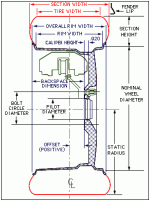
The 245 series tires are 9.65" across the section width of the tire, not the tread. The OP needs 9" of tread width and I don't think the stock tire has 9" of contact tread width but it might. OP, you might need to get wider tires or wheels but no lift required. Here is a quote from Tire Rack and a diagram from me:

"Section Width

Following the letter(s) that identify the type of vehicle and/or type of service for which the tire was designed, the three-digit numeric portion identifies the tire's "Section Width" (cross section) in millimeters.

P225/50R16 91S

The 225 indicates this tire is 225 millimeters across from the widest point of its outer sidewall to the widest point of its inner sidewall when mounted and measured on a specified width wheel. This measurement is also referred to as the tire's section width. Because many people think of measurements in inches, the 225mm can be converted to inches by dividing the section width in millimeters by 25.4 (the number of millimeters per inch).

225mm / 25.4 = 8.86""
 

Attachments

  • wheel_offset.gif
    wheel_offset.gif
    12.3 KB · Views: 1,089
Last edited:
^Interesting. looks like tire shops have been lying to me for years. I've always been told that some 285 series will be wider than others.
 
^Interesting. looks like tire shops have been lying to me for years. I've always been told that some 285 series will be wider than others.

I have had several different tread widths in the same size tires but the cross section was always the same.
 
The 245 series tires are 9.65" across the section width of the tire, not the tread. The OP needs 9" of tread width and I don't think the stock tire has 9" of contact tread width but it might. OP, you might need to get wider tires or wheels but no lift required. Here is a quote from Tire Rack and a diagram from me:

Once again 1engineer spoils a simple, but incorrect, answer with science and logic.
Good catch sir! :yo:
 
The OP needs 9" of tread width and I don't think the stock tire has 9" of contact tread width but it might. OP, you might need to get wider tires or wheels but no lift required.

I will admit that I didn't bother to read past the second page of the requirements posted, but I am wondering how did you conclude that they meant contact tread width and not section width? (It might just be my Adobe PDF acting up, but all I see is a picture of two tires and the text is all blocked out?)

According to the way they drew out what I think they meant by the "tire minimum width", it seems like the arrows are pointing to edge-to-edge total width (and not necessarily the actual contact surface). For example, looking at the tire depicted on the right, the arrows sweep all the way up to the shoulders of the tire, and it seem like the distance is actually pointing to the total arc length of the treads?

With that said, it had never even occurred to me that there are differences between the section width and tread width of a tire until I saw your diagram, great info :yo:

So could you please clarify because I am actually curious myself as to how we are to interpret these kind of requirements. Is this just something that is "understood" by avid off-roaders? Inquiring minds want to know :)
 
I will admit that I didn't bother to read past the second page of the requirements posted, but I am wondering how did you conclude that they meant contact tread width and not section width? (It might just be my Adobe PDF acting up, but all I see is a picture of two tires and the text is all blocked out?)

According to the way they drew out what I think they meant by the "tire minimum width", it seems like the arrows are pointing to edge-to-edge total width (and not necessarily the actual contact surface). For example, looking at the tire depicted on the right, the arrows sweep all the way up to the shoulders of the tire, and it seem like the distance is actually pointing to the total arc length of the treads?

With that said, it had never even occurred to me that there are differences between the section width and tread width of a tire until I saw your diagram, great info :yo:

So could you please clarify because I am actually curious myself as to how we are to interpret these kind of requirements. Is this just something that is "understood" by avid off-roaders? Inquiring minds want to know :)

Let me attempt to explain:
First off, actual tread width would be all that matters for specifying a tire for a surface like sand. I took a few minutes last night and measured my stock 265 tires on my TE and came up with (approximate) these dimensions:

Section width - 10.43" (calculated)
Tread width - 7.50" (measured)
Tread longitudinal contact length - 7.50" (measured)
35 psi in the tire

Now these are measured with a tape measure so they are close but not perfect.
If I take these measurements and also use a curb weight of 4,750 lbs then it is easy to come up with a ground pressure. There is no magic number for ground pressure. The thinner the tire and the higher the inflation pressure, the higher the ground pressure is going to be with respect to the weight of the vehicle.

After doing the calculations I came up with a force of about 21 lbs per square inch of ground. Is this good? Bad? Indifferent? It all depends. See, a passenger vehicle is a design compromise, along with most components on a passenger vehicle. You have to design for all kinds of conditions, and that includes all the different surfaces the vehicle will be driven.

Knowing that, operating on different surfaces (snow, ice, blacktop, mud, sand, etc) optimally will require different ground pressures for the best possible performance. Here is an extreme comparison: A bicycle in loose sand or a 4Runner with 9" wide tires in loose sand. My bike exerts about 35 lbs per square inch and a 4runner with tires that have a 9" wide tread exerts about 17.6 lbs of force per square inch. Have you ever tried to ride a bike in loose sand? Not easy at all but the 4runner only exerts HALF the ground pressure the mtn bike does, and the performance is much better. Basically what a wider tire does is offer FLOTATION over the desired surface. Airing a tire down will increase the contact patch of the tire (not wider but longer) and reduce ground pressure so the tires will not "sink" into the surface. It will also provide increased contact area for traction in loose ground. I did a few examples:

Stock OEM tire with 7.5" of tread = 21 lbs of ground pressure
9" tread - 17.6 lbs of ground pressure
11" tread - 14.4 lbs of ground pressure

If you have seen pictures of the Arctic Toyota trucks with the huge tires they are running just a few lbs of ground pressure, so they can "float" over the deep snow, much like strapping snowshoes to your feet. Conversely, if you have watched a WRC car making a run on ice and snow they are running very thin tires to increase their ground pressure and improve traction.

Bottom line is ground pressure is very important to a vehicle in different conditions, and different conditions require different ground pressure to have optimal traction. In the case of this application and specification from the OP, the park service has probably determined the tire width to keep from having to pull all the dumba$$s out of the sand when they get stuck. Hope this helps.

 
First forum I've been on where getting schooled can actually be a good thing :cheers:

Thanks for taking all the time out to provide real world examples and explaining it, it great to hear about the actual science behind it all :)
 

Members online

No members online now.

Forum statistics

Threads
278,310
Messages
3,554,079
Members
248,016
Latest member
Advally Service

Trending content

Back
Top