Need help with mysterious major oil leak

That vacuum line is for the fuel pressure regulator. Likely not the culprit but don’t rule it out that is could be. Vacuum problems can wreck havoc on an engine from hard stars to throwing off MAP sensors (which we don’t have).

PCV OEM? Any oil in the throttle body?
 
Last edited:
That vacuum line is for the fuel pressure regulator. Likely not the culprit but don’t rule it out that is could be. Vacuum problems can wreck havoc on an engine from hard stars to throwing off MAP sensors (which we don’t have).

PCV OEM? Any oil in the throttle body?

Intermotor PCV valve:

https://www.rockauto.com/en/moreinfo.php?pk=1320710&cc=1357455&jsn=1

It was smoking before and after I replaced it, so it's not likely the culprit. A little oil was inside the throttle body. About a teaspoon of oil was inside each of the 6 passages inside the intake manifold.
 
Did you read my post about checking the front crankshaft seal?

Yep. When (if) I pull it all apart again, I will definitely look at that. However, I can see oil much higher up on the front passenger side of the engine, near the a/c compressor bracket, so it's looking more like it's that camshaft seal.
 
How are you installing the seals? I install them and use a correct diameter piece of pipe or PCV pipe to drive them in until they bottom out.

They go in deeper than flush.

If I don't have something the correct size I tap it in evenly with a punch and small hammer.


Sent from my iPhone using Tapatalk
 
How are you installing the seals? I install them and use a correct diameter piece of pipe or PCV pipe to drive them in until they bottom out.

They go in deeper than flush.

If I don't have something the correct size I tap it in evenly with a punch and small hammer.


Sent from my iPhone using Tapatalk

I install them the same way, making sure they are even with the surface (not cocked), and at the same depth as the ones I removed, which was in this case, flush with the surface next to it. Maybe I should drive them in until they bottom out. But I don't like experimenting, when this much work is involved. I try to stay to the knowns.
 
I install them the same way, making sure they are even with the surface (not cocked), and at the same depth as the ones I removed, which was in this case, flush with the surface next to it. Maybe I should drive them in until they bottom out. But I don't like experimenting, when this much work is involved. I try to stay to the knowns.

I would just remove the cam cap. Way easier and you don't have to pull out anything or hammer anything in.
 
I would just remove the cam cap. Way easier and you don't have to pull out anything or hammer anything in.

Yep. Then I wouldn't nick the shaft, like I did on the driver side. I filled the nick with JBWeld, and sanded it down smooth and flush with the shaft. Funny how it's likely the opposite side leaking now.
 
Update:

I think I have it narrowed down now. The burning oil and the leak are 2 separate items. I never really thought they were related, but it sure is a coincidence.

It appears that the vacuum line to the fuel pressure regulator probably had the vacuum system out of whack enough to blow or draw a significant amount of oil into the intake. After re-connecting the vacuum hose, I just took it for a test drive. It smoked like crazy on startup, but I know there was a good bit of residual oil in the intake manifold, that needed to get out. I shut it off and restated it, getting the same amount of smoke. Then I took it for a test drive. I kept in in D2, to keep the rev's up to around 3k rpm while I drove around at 40-50 mph. I wanted to get a good bit of air flowing through the intake to suck the oil down into the engine. About 2 miles later, I was home again. Shut it off and restarted it. No smoke at all. I tried it again, and still no smoke. I am not 100% certain that that the short, little disconnected vacuum hose was the cause of the intake oil, but so far it is looking good as being the cause.

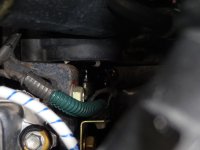
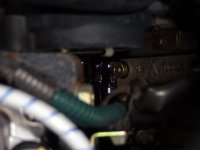
I am posting more pictures of the leak. This is fresh oil. Outside in the sunlight, with a flashlight on it, I could actually see a small drip right in the center of the pictures below. That just so happens to be right below the passenger side camshaft seal. I will remove everything on the front of the engine after it cools, and replace at least that seal. I will look very closely at the other two shaft seals, and replace them too, if there is any sign of leakage. If there isn't any sign of leakage, I am definitely not screwing with them.

In a situation like this, we often can only go with our best guess, as few things are definite, and things are very, very often not what they appear to be. It takes a lot of studying to see enough clues to find the root cause.

I will update again once I learn anything new, and I very much appreciate the help I have gotten so far.

 

Attachments

  • DSC01201.jpg
    DSC01201.jpg
    116.7 KB · Views: 402
  • DSC01203.jpg
    DSC01203.jpg
    110.6 KB · Views: 396
  • DSC01204.jpg
    DSC01204.jpg
    128.8 KB · Views: 386
I install them the same way, making sure they are even with the surface (not cocked), and at the same depth as the ones I removed, which was in this case, flush with the surface next to it. Maybe I should drive them in until they bottom out. But I don't like experimenting, when this much work is involved. I try to stay to the knowns.


Driving them in until they bottom out is not and experiment. It's how it should be done in my opinion that's how I've been doing it since the early 80's


Sent from my iPhone using Tapatalk
 
Driving them in until they bottom out is not and experiment. It's how it should be done in my opinion that's how I've been doing it since the early 80's


Sent from my iPhone using Tapatalk

To me, it's an experiment when the ones I am replacing, that were working fine, weren't bottomed out. I'm talking about the original ones. They weren't leaking.
 
Congrats! At least be happy that you found one of the two problems, with this one probably being more serious. Like I said vacuum problems can lead to nightmares.

Maybe take a closer look at the front semi circular or half moon plug.
 
Congrats! At least be happy that you found one of the two problems, with this one probably being more serious. Like I said vacuum problems can lead to nightmares.

Maybe take a closer look at the front semi circular or half moon plug.

Yep. While doing the rear seals and plugs, it didn't occur to me to do the front ones, until I had already installed one valve cover. I did the remaining half moon, on the passenger side. I will do the other one when I take all of this apart again.
 
Yep - I checked again, and all vacuum hose routing seems fine. I made a reply above that I found a loose vacuum hose, though. I'm hoping that might be the cause of oil in the intake.

I agree about the cam seal likely being the cause of the leak. By process of elimination, it couldn't be much else. I guess I need to go ahead and get all 3 front shaft seals again, take it all apart again, and then likely have the problem glaring at me. Seals are cheap.

Man - you are really running the paces with this issue and I think we can all empathize with you.

As this is a long thread, I do not recall if you replaced the half moons on your rig.....if not, that might be the issue and definitely the front cam seals. Seals are a funny thing. If they are not driven in "just right", they can tend to leak....

I am keeping my fingers crossed you will hunt down this issue and report some good news. Hang in there man!
 
Update:

I think I have it narrowed down now. The burning oil and the leak are 2 separate items. I never really thought they were related, but it sure is a coincidence.

It appears that the vacuum line to the fuel pressure regulator probably had the vacuum system out of whack enough to blow or draw a significant amount of oil into the intake. After re-connecting the vacuum hose, I just took it for a test drive. It smoked like crazy on startup, but I know there was a good bit of residual oil in the intake manifold, that needed to get out. I shut it off and restated it, getting the same amount of smoke. Then I took it for a test drive. I kept in in D2, to keep the rev's up to around 3k rpm while I drove around at 40-50 mph. I wanted to get a good bit of air flowing through the intake to suck the oil down into the engine. About 2 miles later, I was home again. Shut it off and restarted it. No smoke at all. I tried it again, and still no smoke. I am not 100% certain that that the short, little disconnected vacuum hose was the cause of the intake oil, but so far it is looking good as being the cause.

I am posting more pictures of the leak. This is fresh oil. Outside in the sunlight, with a flashlight on it, I could actually see a small drip right in the center of the pictures below. That just so happens to be right below the passenger side camshaft seal. I will remove everything on the front of the engine after it cools, and replace at least that seal. I will look very closely at the other two shaft seals, and replace them too, if there is any sign of leakage. If there isn't any sign of leakage, I am definitely not screwing with them.

In a situation like this, we often can only go with our best guess, as few things are definite, and things are very, very often not what they appear to be. It takes a lot of studying to see enough clues to find the root cause.

I will update again once I learn anything new, and I very much appreciate the help I have gotten so far.


The hose to the fuel pressure regulator is not a vacuum hose like it is on other vehicles. Follow it. It should go to air filter housing.
 
Last edited:
The hose to the fuel pressure regulator is not a vacuum hose like it is on other vehicles. Follow it. It should go to air filter housing.

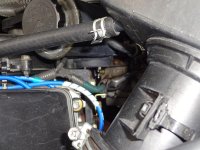
I followed it its entire 3" length. If that is the case, then my 3" long hose that has been there for at least 10 years should have been a couple of feet longer. The hose I was talking about goes from a fitting on the back of the intake manifold to a valve immediately behind and below it. See my picture in post #77.
 
I followed it its entire 3" length. If that is the case, then my 3" long hose that has been there for at least 10 years should have been a couple of feet longer. The hose I was talking about goes from a fitting on the back of the intake manifold to a valve immediately behind and below it. See my picture in post #77.

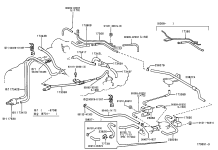
That 3" hose goes to a piece of metal tubing that goes between the two upper manifold sections and comes out and a hose goes from there to the air filter housing
 
Here's a breakdown

Now I see what you were saying - thanks. When I found it, I was on a step stool, leaned over as far as I could, with the hood latch trying to rupture my stomach. I wasn't able to study where it went at the time, and it appeared to run right into the manifold.
 
Leak repair update.

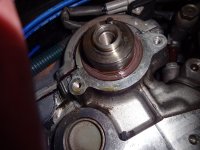
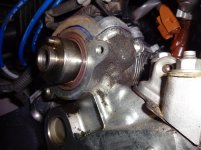
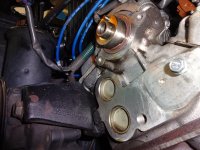
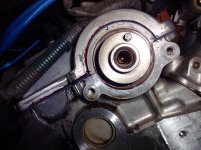
Almost 7 hours after I started taking it back apart again, I found the leak, without a doubt. Looking at the pictures, it looks like the shaft seal was "rolled", despite me lubing the insides of the seals before I installed them, and despite me being careful overall, and driving them in with a piece of PVC pipe. I am going to replace it, and study it closely for being "rolled", before I put everything back together.

Now I am torn between getting new seals from NAPA (Fel-pro seals), or the Toyota dealer. I am aware that normally OEM is best, despite the fact that Toyota does not make seals - they just "brand" them. But they chose the vendor that they believe makes the best seal. However, another member here posted that a new OEM crank seal leaked, and a NAPA one worked correctly.

Here are some pictures. Any other thoughts or advice? I am going to rest some and think on things before I buy seals and put it all back together. When I am finally done, it will be done correctly. No ifs, ands or butts. I am NOT going to do this horrendous job for the third time.

Also, the most difficult part of this entire job is removing that &*&&$^#&#^#^ a/c compressor bracket, so I could remove the timing belt tensioner. Yes, I am aware that the tensioner can be removed with a 1/4" drive extension and a universal joint. I did try that, but was unable to get a socket on the rear tensioner bolt, because I couldn't see a path to it. I tried real hard, but didn't succeed. It took me well over an hour just to remove that *($&#*&*&#*&#*&# compressor bracket.
 

Attachments

  • DSC01221.jpg
    DSC01221.jpg
    135.6 KB · Views: 348
  • DSC01223.jpg
    DSC01223.jpg
    135.2 KB · Views: 335
  • DSC01225.jpg
    DSC01225.jpg
    137.4 KB · Views: 342
  • DSC01226.jpg
    DSC01226.jpg
    137.1 KB · Views: 339

Members online

Forum statistics

Threads
278,316
Messages
3,554,121
Members
248,016
Latest member
Advally Service

Trending content

Back
Top