

You are using an out of date browser. It may not display this or other websites correctly.
You should upgrade or use an alternative browser.
You should upgrade or use an alternative browser.
Octanejunkie's 4runner Journal - 2WD
- Thread starter octanejunkie
- Start date
octanejunkie
Elite Member
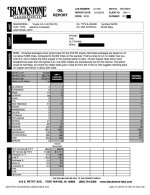
Impressive oil report. Would be interested to see the TBN to understand if the detergency is still holding up after 30k.
EDIT: I reached back out to Blackstone and asked if they could run the TBN test and they did. See post #166
Last edited:

jgue467
Senior Member
...
16" 5-star with Hankook Dynapro ATs ...
I want those back on again - went 70k with a set, Excellent tire for the $. :cowboy:
octanejunkie
Elite Member
I want those back on again - went 70k with a set, Excellent tire for the $. :cowboy:
Considering Hankook MTs on my 17" rims for summer crawling but will go with 285 ATs on the 16" rims next time. The Hankooks have been good tires for me.
octanejunkie
Elite Member
Impressive oil report. Would be interested to see the TBN to understand if the detergency is still holding up after 30k.
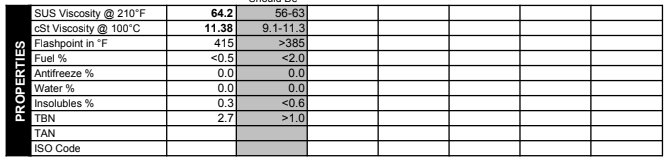
Reached back out to Blackstone, they had enough oil to run a TBN test and here is the result, TBN = 2.7
Last edited:

Wedgy
New member
I had to look up TBN....
2.7 looks pretty low
AMSOIL Advantage – High TBN
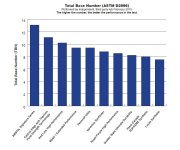
Because AMSOIL synthetic lubricants demonstrate consistently high TBNs, they neutralize acidic contaminants and keep them in suspension to prevent corrosion, maximizing engine protection. AMSOIL lubricants use detergent and dispersant additives to significantly reduce sludge and carbon deposit formation. In the Total Base Number Test (ASTM D2896), AMSOIL Signature Series 5W-30 Synthetic Motor Oil demonstrated the highest TBN of the oils featured in the test, helping it deliver reliable protection for extended drain intervals.
2.7 looks pretty low
AMSOIL Advantage – High TBN
Because AMSOIL synthetic lubricants demonstrate consistently high TBNs, they neutralize acidic contaminants and keep them in suspension to prevent corrosion, maximizing engine protection. AMSOIL lubricants use detergent and dispersant additives to significantly reduce sludge and carbon deposit formation. In the Total Base Number Test (ASTM D2896), AMSOIL Signature Series 5W-30 Synthetic Motor Oil demonstrated the highest TBN of the oils featured in the test, helping it deliver reliable protection for extended drain intervals.
Attachments
octanejunkie
Elite Member
[MENTION=211420]Wedgy[/MENTION]
According to Blackstone Labs, a TBN over 1.0 in used oil indicates the oil still has "life" left in it from a performance standpoint. A TBN of 2.7 after 30K miles is obviously lower than the TBN of new oil, usually 6.0 to 14.0, but is still considered in the "performance range" from the standpoint of detergency, lubricity and anti-acidity. I do not know what the TBN of my oil was when it was new to compare how much of a drop in performance 2.7 represents from new oil.
In a nutshell, I'm pretty impressive given the age/mileage of the oil, IMO
According to Blackstone Labs, a TBN over 1.0 in used oil indicates the oil still has "life" left in it from a performance standpoint. A TBN of 2.7 after 30K miles is obviously lower than the TBN of new oil, usually 6.0 to 14.0, but is still considered in the "performance range" from the standpoint of detergency, lubricity and anti-acidity. I do not know what the TBN of my oil was when it was new to compare how much of a drop in performance 2.7 represents from new oil.
In a nutshell, I'm pretty impressive given the age/mileage of the oil, IMO

JZiggy
Senior Member
[MENTION=211420]Wedgy[/MENTION]
According to Blackstone Labs, a TBN over 1.0 in used oil indicates the oil still has "life" left in it from a performance standpoint. A TBN of 2.7 after 30K miles is obviously lower than the TBN of new oil, usually 6.0 to 14.0, but is still considered in the "performance range" from the standpoint of detergency, lubricity and anti-acidity. I do not know what the TBN of my oil was when it was new to compare how much of a drop in performance 2.7 represents from new oil.
In a nutshell, I'm pretty impressive given the age/mileage of the oil, IMO
PQIA has virgin oil analysis (VOA) reports on a lot of motor oils including Mobil 1 which I think you said you were using. Their report here shows a starting TBN of 9.7, which is quite high for a standard gasoline engine oil.
An ending TBN of 2.7 is very reasonable. It means the dirty soapy water in the sink will still clean the dishes :tongue:
Wedgy
New member
I was looking to see what the TBN of conventional oil is and found some interesting stuff, could probably rear days worth of it....LOL
I guess the TBN's are similar.
I have always been of the "change oil often because it gets dirty" and use cheaper oil and a decent filter. I would never dream of going 30K miles but your case makes a strong argument for longer intervals. Automatic transmissions go a long ways without getting the fluid changed, most people don't do anything until they have a problem, so I guess it can work, until it doesn't.
Mike, were you worried about it at all, other than topping it off ?
The only person I know that went that long was a buddy in high school whose engine leaked & burned oil so bad he just kept adding used oil he got from his job at the gas station.... about 2 quarts a week.
-----------------------------------------------------------------------------------------------------------------------------------------------
Because in light duty applications synthetics are designed for extended OCIs and conventional oils aren't. It has nothing to do with synthetic vs conventional superiority.
If you look at heavy duty applications, there are all sorts of conventional oils that will spank most if not all PCMO synthetic oils in TBN and their ability to go the distance.
Also TBN is just one aspect of oil makeup for extended OCIs, there are other factors as well.
They do not necessarily "spank" PCMO syn oils, the TBN is relatively comparable, that's not the difference between PCMO and HDEO. HDEO's are designed with hard use and high temperatures in mind, so they are mainly more shear resistant with more anti wear additives on average. EX is T5 10W30, its rated SM due to higher than SN wear additives (while having a similar TBN to PP) and its not rated as resource conserving due to higher viscosity for a 30w, but SN is not its target, a hard working diesel or gas engine is.
I guess the TBN's are similar.
I have always been of the "change oil often because it gets dirty" and use cheaper oil and a decent filter. I would never dream of going 30K miles but your case makes a strong argument for longer intervals. Automatic transmissions go a long ways without getting the fluid changed, most people don't do anything until they have a problem, so I guess it can work, until it doesn't.
Mike, were you worried about it at all, other than topping it off ?
The only person I know that went that long was a buddy in high school whose engine leaked & burned oil so bad he just kept adding used oil he got from his job at the gas station.... about 2 quarts a week.
-----------------------------------------------------------------------------------------------------------------------------------------------
Because in light duty applications synthetics are designed for extended OCIs and conventional oils aren't. It has nothing to do with synthetic vs conventional superiority.
If you look at heavy duty applications, there are all sorts of conventional oils that will spank most if not all PCMO synthetic oils in TBN and their ability to go the distance.
Also TBN is just one aspect of oil makeup for extended OCIs, there are other factors as well.
They do not necessarily "spank" PCMO syn oils, the TBN is relatively comparable, that's not the difference between PCMO and HDEO. HDEO's are designed with hard use and high temperatures in mind, so they are mainly more shear resistant with more anti wear additives on average. EX is T5 10W30, its rated SM due to higher than SN wear additives (while having a similar TBN to PP) and its not rated as resource conserving due to higher viscosity for a 30w, but SN is not its target, a hard working diesel or gas engine is.
octanejunkie
Elite Member
PQIA has virgin oil analysis (VOA) reports on a lot of motor oils including Mobil 1 which I think you said you were using. Their report here shows a starting TBN of 9.7, which is quite high for a standard gasoline engine oil.
An ending TBN of 2.7 is very reasonable. It means the dirty soapy water in the sink will still clean the dishes :tongue:
Lol, exactly

I would never dream of going 30K miles but your case makes a strong argument for longer intervals. Automatic transmissions go a long ways without getting the fluid changed, most people don't do anything until they have a problem, so I guess it can work, until it doesn't.
~
Mike, were you worried about it at all, other than topping it off ?
To be honest, no. I wasn't worried at all, other than critical stares from my peers, but I was and remain convinced that these engines are capable of both extended life and service intervals under the right conditions; as evidenced by people going 300K and 400K miles without breaking a sweat.
I did a fair amount of research before and during the EOCI experiment and kept a good eye on the oil level and engine vitals along the way. Plus before the transition I did a series of short run oil changes and seafoam treatments and felt confident going in that my oil system was as clean as it was going to get for my mileage.
I was most surprised that in the 15 months (I extended the trial which I originally planned to be 12 months) I only added 1 quart total to maintain the proper oil level.
Moving forward, my goal is once a year oil changes, or 20K miles, whichever comes first. My next is at 297/300K, when major service is due. The goal at that time is timing belt, water pump, belts, plugs, wires, injectors, and of course, an oil change.

4Runner4Leon
Senior Member
This is good info Mike! I used to do 5K oil changes (using Mobil 1), but have since transitioned to 10K. Good to know that there's probably tons of margin on top of that.
I'll probably stick with the 10K, if for no other reason than it gives me the opportunity/incentive to look at the motor more closely, to make sure nothing is leaking or falling off.
I'll probably stick with the 10K, if for no other reason than it gives me the opportunity/incentive to look at the motor more closely, to make sure nothing is leaking or falling off
.
octanejunkie
Elite Member
286000
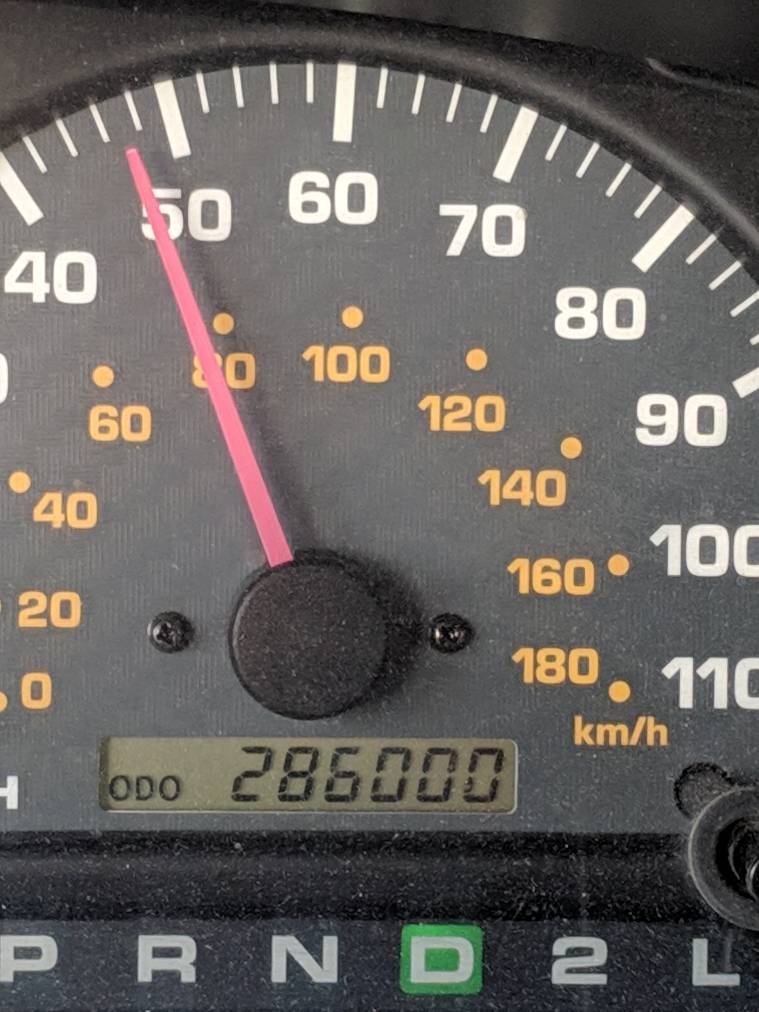
Turned 286K yesterday (I told Waze I was a passenger so it was okay to take the pic)
Noticed my brake pedal going stiff a few times in the last week, I suspect the booster may be on it's way out but I'm exploring all avenues (check valve, grommet, etc
Harvested PNs from this thread
Check Valve PN 44730-60060
Check Valve Grommet PN 90480-2415
Noted DrCoffee revived a frozen check valve wtih a WD-40 soak from both sides but I doubt I'm suffering a frozen check valve in SoCal in May
Turned 286K yesterday (I told Waze I was a passenger so it was okay to take the pic)
Noticed my brake pedal going stiff a few times in the last week, I suspect the booster may be on it's way out but I'm exploring all avenues (check valve, grommet, etc
Harvested PNs from this thread
Check Valve PN 44730-60060
Check Valve Grommet PN 90480-2415
Noted DrCoffee revived a frozen check valve wtih a WD-40 soak from both sides but I doubt I'm suffering a frozen check valve in SoCal in May
Last edited:

TonyB66
New member
Turned 286K yesterday (I told Waze I was a passenger so it was okay to take the pic)
Noticed my brake pedal going stiff a few times in the last week, I suspect the booster may be on it's way out but I'm exploring all avenues (check valve, grommet, etc
Harvested PNs from this thread
Check Valve PN 44730-60060
Check Valve Grommet PN 90480-2415
Noted DrCoffee revived a frozen check valve wtih a WD-40 soak from both sides but I doubt I'm suffering a frozen check valve in SoCal in May
Already have your 300K patch or sticker ordered? Seems like a milestone you'll be hitting pretty soon Mike...
I recalled some pedal testing for a brake booster, and I believe this is it (has been a while):
...there is a there is a quick and simple way to check the booster. Follow the steps below:
A) With the engine not running, press and depress the brake pedal several times to remove any vacuum from inside the booster.
B) On the last push of the brake pedal, hold moderate pressure on the brake pedal. Don’t push like you are panic stopping, but simply hold pressure like you are sitting at a red light.
C) With your foot still on the brake pedal, start the engine and pay attention to what happens to the brake pedal. One of two scenarios is going to happen:
1) If the pedal drops slightly, that means that the booster diaphragms are working correctly as the engine starts to create vacuum and the diaphragms are physically holding. At this point, it must be assumed the booster is working correctly.
2) If the pedal does not move at all, that says that the booster does not have the ability to hold the necessary vacuum inside or the two-way valve internal of the booster is not functioning properly. Replacement of the brake booster would be recommended at this point.
How to: Diagnosing a Hard Brake Pedal
Curious what you find-out...
octanejunkie
Elite Member
Thanks for that Tony
I've done it a few times with mixed results... I guess that confirms my booster is behaving inconsistently lol
Sent from my Pixel XL using Tapatalk
I've done it a few times with mixed results... I guess that confirms my booster is behaving inconsistently lol
Sent from my Pixel XL using Tapatalk
octanejunkie
Elite Member
287675 Brake booster swap
My booster died about a week ago, boy was it fun driving with manual brakes for a week. I found disconnecting the vacuum hose and plugging the port on the manifold kept me from having to fight the failed booster which used the envine's vacuum to make the pedal even harder to press lol.
While researching the booster swap, I found this thread - all tolled, the swap took me 20 mins to do and I did not have to bleed the brakes.
Went to LKQ and scored a booster off a 97 4runner with 263K miles on the clock. 40% off Memorial Day weekend didn't suck but with a warranty it was still over $45 but it's all good.
The swap was pretty simple. On my 99 I left the hard lines connected to the MC and just pulled the MC forward of the engine hook after unbolting it and disconnecting the fluid sensor wire and let it rest against the hook towards the front of the truck - no need to disco the hard lines, or the engine hook for that matter.
Once you disco the pedal and remove the 4 nuts from the inside, the top right nut at 1:00 being the hardest/first you should do, the booster pulls right out and up in the engine bay. Be careful around all the eval crap. There is a small, hard plastic line that i removed completely to avoid cracking it, the rest of the plugs and hoses can just be moved to the side.
The new booster slides in the same way the old one came out. You can themp up the MC first hold the booster in place for you Snug down the 4 bolts on the inside, the 2 MC bolts on the outside, and connect all the hoses and voila, power brakes are back.
The only tools I used/needed were a 12mm deep socket, 6" swivel extension (mine is a snap on) and needle nose pliers (for the clevis pin at the pedal)
I also used a 10mm socket to remove the evap vacuum relay bracket on the firewall above the booster at 1:00 but you may be able to remove the booster without removing that.
The most time consuming part was finding a good donor truck at the yard that still had a booster and check valve complete.
Unrelated
My battery light came on yesterday while driving for about 2 miles then turned itself off. I tested the alternator (pull the + battery cable while the car is running in park) and it "passed" but I snagged another OEM alternator at the yard just to have on hand. I'll swap the new alternator in to make sure it works before the warranty runs out.
My booster died about a week ago, boy was it fun driving with manual brakes for a week. I found disconnecting the vacuum hose and plugging the port on the manifold kept me from having to fight the failed booster which used the envine's vacuum to make the pedal even harder to press lol.
While researching the booster swap, I found this thread - all tolled, the swap took me 20 mins to do and I did not have to bleed the brakes.
Went to LKQ and scored a booster off a 97 4runner with 263K miles on the clock. 40% off Memorial Day weekend didn't suck but with a warranty it was still over $45 but it's all good.
The swap was pretty simple. On my 99 I left the hard lines connected to the MC and just pulled the MC forward of the engine hook after unbolting it and disconnecting the fluid sensor wire and let it rest against the hook towards the front of the truck - no need to disco the hard lines, or the engine hook for that matter.
Once you disco the pedal and remove the 4 nuts from the inside, the top right nut at 1:00 being the hardest/first you should do, the booster pulls right out and up in the engine bay. Be careful around all the eval crap. There is a small, hard plastic line that i removed completely to avoid cracking it, the rest of the plugs and hoses can just be moved to the side.
The new booster slides in the same way the old one came out. You can themp up the MC first hold the booster in place for you
Snug down the 4 bolts on the inside, the 2 MC bolts on the outside, and connect all the hoses and voila, power brakes are back.The only tools I used/needed were a 12mm deep socket, 6" swivel extension (mine is a snap on) and needle nose pliers (for the clevis pin at the pedal)
I also used a 10mm socket to remove the evap vacuum relay bracket on the firewall above the booster at 1:00 but you may be able to remove the booster without removing that.
The most time consuming part was finding a good donor truck at the yard that still had a booster and check valve complete.
Unrelated
My battery light came on yesterday while driving for about 2 miles then turned itself off. I tested the alternator (pull the + battery cable while the car is running in park) and it "passed" but I snagged another OEM alternator at the yard just to have on hand. I'll swap the new alternator in to make sure it works before the warranty runs out.
octanejunkie
Elite Member
Alternator
Got a random Battery warning light on the dash on Memorial Day Sunday and decided to pull and test my alternator. Before I did that I added a voltage gauge to Torque Pro and am seeing voltage in the 12.0v-13.3v range while driving. Battery voltage while warm idling is 13.8v (14.4v at a cold start).
I pulled a junkyard alternator on Memorial Day from a truck that had 268K on the clock. I had it tested at O'Reillys and it passed all their tests, high voltage of 14.78v recorded with a lamp off reading of 14.42v
Put that alt in my truck and Torque Pro still only reads 13.3v (per ECU requirements) maximum.
Took my alternator to O'Reillys and had it tested and it came up exactly the same as the junkyard alternator. So now I have 2, used Toyota alternators.
Got a random Battery warning light on the dash on Memorial Day Sunday and decided to pull and test my alternator. Before I did that I added a voltage gauge to Torque Pro and am seeing voltage in the 12.0v-13.3v range while driving. Battery voltage while warm idling is 13.8v (14.4v at a cold start).
I pulled a junkyard alternator on Memorial Day from a truck that had 268K on the clock. I had it tested at O'Reillys and it passed all their tests, high voltage of 14.78v recorded with a lamp off reading of 14.42v
Put that alt in my truck and Torque Pro still only reads 13.3v (per ECU requirements) maximum.
Took my alternator to O'Reillys and had it tested and it came up exactly the same as the junkyard alternator. So now I have 2, used Toyota alternators.

Quantumkiwi
New member
That's weird. I've been seeing between 13.7 and 14.4 volts on my ultragauge since I put it in. Maybe you need to spend some time looking at better grounds?Got a random Battery warning light on the dash on Memorial Day Sunday and decided to pull and test my alternator. Before I did that I added a voltage gauge to Torque Pro and am seeing voltage in the 12.0v-13.3v range while driving. Battery voltage while warm idling is 13.8v (14.4v at a cold start).
I pulled a junkyard alternator on Memorial Day from a truck that had 268K on the clock. I had it tested at O'Reillys and it passed all their tests, high voltage of 14.78v recorded with a lamp off reading of 14.42v
Put that alt in my truck and Torque Pro still only reads 13.3v (per ECU requirements) maximum.
Took my alternator to O'Reillys and had it tested and it came up exactly the same as the junkyard alternator. So now I have 2, used Toyota alternators.
TonyB66
New member
That's weird. I've been seeing between 13.7 and 14.4 volts on my ultragauge since I put it in. Maybe you need to spend some time looking at better grounds?
A bad or loose ground has solved quite a few issues for me in the past, so seems like good advice to me...
octanejunkie
Elite Member
That's weird. I've been seeing between 13.7 and 14.4 volts on my ultragauge since I put it in. Maybe you need to spend some time looking at better grounds?
A bad or loose ground has solved quite a few issues for me in the past, so seems like good advice to me...
I will look at all the usual suspects (grounds) THANKS!
I did clean some white crud off my negative battery cable on Sunday but not enough to cause consistently low voltage, in my opinion
Similar threads

- Replies
- 13
- Views
- 3K

- Replies
- 0
- Views
- 111

- Replies
- 2
- Views
- 3K

- Replies
- 0
- Views
- 2K
- Replies
- 0
- Views
- 2K


