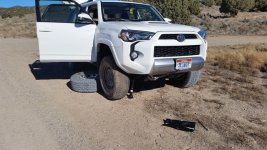
OEM bottle jack vs Pittsburgh 8ton

Harbor Freight for the win! :dancin:

Have one in my dads farm truck to use for one of the smaller New Holland loaders, and it works great. No problems after 3 years, even with heavy use.

Might be over kill, but if you are willing to lug around the extra weight, it will definitely work!
 
Well as described we have. However, that's not the point - if you have a flat then frequency doesn't matter - it's flat. 12 ton jack because the smaller ones don't go high enough. Overkill is better than insufficient.

Oh, I understand that. But, you could say the same thing about radiator hose failures, serpentine belt failures, various electrical failures, and a whole host of other components that have about the same failure rate as modern tires and will stop you just as dead. We don't carry extras of any of those. We only carry spare tires because back in the 50's and before tires were crap and blew at the slightest provocation and we haven't let that go in our minds.

Good point about the 12T jack being taller - makes sense.
 
Well as described we have. However, that's not the point - if you have a flat then frequency doesn't matter - it's flat. 12 ton jack because the smaller ones don't go high enough. Overkill is better than insufficient.

Do you carry an ECM with you? How about a spare battery? I am being facetious but the chances of getting a flat on the highway nowadays has dropped to almost nil. I drive around 30K/year and the vehicles with flats are few and far between and if truth be told, if people would just run half decent tires, most of those go away.

I don't want to do the math but I would guess that the odds of getting a flat tire nowadays (good tires, good maintenance, careful driver, road only) would be about the same as being in an accident. I understand being careful and prepared ( I am to a point) but to carry all the crap needed to fix what Might happen means dragging a spare 4Runner around!
Just in this thread I have read about 4X over capacity jack, jack stand, lots of boards, wheel chocks and the like. Really? Where does it end?

Don't get me started on go bags or recovery gear lol.
 
Question (and be honest):
How many have had a flat tire (on Highway only) in the past 10 years? Not me.

Actually, twice in the last 6 years. Both times were a road hazard thing that put a 1/4 inch hole in the tire that required a quick pull over an tire change. I The last was in the 4runner, and I was not really happy with trying to set up the factory jack. I am a careful driver, and I am meticulous about maintaining my tires. I do about 20k a year and I check my tires each rotation. Some times you just don't know what is in the road.
 
Last edited:
Question (and be honest):
How many have had a flat tire (on Highway only) in the past 10 years? Not me.

I have. I've had at least 3 with my 2008 4runner, 2 with the factory Dunlops and one with the Hankooks that replaced the Dunlops. I've also had a few flats on a couple of my trailers but luckily I do carry a hydraulic jack with them. One of those flats was in SD, in the middle of nowhere, and I don't recall there being any cell service so AAA wasn't going to come to the rescue even if I did carry them.
 
Do you carry an ECM with you? How about a spare battery? I am being facetious but the chances of getting a flat on the highway nowadays has dropped to almost nil. I drive around 30K/year and the vehicles with flats are few and far between and if truth be told, if people would just run half decent tires, most of those go away.

I don't want to do the math but I would guess that the odds of getting a flat tire nowadays (good tires, good maintenance, careful driver, road only) would be about the same as being in an accident. I understand being careful and prepared ( I am to a point) but to carry all the crap needed to fix what Might happen means dragging a spare 4Runner around!
Just in this thread I have read about 4X over capacity jack, jack stand, lots of boards, wheel chocks and the like. Really? Where does it end?

Don't get me started on go bags or recovery gear lol.

No I don't have a spare ECM or battery - but since the 4Runner comes with a spare (despite the odds of a flat or blowout Toyota still includes one) I figure I should be able to use it if need be. Granted I'm erring on the side of caution (I carry tools too sometimes) old habits are hard to break; and at my age I like to hedge my bets when I can!
 
No I don't have a spare ECM or battery - but since the 4Runner comes with a spare (despite the odds of a flat or blowout Toyota still includes one) I figure I should be able to use it if need be. Granted I'm erring on the side of caution (I carry tools too sometimes) old habits are hard to break; and at my age I like to hedge my bets when I can!


It's a good point and I go over in other areas of my life. Carrying a gun, having a go bag....do I need them? Haven't yet and don't want to! But when I do...I do.

Tires....fall shorter down the line for me. YMMV on that and no worries with your priorities.
 
So, for all you 'be prepared' Boy Scouts, just curious how many have actually 1) practiced lowering your spare, and 2) checked the pressure in your spare?

1) can be interesting.
 
Well as described we have. However, that's not the point - if you have a flat then frequency doesn't matter - it's flat. 12 ton jack because the smaller ones don't go high enough. Overkill is better than insufficient.

I agree with your comment on the jack tonnage.

I use these jacks on other work also , not just to jack up a vehicle.

also the higher rating does a better job holding the set position .

for those that have only the toyota jack when you get a flat call AAA. esp those front wheels . the base of the toyota jack is too small. if using this get some wood just in case its on soft ground to increase the ground support .

last time I had to fix flat was 5 yrs ago. restaurant parking lot . got out and saw tire was low .. took 10 min to replace it . sharp piece of metal in it , but I later put a plug in it . replaced all the tires 11 months ago.

so carrying a plug kit and compressor is also good insurance if on a long road trip ..may not have to take tire off.
 
I have only had 1 blowout and it was in high school driving the GF's car. Otherwise everything has been slow leaks from nails etc. Nothing that a Plug or two couldn't handle. I have a spare vehicle so all I need to do is get home and I can repair it when the weather is good. Some plugs I have even installed without even taking the tire off the vehicle.
Been driving about 30 years now.

Helped others change tires though. Used to carry a small roll around jack in college. Loved that thing.
 
OEM Toyota is not necessarily a better design or jack for that matter. The wife and I had a blow-out at 80 mph on I40 on our way to Memphis. Blow out was caused by a piece of metal in the road kicked up by a truck in front of us.

I used the OEM jack and just had the right rear wheel off the ground when the jack failed with a loud bang and the truck fell. I was half way under the truck in order to reach the jack handle. I was more scared than hurt, but won't use an OEM Toyota jack ever again.

How did it fail? You mean the 4runner fell off because it wasn't positioned correctly? Or it collapsed? If it collapsed I'd love to see a picture. For an internal screw type bottle jack to fail (collapse) is exceptionally rare. I've never heard of such a thing, but it could happen I suppose. For one to be poorly positioned is common. A hydraulic bottle jack is no safer - probably significantly less safe due to the higher probability of a fluid leak.

Also - fun tip for safety first folks - put the spare tire under the frame rail while you take off the tire, then swap and put the flat tire under the frame rail until you're ready to drop the vehicle back off the jack. Might save your fingers if your don't get your jack positioned well and the vehicle slips off.
 

Attachments

  • 20151114_133816.jpg
    20151114_133816.jpg
    105.4 KB · Views: 2,456
Last edited:
So, for all you 'be prepared' Boy Scouts, just curious how many have actually 1) practiced lowering your spare, and 2) checked the pressure in your spare?

1) can be interesting.

I have lowered the spares many times. The 4th gen takes a little work as I hoist the 255/80 ST Maxx in place deflated then air it up in place ( that's the only way it fits) so it's sort of wedged in there. A couple kicks and it breaks loose though.

I also check the spare tire pressure at least every oil change ( about every other month).

I often carry a CO2 tank in the 4th gen and a small compressor in the 5th gen with plug kits in both.
 
Once last year, rear sidewall blow-out. I was fortunate as 2mins later, a highway tow truck came by and change my wheels for free. But for the life of me, i need to change out my stock spare to match my 33"
 
Last edited:
Question (and be honest):
How many have had a flat tire (on Highway only) in the past 10 years? Not me.
I've had a screw which caused leak overnight flattened tire by morning. Had a razor blade, and I still don't know how it happened, pierce the sidewall caused tire to go flat 2 miles from my house. Both were first year owning the T4R. Now like a blowout while driving actually on the highway, yeah that's been more like over 12 years
 
BTW great discussion here guys. I like the differing opinions about preparedness and how much is too much. Whenever I hear a debate regarding the merits of overkill, I think of Burt Gummer and his opinion on the matter, "When you need it and don't have it, you sing a different tune"
Heh heh I know someone here will get the reference
 
Last edited:
To those who ask about carrying spare batteries, belts, ECUs, etc.

A flat tire is a pretty straight forward problem. It obvious and relatively easy to fix on the side of the road.

Changing out those other things are possible, but unlikely within the skill set of the average driver, hence why car manufacturers still include them.

Also, I understand the members of this forum are above average drivers. :bounce:
 
To those who ask about carrying spare batteries, belts, ECUs, etc.

A flat tire is a pretty straight forward problem. It obvious and relatively easy to fix on the side of the road.

Changing out those other things are possible, but unlikely within the skill set of the average driver, hence why car manufacturers still include them.

Also, I understand the members of this forum are above average drivers. :bounce:

Well, see, I would argue that changing a flat on a modern car on the side of a busy freeway is really not obvious and relatively easy for most drivers. At best it's unsafe, and is probably outside of what they ought to be attempting, especially if they've never done it before. In no other area of life would we consider it a good idea for unskilled people to lift 2000lbs on a spindly device while 80,000lb trucks go by 6 feet away at 75mph. In fact, I doubt the Toyota bottle jack could pass OSHA requirements for use in a tire shop. A AAA truck with big flashing lights and an experienced mechanic with a floor jack is a better way to go for most people.

Don't know about the driving skills of the members of this forum, but I think it's safe to say most have above average mechanical skills, which changes the equation quite a bit.
 
Last edited:
I also carry an extra serpentine belt for each 4runner and the tools to change it. While highly unlikely that I would ever have a belt fail, they're relatively cheap and easy to store and I have had one fail before (on a gm truck). Had I been carrying a spare belt, I could've replaced it and continued on my way.

I agree that we can't carry everything for every situation though.
 
Well, see, I would argue that changing a flat on a modern car on the side of a busy freeway is really not obvious and relatively easy for most drivers. At best it's unsafe, and is probably outside of what they ought to be attempting, especially if they've never done it before. In no other area of life would we consider it a good idea for unskilled people to lift 2000lbs on a spindly device while 80,000lb trucks go by 6 feet away at 75mph. In fact, I doubt the Toyota bottle jack could pass OSHA requirements for use in a tire shop. A AAA truck with big flashing lights and an experienced mechanic with a floor jack is a better way to go for most people.

Don't know about the driving skills of the members of this forum, but I think it's safe to say most have above average mechanical skills, which changes the equation quite a bit.

The same can be said for doing ANY work on the side of a busy freeway.

And as for the "obvious and relatively easy" comment, I should have been clearer.

A flat tire is obvious, it's not round all the way around. While a belt failure is also pretty obvious, ecu and other electrical issue are not.

And the relatively easy remark was aimed at the actual mechanics of changing the tire, not the conditions under which the work is done. Perhaps I should have said straightforward rather than easy.

In no other area of life would we consider it a good idea for unskilled people to pilot a 2000+ lb machine at highway speeds, just a few feet from other people doing the same thing. And yet it happens every day.
 

Members online

No members online now.

Forum statistics

Threads
278,316
Messages
3,554,112
Members
248,016
Latest member
Advally Service

Trending content

Back
Top