OEM bottle jack vs Pittsburgh 8ton

Question (and be honest):
How many have had a flat tire (on Highway only) in the past 10 years? Not me.

I had the right rear shred and come off the rim on my RX7 last Fall. Had it toed home because I don't carry a spare or a jack.... damnit! Have not hard a tire go on any of my trucks in years though
 
My C5 doesn't have a spare and the run flats are long gone!

I see quite a few manufactures going to tire slime, pumps and ditching the lame donuts and spare tires. Sure weight is an issue these days as well as space with performance cars, but just think about that.

I stand by having good tires and maintenance that includes checks and a careful eye. :reddance:
 
So, for all you 'be prepared' Boy Scouts, just curious how many have actually 1) practiced lowering your spare, and 2) checked the pressure in your spare?

1) can be interesting.

Shortly after I got my 4runner home from the dealership I racked out the spare and check the pressure. It was 60 psi! I have no idea if this was 'dealer prep' BS, or if it came that way from the factory (it had 9 miles on it when I picked it up). This was also helpful because I discovered beforehand that the set screws on the handle work better if you toss a small wrench in there to tighten it. I just keep a little boxend (7/16?) to torque the square nut down.
I typically check the pressure during a tire rotation, and give the chain and mechanism a spray down with WD-40 or the like. I'm not a big fan of the way the OEM jack cranks - it is really hard to get it steady while cranking, and is a real PITA to get it under the rear axle lift point.
 
At best it's unsafe, and is probably outside of what they ought to be attempting, especially if they've never done it before. In no other area of life would we consider it a good idea for unskilled people to lift 2000lbs on a spindly device while 80,000lb trucks go by 6 feet away at 75mph.

I pulled over on the Interstate the other day and couldn't believe how dangerous it seemed. I had forgotten. I thought then, man... glad I'm not changing a drivers side flat.

33 years driving all of the city on regular streets and Interstate for a living and a good 10+ of basic driving before that... 1 blowout.

Many tread nails that I actually drove on for days. One sorta sidewall nail that went fast but I could probably have plugged it / aired it, and limped to safer place if not a service station... and that was in my driveway.

I am seriously considering an XJack ( for driving on beach ). It just seems like the safest-easiest and could assist in using the bottle jack so it gets positioned properly and only jacked on for an inch or two.

Think of the stuff you could store in a giant doughnut container that fits where the spare is located. I dove a taco from 75K to 255K with the spare hanging under there and never used it except in my driveway when I swapped out a partial flat due to nail so I could drop that off at station.

It's a tough call... worried about your battery going? Many safe options for that from a dual setup to a simple Cig. Lighter plugin.

Tires are the one things that are constantly ( well on the highway at least ) in contact with the potential cause of failure.

Again driving all that I do, I think I've seen 2 maybe three people changing tires and that often ends up with some sort oversight. LEO, Traffic Safety Vehicle, etc..

the only real reason I would keep a spare is if I do pick up a nail or something.. I can at least make it to somewhere safe, swap it out, and get on with what I was doing if need be. sometimes you just don;t have the time to fix a flat right then and there. so it's good for that. But unless the Interstate had a really wide shoulder, I wouldn't want to do it... and if you end up in the grass for safety, you are going to need some sort of solid base, chocks, and sorts of other stuff. that's where a cell phone or Toyoto's $10 a month SOS program comes in.

 
Someone asked how tall the factory jack goes, it's a bit over 19" in height. Granted that was based off my 4th gen unit, but they're basically the same jack for most of the Toyotas.

132495d1412548248-bottle-jack-too-short-my-4r-trail-2015-20141005_152727.jpg


As for stability/strength? Well they were designed to lift a stock vehicle high enough to change a tire on, so while not the best design they should hold fine if set up properly. (I've actually never heard of one failing until the forum member earlier posted about his experience, could you extrapolate on the failure it encountered? I'm curious).

Question (and be honest):
How many have had a flat tire (on Highway only) in the past 10 years? Not me.

Personally? I can't really remember, most of the time they're running low and/or I pump them up to pressure and run them to the shop to repair/replace. :) That being said when I worked in the Bay Area flat tires were very common and sometimes we even had people tow their vehicle in because of it. All the debris and crap on the city streets and freeways just destroys tires. When they were redoing the main street in front of our dealership it was not uncommon for a car to come in for an oil change, leave, then come back 5 min later with a flat because they snagged a chunk of shit in their tire on the road.

Well, see, I would argue that changing a flat on a modern car on the side of a busy freeway is really not obvious and relatively easy for most drivers. At best it's unsafe, and is probably outside of what they ought to be attempting, especially if they've never done it before. In no other area of life would we consider it a good idea for unskilled people to lift 2000lbs on a spindly device while 80,000lb trucks go by 6 feet away at 75mph. In fact, I doubt the Toyota bottle jack could pass OSHA requirements for use in a tire shop. A AAA truck with big flashing lights and an experienced mechanic with a floor jack is a better way to go for most people.

Don't know about the driving skills of the members of this forum, but I think it's safe to say most have above average mechanical skills, which changes the equation quite a bit.

I would argue that it's not obvious to modern driver's because their brains have regressed on the evolutionary scale and their ability to think without someone holding their hand is a consistent theme in today's generation. Can't keep track of how many so called engineers or "genius" level persons I've had to walk through the basics of leverage, torque, and such before their dim 1w lightbulb flickers alive in that near-black hole they call a skull. That's of course before I show them it's in the owner's manual, because... "you don't have to know everything, just know where to find it." because again, if someone isn't directing them on how to think they're unable to come up with a conclusion on their own.

That being said, you're logic in that respect is not entirely wrong about unskilled people playing with dangerous things, though the counter point of that should be if they are unable to operate their multi-ton machine properly and perform basic repairs (as many operators of various machinery would be trained to do so in limited cases before it supersedes to a dedicated repair technician) then they have no business getting behind the wheel period. In every other field for the most part we require training and certification to operate heavy machinery, in the venue of automobiles we do a driving test, a paltry paper test, and then let complete idiots operate dangerous machinery without any idea of what they're doing.
 
Last edited:
How did it fail? You mean the 4runner fell off because it wasn't positioned correctly? Or it collapsed? If it collapsed I'd love to see a picture. For an internal screw type bottle jack to fail (collapse) is exceptionally rare. I've never heard of such a thing, but it could happen I suppose. For one to be poorly positioned is common. A hydraulic bottle jack is no safer - probably significantly less safe due to the higher probability of a fluid leak.

Also - fun tip for safety first folks - put the spare tire under the frame rail while you take off the tire, then swap and put the flat tire under the frame rail until you're ready to drop the vehicle back off the jack. Might save your fingers if your don't get your jack positioned well and the vehicle slips off.

Sorry - didn't see this until now. It was the OEM jack on our 2000 Tundra not our 4 Runner jack. No the vehicle did not fall off the jack. The jack failed with a loud bang and no warning. The truck fell straight down. No pics and I tossed the jack. This happened a few years ago. I bought the replacement jack in Memphis so I would have one for the trip home. I've had two tires fail at highway speed in thousands of miles of driving. So 1Engineer is right - the odds are slim you will need a jack. But like I said - old habits...
 
Someone asked how tall the factory jack goes, it's a bit over 19" in height. Granted that was based off my 4th gen unit, but they're basically the same jack for most of the Toyotas.

Wait a minute, are you getting back to the original question of the thread? Thanks! I'm a little disappointed no one has the stock OEM jack minimum & maximum as well as the height with a fully deflated tire & the minimum height to get a stock tire off the ground. The T4R I care for travels the country and I only get to service it a couple times a year or I'd go do it know. I was hoping to upgrade it's OEM jack and add an axle saddle but I guess I'll have to wait. I am astounded at how high that OEM jack extends!
 
Wait a minute, are you getting back to the original question of the thread? Thanks! I'm a little disappointed no one has the stock OEM jack minimum & maximum as well as the height with a fully deflated tire & the minimum height to get a stock tire off the ground. The T4R I care for travels the country and I only get to service it a couple times a year or I'd go do it know. I was hoping to upgrade it's OEM jack and add an axle saddle but I guess I'll have to wait. I am astounded at how high that OEM jack extends!

I could try and get a minimum (compressed) measurement for you when I get home if I remember.

The other measurements have too much variability to really be helpful. Tire size, suspension, ect. will all change those numbers.

i.e. a 33" tire with 16" rims will deflate more than one with 18" rims. Aftermarket suspension or even a TRD Pro suspension will probably "droop" more and thus require a bit more to get the wheel completely off the ground. (Though factory suspension will probably be pretty close since they wouldn't want to change the geometry too much).
 
I know it's an old thread, but some great conversations about what spares/tools to carry. I've been thinking about that recently too for my offroad adventures (which is different than daily driving). The factors I consider for deciding what I want to be able to fix (ie: the tools and parts I carry for a given fix):

1. Am I confident that I can do the fix? (ie: have a done it before and/or have the knowledge/skill/experience to do it. I don't know how to replace an ECU, so why carry a spare?)
2. Is the size/weight/cost of the tools and parts reasonable? (sure I can replace a battery, but that is a ton of weight to carry. Also, some jobs require too many specialty tools to make it worth being prepared for).
3. Is the fix necessary to TOW my vehicle out (ie: for a friend to tow me off the trail I need working tie rods, but don't need working CV axles).

Example: Wheel Hubs: 1. I don't think I can fix, 2. the size of the part means I wouldn't want to bring it 3. Yes, but because 1 & 2 are no's, I'm not prepared to fix trail side.

Example: Tie Rods: 1. Yes, 2. Under $40 and small, 3. Yes (maybe I could get creative with straps and a tree branch, but yikes...)
 
Recent Flat 2018 SR5 4Runner

I was changing the tire in excellent conditions on a concrete driveway.
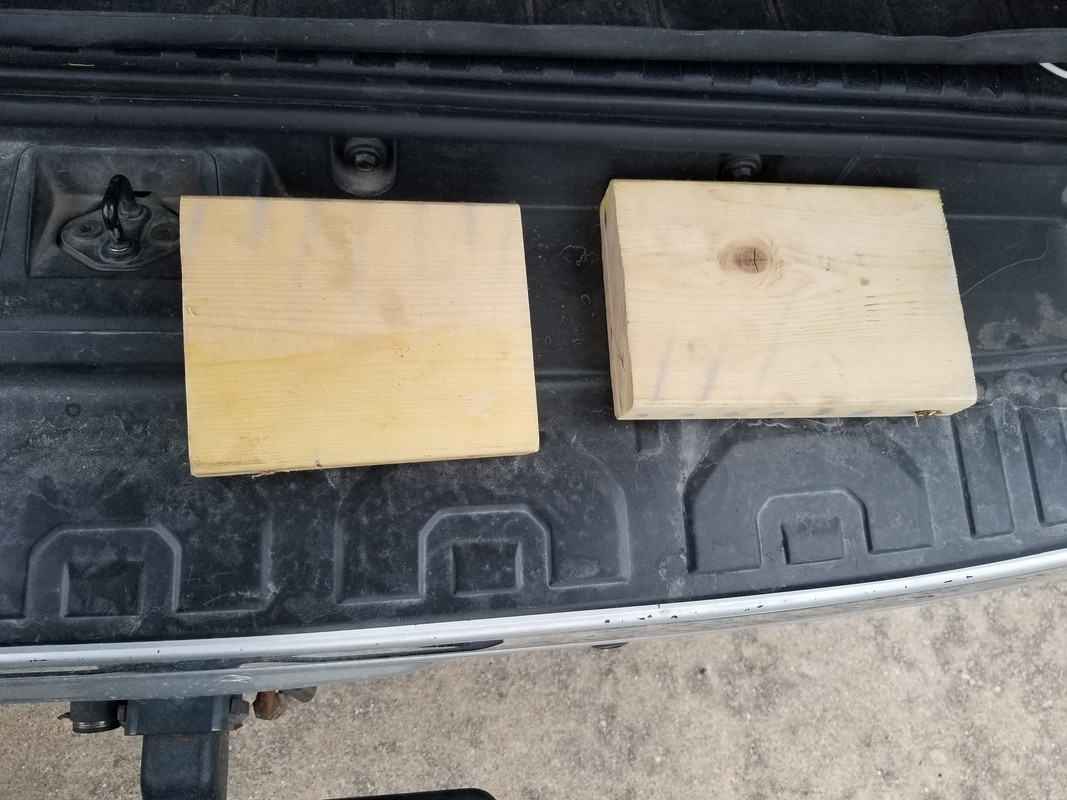
I was OK getting the flat tire off. I ran the jack up as far as it would go to put on the spare. I had to kick the bottom of the tire to get it on...it barely made it. I threw a board in the 4Runner for next time. It's about 2" thick; I'll probably need to test it to see if the jack will fit. I'm looking for a jack upgrade. I'll use the information in this discussion.
 
Question (and be honest):
How many have had a flat tire (on Highway only) in the past 10 years? Not me.

I have had to repair one in my wife's vehicle. It's not fun. And of course it happens in the worst time, we had a tropical storm incoming when I changed this one.

I wish I had a better jack at the time. It's one of those things you never think about, but it is really nice to have when you need it.
 
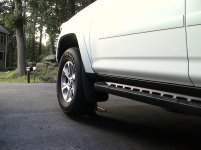
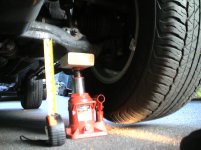
Ya same deal I had using the Toyota jack front tire removal.. this is what I use to remove the front wheels

very safe lifts vehicle up about 2 inches.. using the Toyota jack body lifts up way too high very unstable.. small base plate IMO Dangerous on front wheel removal
 

Attachments

  • T4R jack points.pdf
    T4R jack points.pdf
    35.4 KB · Views: 81
  • jack lower control arm 3.jpg
    jack lower control arm 3.jpg
    132.5 KB · Views: 582
  • jack lower control arm 2.jpg
    jack lower control arm 2.jpg
    132.2 KB · Views: 817
Last edited:
Ya same deal I had using the Toyota jack front tire removal.. this is what I use to remove the front wheels

very safe lifts vehicle up about 2 inches.. using the Toyota jack body lifts up way too high very unstable.. small base plate IMO Dangerous on front wheel removal

I have done that before and it's super unstable. Now I carry two pieces of 4x6's to put the jack on.
 
you should drill out the wood a bit so it seats over the bottle jack top

no need to drill any holes .. jack goes up 2 inches that is it ..you do this as I did and you will know how safe and the vehicle looks level no roll / wobble etc... very solid like tire on ground..

you do the toyota jack set up on front end ya you need 2X12 so that POS jack is not gonna crash down on you ... need a couple of jack stands or wooden solid blocks to keep it from falling on the ground.
 
Ya same deal I had using the Toyota jack front tire removal.. this is what I use to remove the front wheels

very safe lifts vehicle up about 2 inches.. using the Toyota jack body lifts up way too high very unstable.. small base plate IMO Dangerous on front wheel removal
why not use the oe jack in this exact configuration?


for all of you hating on the OE screw jack, send them my way. I will use one of those over a small bottle jack any day.
 
why not use the oe jack in this exact configuration?
FOR all of you hating on the OE screw jack, send them my way. I will use one of those over a small bottle jack any day.

my jack is a 12 ton jack short , so it fits under the front lower control arm ..........................Toyota jack , no fit a bit tooooo tall..

HYDRO JACK much faster, little jacking only 2 inches ..safe..
I can also use this jack for other uses ..I can use this to jack up my house .
 
I use both. Just depends what and where I'm jacking as to which one I use.

OEM jack has been a learning process.

Nothing beats the stability of a floor jack (although they can't be used in all scenarios). I toy with getting a one of those pro eagle deals mounted in my truck.
 

Forum statistics

Threads
278,316
Messages
3,554,110
Members
248,016
Latest member
Advally Service

Trending content

Back
Top