Off-roading Tips

Mud usually tends to hide obstacles such as tree roots and sticks just waiting to slash your sidewalls, so its best to avoid reducing tire pressures if you can avoid it..

i fully realize this was posted back 11 years ago, but nobody took exception to it, and it is wrong.

sidewalls are more susceptible to being punctured at higher pressure, not lower pressure. where sharp objects are likely to be encountered, run the lowest pressure that you are comfortable running that will maintain the bead. that will vary by tire type, make, and wheel combination (beadlocks/no beadlocks, etc).

this applies to rock surfaces, too, not just mud.

puncture resistance, and sidewall strength are one of the reasons i prefer running bias-ply tires where i wheel (new england). i've got over 20 years experience wheeling, and 15 of that running bias swampers (ltb and "plain"). another advantage is being able to run very low pressures w/out beadlocks. i typically run 2 to 4 psi when wheeling my cj, vs the 7 to 10 psi when running radials on the cj. those numbers would/will be slightly higher for the 4runner, since it weighs more. i think i could get away with 4 to 6 psi for bias, and 8 to 12 with radials.
 
this is crude, and the distances arent to scale, but I think you get the idea. :D


leverage_zps7c31e75f.png

No joke, I once lifted a 2wd F150 that was buried to it's rear axel in sugar sand on a riverbed here in Oklahoma that could not be mitigated with the assistance of a tug strap and my trusty 4Runner. However, we were able to resolve it with a simple lever made out of a long log and a stump.

We rolled the stump over just behind the truck, and it was so large that we had to use a few walking-stick sized branches to wedge it towards the truck on about a 150' run. Then, we found a dried out log that was about 20' long and at its thickest point near its base, probably 2' in diameter, tapering up to about 10" in diameter at its broken off top. Luckily, it was a completely dried out driftwood log that was remarkably round and easy to roll with 3 guys.

So we rolled it about 50 yards or so to the back of the truck, placed the smallest diameter end up underneath the rear hidden hitch (which was touching sand, he buried it so deep before I got there), and then lifted the heavier, wider end up as high as we could and put the large stump underneath it as close to the truck as possible (that acted as the fulcrum, and was about 4' away from the tailgate).

Once under, just the weight of the trunk with the mechanical advantage was enough to start lifting the rear end a bit. Then, I walked out to the end of the lever-log and started to lift the truck pretty well with just my weight (around 180 lbs), then my 200 lbs friend jumped up there and we were able to completely pick up the back end of the truck, rear axle and wheels completely suspended. However, just getting it in the air did nothing.

So while we sat on the end of the log, our third friend started back-filling in the holes with sand, sticks, tall river-weeds, a few cardboard beer boxes, and even a large scrap piece of carpet that someone dumped out there. We set it back down on all the junk and it compressed it pretty good and still could not get out of its own holes, so we moved the fulcrum (the large stump) to about 1.5' away from the tailgate and repeated the process. This time, GREAT SUCCESS! lol. It freaking worked. Unbelievable.

My buddy then told me that I was the smartest man alive. I took the compliment, but honestly, had I not just seen the first massive stump just sitting there, the thought would have never crossed my mind. It just so happened to be in the perfect spot to spark an idea.


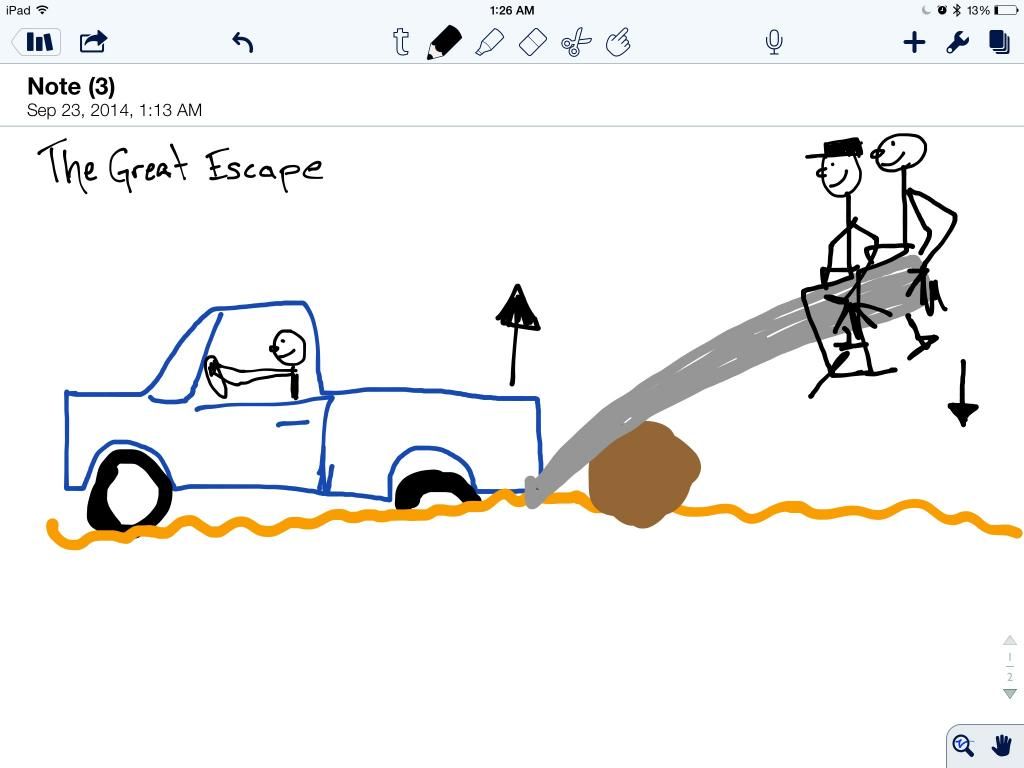
My rendition of the event:
imagejpg1_zps1b204753.jpg~original
 
Another good tip for driving on snow and ice is when you want to stop, shift into neutral and gently use the brakes. You will have better braking balance without the power train pushing you forward. On level ground most hehicles in drive will creep forward. This makes it more difficult to brake effectively.
 
wheels and tires

forgive me, I could find a new post to type some comments about my 4runner limited - wheels and tires

I purchased 2015 Toyota 4runner limited6 months ago. I asked sale rep if this suv is able to drive - off road. She said Yes. 6 months later - I learned that my limited suv is not fitting for off road bec of tires - 245/60/20 and luxury. I wish I could buy 4runner trail, but I was wondering if I could buy other wheels and tires for off road? Please share your experience with me. Thanks
 
recovery points

i searched this thread looking for advice on using the recovery points on the 15 4 runner. i couldnt find anything specific regarding them. anyone like to direct me or provide some advice on using them for recovery? are they just tie downs? thanks in advance
 
wheels and tires

forgive me, I could find a new post to type some comments about my 4runner limited - wheels and tires

I purchased 2015 Toyota 4runner limited6 months ago. I asked sale rep if this suv is able to drive - off road. She said Yes. 6 months later - I learned that my limited suv is not fitting for off road bec of tires - 245/60/20 and luxury. I wish I could buy 4runner trail, but I was wondering if I could buy other wheels and tires for off road? Please share your experience with me. Thanks

Hi Suzanne, I just noticed your post from April, so you've probably resolved your problem by now. In case you haven't:

The vehicle will become very capable as soon as you switch to 17" wheels and tires with a taller sidewall. This video, featuring the same model as yours, is a great example of this mod:

Epic Drives: Alaska's Dalton Highway in a 2014 Toyota 4Runner Limited

You can use this tire fitment guide to pick a tire size that doesn't require additional modifications and where the spare still fits underneath the vehicle. I would go with 265/70/17 (the stock 17" size) or 255/75/17 for the taller sidewall.

http://www.toyota-4runner.org/5th-gen-t4rs/156378-5th-gen-tire-fitment-guide.html

That setup should get you through most trails rated 3-4 out of 10 on TrailDamage.com, possibly higher. Whether you need more aggressive mods will depend on your priorities: scenic backcountry driving versus heavy off-roading.
 
No joke, I once lifted a 2wd F150 that was buried to it's rear axel in sugar sand on a riverbed here in Oklahoma that could not be mitigated with the assistance of a tug strap and my trusty 4Runner. However, we were able to resolve it with a simple lever made out of a long log and a stump.

We rolled the stump over just behind the truck, and it was so large that we had to use a few walking-stick sized branches to wedge it towards the truck on about a 150' run. Then, we found a dried out log that was about 20' long and at its thickest point near its base, probably 2' in diameter, tapering up to about 10" in diameter at its broken off top. Luckily, it was a completely dried out driftwood log that was remarkably round and easy to roll with 3 guys.

So we rolled it about 50 yards or so to the back of the truck, placed the smallest diameter end up underneath the rear hidden hitch (which was touching sand, he buried it so deep before I got there), and then lifted the heavier, wider end up as high as we could and put the large stump underneath it as close to the truck as possible (that acted as the fulcrum, and was about 4' away from the tailgate).

Once under, just the weight of the trunk with the mechanical advantage was enough to start lifting the rear end a bit. Then, I walked out to the end of the lever-log and started to lift the truck pretty well with just my weight (around 180 lbs), then my 200 lbs friend jumped up there and we were able to completely pick up the back end of the truck, rear axle and wheels completely suspended. However, just getting it in the air did nothing.

So while we sat on the end of the log, our third friend started back-filling in the holes with sand, sticks, tall river-weeds, a few cardboard beer boxes, and even a large scrap piece of carpet that someone dumped out there. We set it back down on all the junk and it compressed it pretty good and still could not get out of its own holes, so we moved the fulcrum (the large stump) to about 1.5' away from the tailgate and repeated the process. This time, GREAT SUCCESS! lol. It freaking worked. Unbelievable.

My buddy then told me that I was the smartest man alive. I took the compliment, but honestly, had I not just seen the first massive stump just sitting there, the thought would have never crossed my mind. It just so happened to be in the perfect spot to spark an idea.


My rendition of the event:
imagejpg1_zps1b204753.jpg~original

That is freakin classic. Nice work. Better drawing!
 
Need help

I drove my 2014 4runner off road, and while doing so, I accidently drove a large rock that got stuck behind my left lower control arm. I put the car in reverse and forced it over the rock. Now my steering column appears to be shifted to the left ( not sure if it was like that before), and on inspecting the bottom, the LCA is scraped, and the brackets where the LCA inserts in the frame is bent. The left front wheel is now 5mm ahead of the right one. Alignment is within specs. what could have happened to the steering column and to the left wheel?
 
Always look under the truck after off-roading. Especially if you don't have skid plates yet.
 

Attachments

  • IMG_2016-04-30_08-53-24.85.jpg
    IMG_2016-04-30_08-53-24.85.jpg
    126 KB · Views: 1,784
Took a wealthy friends brand new land Rover into a creek when I was 16. This creek was running through a highly populated apartment complex at the time. Somebody called the police and the cops came. Thankfully he came in an explorer, and pulled us out.
 
Reading through all the tips and comments, would be glad if anyone can add to or revise what this noob understands:

1) practice driving off road in a safe environment, with help, before trying anything crazy/fun
2) carry first aid, food and water, communication devices
3) bring a tow strap/set
4) a working hi-lift jack
5) what about a portable warn winch set?*
6) any need for a portable compressor for light driving?

Anything else in your basic noob locker? I'm in an unmodified 16 LE so I don't expect to use this stuff, but who does at first?
-T

*1,000 lb limit on this, that's not likely to help anything
 
Last edited:
Reading through all the tips and comments, would be glad if anyone can add to or revise what this noob understands:

1) practice driving off road in a safe environment, with help, before trying anything crazy/fun
2) carry first aid, food and water, communication devices
3) bring a tow strap/set
4) a working hi-lift jack
5) what about a portable warn winch set?
6) any need for a portable compressor for light driving?

Anything else in your basic noob locker? I'm in an unmodified 16 LE so I don't expect to use this stuff, but who does at first?
-T

I'm a strong believer that a hi-lift jack is unnecessary for 99% of the off-roading population. I have several friends with rock crawlers that have never used theirs. A tow strap and/or traction mats are more than enough for most situations. But I could see how they'd be necessary for changing a flat on the trail, I guess...

I would add a collapsible shovel to your list. Get one with a serrated edge. You can cut tree limbs and make your own traction mats with branches (for mud or snow)
 
I'm a strong believer that a hi-lift jack is unnecessary for 99% of the off-roading population. I have several friends with rock crawlers that have never used theirs. A tow strap and/or traction mats are more than enough for most situations. But I could see how they'd be necessary for changing a flat on the trail, I guess...

I would add a collapsible shovel to your list. Get one with a serrated edge. You can cut tree limbs and make your own traction mats with branches (for mud or snow)
until you actually need one. then, much like a winch, or a parachute, you will wish you had it. cheap insurance as far as im concerned.


this was from one of my last trips this winter.


IMG_0876_zps6z6eft00.jpg~original


we were able to reseat the bead, and air the tire up. after about 30 minutes, we were back on our way. it would have been VERY long night without that jack...
 
Reading through all the tips and comments, would be glad if anyone can add to or revise what this noob understands:

1) practice driving off road in a safe environment, with help, before trying anything crazy/fun
2) carry first aid, food and water, communication devices
3) bring a tow strap/set
4) a working hi-lift jack
5) what about a portable warn winch set?
6) any need for a portable compressor for light driving?

Anything else in your basic noob locker? I'm in an unmodified 16 LE so I don't expect to use this stuff, but who does at first?
-T


Is it even possible to lift a 2016 with a hi-lift jack? Where do you attach it? I was going to get one for my 2004 but cancelled it when trying to figure out where it could go to lift the 4R.
 
Is it even possible to lift a 2016 with a hi-lift jack? Where do you attach it? I was going to get one for my 2004 but cancelled it when trying to figure out where it could go to lift the 4R.

I'm guessing it fits any appropriate frame/lift point, just like they stowable jack in the spare tire changing kit. Not that I've used either yet.
 
I'm guessing it fits any appropriate frame/lift point, just like they stowable jack in the spare tire changing kit. Not that I've used either yet.


The stock stowable jack goes under the 4R and lifts the frame. A Highlift jack lifts a steel bumper or sliders, neither item stock on a 4th or 5th Gen 4R.
 

Members online

Forum statistics

Threads
278,305
Messages
3,554,042
Members
248,016
Latest member
Advally Service

Trending content

Back
Top