Oil substance in intake/j-pipe

Myrunr2010

New member
I recently completed doing the timing belt and valve cover gaskets on my 97 4runner. I picked her up a few months ago with just over 230,000 miles on it. While I was pulling the intake the all off I noticed a pretty oily film throughout the intake, throttle body and upper/lower intake. I found it curious but wasn't able to determine were it came from, so I cleaned it up and dismissed it as poor maintenance by the previous owner.

Tonight I was out gathering parts to do the deck plate mod and isr mod. When I got home I went ahead and pulled the intake off so it would be ready for me when I get home from work tomorrow, and that's when I noticed it, a substance that looked just like used motor oil had collected, and was pouring out of my j-pipe. I poured it all out onto a shop rag and cleaned up the inside of the intake pipe. When I looked back at it, it had hardened. So it was liquid when hot but solid when cool, and looked like very dirty motor oil.

Any thoughts of what it could be or where it came from? It explains the dirty intake pipes and all but I'm still curious.....
 
Register to hide this ad
I have the air aid jr. on mine and when i took it apart last time to clean the MAF i noticed the same substance. It was coming from the hose thats about 1 inch OD that connects to the back of the intake elbow. I don't know what it is though, hopefully someone know because I would like to know as well
 
Isn't it connected to the PCV or the valve covers? It should be congealed oil vapor from the crankcase. That's why I like catch cans.
 
Yes, it's part of the PCV system. Replace the PCV valve first. If it continues, that's a sign of excessive piston blow-by, which you then would need to get the engine compression checked.
 
If you have really old motor oil that has gotten enough other debris and stuff in it would it coagulate when it cools down?
 
Last edited:
Yes, it's part of the PCV system. Replace the PCV valve first. If it continues, that's a sign of excessive piston blow-by, which you then would need to get the engine compression checked.

I replaced the PCV and its grommet/gasket when I did the valve cover gaskets, which was only like 200 miles ago. While doing it I also did my spark plugs too. If it was piston blow-by causing it, the spark plugs should have been dirty, right? The spark plugs looked pretty normal, didn't notice any excess oil or anything on them and they weren't abnormally dark.
 
I replaced the PCV and its grommet/gasket when I did the valve cover gaskets, which was only like 200 miles ago. While doing it I also did my spark plugs too. If it was piston blow-by causing it, the spark plugs should have been dirty, right? The spark plugs looked pretty normal, didn't notice any excess oil or anything on them and they weren't abnormally dark.

Might be normal then if it's not too excessive. Check out this thread. Some of the later years put a filter on it. Also if the PCV isn't oem try that also.

http://www.toyota-4runner.org/3rd-gen-t4rs/140850-oil-tb-vacuum-hose.html
 
I'm telling you, that's why oil catch cans are a great idea. A friend of mine and I did some research and experiments with them. Even on a normal, healthy engine, there is a lot of oil vapor running through the PCV system and recycling back into your engine. I understand it's purpose from an emissions standpoint, but from a performance/efficiency perspective it's counterintuitive.
 
I'm telling you, that's why oil catch cans are a great idea. A friend of mine and I did some research and experiments with them. Even on a normal, healthy engine, there is a lot of oil vapor running through the PCV system and recycling back into your engine. I understand it's purpose from an emissions standpoint, but from a performance/efficiency perspective it's counterintuitive.

An oil catch? Something similar to the filter they're talking about in the link JRZEE posted?
 
There's not enough oil being passed into the intake via the PCV system to make any "performance" difference if it's caught in a catch can.
 
Oil catch cans work great! I run one on my G8. It's pretty normal to have a bit come through the intake. That's why the throttle body needs cleaned regularly. If your getting a lot. Then you might have an issue. Mine has a normal amount. Get a factory PCV and clean everything out. Then recheck. I'm sure you will still get a bit through. If your not using a excessive amount of oil your fine.
 
There's not enough oil being passed into the intake via the PCV system to make any "performance" difference if it's caught in a catch can.

It's not performance so much as economy. When you burn oil vapor in your combustion chamber, or when it pools up in your intake, it turns into carbon. Carbon absorbs fuel. So, the back of your intake valves all get this carbon built up. I don't care what fuel you buy, based on injector placement, that fuel isn't going to wash all that off. In the long term, it builds up. The testing we did, on an otherwise stock Honda CRX, returned fairly substantial gains in fuel economy. (my friend and I were commuting to UTI everyday) Same route, same car, same gas station, same occupants. Only difference was the catch can. So, performance? No, not really. Efficiency? Yes.
 
An oil catch? Something similar to the filter they're talking about in the link JRZEE posted?

Catch cans sound great and all, but could someone please tell me what I would do to put one in on our motor? Is it simply the filter talked about in the post above? Is it something I can go to my local auto parts dealer and get? Where would be the best place to install one?
 
So, performance? No, not really. Efficiency? Yes.

Well understood what the effects are, which is why I only singled out the word performance. ;)

It takes a LOT (like 100k+) of miles to make an efficiency difference as well. If your mileage test only included adding the catch can, and you didn't start with a freshly cleaned intake path, your results aren't really telling you anything. Adding the catch can didn't do anything to clean existing carbon deposits.
 
Well understood what the effects are, which is why I only singled out the word performance. ;)

It takes a LOT (like 100k+) of miles to make an efficiency difference as well. If your mileage test only included adding the catch can, and you didn't start with a freshly cleaned intake path, your results aren't really telling you anything. Adding the catch can didn't do anything to clean existing carbon deposits.

It was a freshly rebuilt engine in the CRX. So, no, high mileage isn't a prerequisite. Besides, aren't ALL of us on here in the "high mileage" category unless we've just built a fresh engine? And, if I had started the testing with, or without a clean intake, the catch can is still the isolated variable that was being tested. It proved itself. Does a catch can reduce existing deposits? In a roundabout way, yes. By eliminating the addition of MORE carbon, it allows the fuel and combustion process to actually catch up and eliminate the existing ones.


Myrunr2010, You can find them on ebay, there's a lot of different styles. You can mount it wherever it fits, and you should be able to do it with very basic hand tools.
 
Sorry, I don't buy your "experiment" with the CRX. Too many variables, despite all the stuff you listed as the same.

If a catch can made that much of a difference consistently you'd hear more about them being used.
 
Exactly what variables are there that I didn't already discuss? It was a 3 month long experiment, through multiple tanks of fuel. Don't buy it if you don't want to, but the basic science is solid, the theory makes total sense, and I've lived it. Ignore what you will.
 
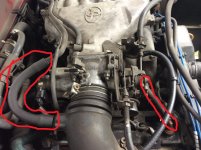
Ok, so I've done a little looking around and cannot seem to find anything consistent. When i did the valve cover gaskets there seemed to be a good bit of oil in the left hose, which would be consistent with the oil in the j-pipe. But some of the info i've been able to read suggest using the right hose (PCV valve). Some of what I read said it doesn't matter, as long as you have it on one of the other. Can anyone confirm or provide some guidance? Thanks!!!
 

Attachments

  • intake stuff2.jpg
    intake stuff2.jpg
    83.3 KB · Views: 263
Probably your valve stem seals are just too old to seal well enough and the excessive blowby is getting into the crankcase. If you see any blue smoke on start up, I'd bet such. Do a dry and wet compression test.

To slow it down I'd first try using a high mileage oil such as Maxlife or Mobil Super that contains swell additives to soften the seals.

Add the catch can. The reason they aren't used from the factory is that they have to be dumped or drained after a given time. Most automobile owners would not take the time to do such. Some car makers such as BMW actually design to dump it back into the crankcase.

The real fix will be to replace the seals.

Whichever line is wet is the one you want the catch can on. If both, then run two.
 

Members online

Forum statistics

Threads
278,313
Messages
3,554,091
Members
248,016
Latest member
Advally Service

Trending content

Back
Top