Pictures Of My Supercharger

Biff, correct me if i am wrong...but the TRD S/C (and Eaton in general) does not turn on based on RPMs. It comes on depending on the position of your gas pedal. To turn the supercharger on, you will need to press the gas pedal around 1/2 to 3/4 (usually 3/4) of the way down. That is why in city driving or cruising around, the S/C is "bypassed". Of course, to activate it quickly, just stomp on the gas pedal. Also, it will turn on if you want to pass someone (again, by pressing the gas pedal further down).

This is one reason that S/C in off-roading is not as good as it can be. In American-type off-roading (aka crawling over rocks at SLOW speed), S/C will hardly be activated. HOWEVER, at the same time, it can be dangerous because you can accidently press the gas pedal too hard and your tires will spin out (due to the enormous amount of torque all of a sudden from S/C)...losing traction or you may fly off a rock and damage your underbody.

Now, if you are into rally off-roading racing, then S/C is quite useful...as it is on the highway.

Just my opinion.
 
Originally posted by Thai \


You're right, the s/c is mostly useful for highway driving. It does not activate until the pedal is on 1/4-1/2 way in. You can also activate it the s/c by flooring the gas pedal this is very useful when passing. As far as offroading, I have only been offroading once and I never used the s/c.
 
It appears that there is a misunderstanding about how the Eaton M90 supercharger TRD offers works. The M90 provides boost throughout the rev range. That is the beauty of a supercharger, as opposed to a turbocharger. The increase in torque is immediate and consistent, from idle to redline. The M90 also has a boost bypass gate that allows for reduced parasitic horsepower draw at low RPMs. This allows for only 1/3 horsepower to be needed or supercharger operation during low RPM operation (say tooling along at 60 mph).

I found this FAQ when Googling Eaton M90 superchargers. It seems to answer some of the questions I have seen on this thread.


Will this improve my fuel mileage or hurt it?
While there is always the opportunity to utilize more power, your mileage may be less. However, if your driving habits remain equal so will your mileage. Your highway mileage will be virtually unaffected.

How much boost do I get and when?
We have different boost levels available on different vehicle applications. The Mustangs are 6-9 psi and the trucks are closer to 5-6 psi. This may seem like a low amount of boost compared to centrifugal products rating (eg: turbochargers). The use of an Eaton (positive displacement blower) allows an almost constant boost level over the entire engine speed range. The centrifugal kits ramp up boost as engine speed rises, and are thus rated as a maximum. The average amount of available boost with a positive displacement blower is therefore higher even with a lower peak boost rating, and translates to a better driving and quicker vehicle. It also does not require the use of lower gears to keep the engine "in boost".

Do you use a wastegate to control boost?
We use the blower pulley to control boost. A smaller blower pulley spins the blower faster and makes more boost. We do use a Bypass valve, but it is not to control boost. What it does is open an air flow path between the inlet and outlet of the blower. This allows the blower to spin freely in the vacuum of the intake manifold when boost is not desired. As soon as boost is desired (actually slightly before) the valve is closed. The benefits of this valve are reduced fuel consumption and quieter blower operation under normal un-boosted driving modes. (((I expect that we will find that the TRD M90 boost is at the full 7 PSI at 2000 RMP.) (TRD V8 Supercharger features new exclusive system enhancements dedicated to improving efficiency and performance such as an internal bypass system to ensure proper idle... ) (This is from a Toyota site: Torque increases 32% at 2800 RPM)))

How much power can I expect?
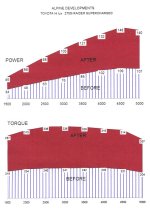
Since all of our kits have a similar design, they provide similar power improvements. Typically a 40%-50% improvement in engine output is realized. Power curves are provided in the area of the website pertaining to your vehicle of interest. (most cases)

What other parts do you recommend I use in addition to the supercharger kit?
Additional bolt on parts such as exhaust systems, throttle bodies, and air filters will make viable gains. Changes in parts that will affect the proper fuel metering and emissions compliance are not recommended. Such as: Mass air meters, adjustable fuel pressure regulators, off road H piped etc. (TRD has taken care of all of these needs in their kit.)

I heard that he roots blowers are really inefficient and make lots of heat?
While roots supercharger designs of the past were less than stellar performers in regard to adiabatic efficiency, modern (modified roots) Eaton superchargers are quite good overall. Their overall efficiency at reasonable boost levels (4-8 psi) is quite competitive with other designs (screw and centrifugal). Combined with the quiet operation and 100,000 mile durability, the Eaton supercharger is the logical choice for OEM
 

Attachments

  • toyota_2700_sup_graph.jpg
    toyota_2700_sup_graph.jpg
    62.2 KB · Views: 1,411
that answers my questions about quietness. . .well, I'm almost 100% sold. Who was that guy who quoted the $3890 shipped price???

This is a plus also because it doesn't void my 6year-72k warranty.

YEAH!

Thanks for the info!

Suneil
 
Re: Supercharger questions answered.

RL Lemke said:
How is an Eaton supercharger different from a turbocharger? A supercharger is connected directly to the crankshaft by a belt unlike a turbocharger which is driven by exhaust gases. An Eaton supercharger provides improved horsepower and torque, at lower engine rpm's, by pumping extra air into the engine in direct relationship to crankshaft speed. The positive connection yields instant response, in contrast to turbochargers, which must overcome inertia and spin up to speed as the flow of exhaust gas increases. The supercharger is a way to get around "turbo lag".

A supercharger is belt driven off the engine, so if the engine is turning so is the supercharger. That is the beauty and drawback of a blower. At idle, when a supercharger robs horsepower from the engine in a parasitic way, it continues to spin the blower vanes. The TRD / Eaton M90 supercharger deals with this low RPM parasitic loss with an internal bypass. The vanes are still spinning, but there is little horsepower required as the boost is allowed to circulate to the front of the vanes also. This is where the 1/3 horsepower requirement comes into effect. When there is load on the engine (and corresponding vacuum) the bypass closes and full boost is given to the engine.

The way I see it, a supercharger is best for low RPM use, and a turbocharger is best for high RMP racing use. Off-roading requires instand and controlled torque, as opposed to WFO horsepower.

Yes, a turbo can be tuned for low RMP use - eg: big diesel trucks use turbos. There are also variable vaned turbos which minimize the dreaded turbo lag. Overall though, a turbo gives you the hit a two stroke motor gives you when it comes into the powerband. (A crazy heart pounding kick in the pants, kinda like a soft NOS injection.) Whereas, a supercharger gives you a consistant boost in power throughout the powerband.

I hope all these posts help all l'all see that for adding grunt to an already great V8, the TRD supercharger is the best way to go.
 
RL,

No, i did not misunderstand about supercharger.

Here are a few things:

1. Yes, the Eaton S/C is linear in power delivery (no "turbo lag"). This is ONLY true if your 4runner is at a stoplight and you then slam on the gas pedal. However, remember, the pedal has to move a certain extent before the bypass valve closes...this is how it reads your mind. In the past, JacksonRacing supercharger (new Eaton design...same as TRD) for Honda CRV requires 3/4 of the pedal to the floor BEFORE the bypass valve closes. This was how the JR S/C worked on Honda CRV (i did extensive research on it when i had the CRV).

So, if you're cruising at 20 mph and your pedal is 1/4 of the way down...supercharger is freely spinning (bypass valve OPEN). Then, you want to accelerate to past a car...you push the gas pedal down gradually (not slamming it down)........so for the next 1/2 of the way down, your engine accelerates like a naturally-aspirated engine (bypass valve still OPEN). Only when you get to 3/4 of the way down does the bypass valve CLOSES. This will create a jolt of acceleration...thus, a PERCEIVED "lag."

So, yes, S/C is linear from a stoplight...if you hammer the gas pedal...or go right away to 3/4 of the way down.

NOTE: i am using 3/4 of the way down as an example. This may not be the exact pedal position for TRD and 4runner...but the concept is generally true.

2. In off-roading, the above situation is not a good thing. When you're in LOW range (and especially if you're in 1st gear), you will be crawling along rocks at a slow speed, BARELY touching your gas pedal. In THIS situation, bypass valve is OPEN (aka. S/C is spinning freely). Now, let's say that you approach a big rock and need more power to crawl over it. You give it a little gas...BUT, you have to watch VERY CAREFULLY how MUCH you give...because too much gas will turn on the S/C (bypass valve closes), and the resulting jolt of acceleration can be deadly to your 4runner.

BOTTOM LINE: S/C makes gas pedal modulation more difficult.

3. Superchargers are ALWAYS parasitic! It is BY DEFINITION parasitic because it runs off the engine. No matter how efficient it is, it will ALWAYS be an extra load on the engine (small, but significant). Fuel economy will almost always be lower than naturally-aspirated engine...maybe not 1 or 2 mpg lower, but 0.5 mpg or something. From my past conversations with S/C'ed owners, ALL of them admit to noticing a slight decrease of fuel economy in daily (non-racing) driving.

4. Turbochargers are NOT parasitic because they run off the exhaust. This is why it is favored so much in cars.

5. The above S/C shortcomings are not unexpected. It is part of the design.

Nothing in life is for free!

NO REPLACEMENT FOR DISPLACEMENT.

Truly linear power = naturally aspirated.

Thanks.

P.S.: Maybe BIFF can comment on this...he's more qualified than me since he owns one!:)
 
I've read through this entire thread and as the newest guy to the forum I would like to contribute some information. I own 2 Mustangs, a 2001 Cobra with a Vortech and Aftercooler, and a 2000 Saleen Speedster with an Eaton M90. I am a power adder junkie and would like to share some real world comparisons with all of you in hopes to help you make the choice that fits your needs.

Basically the supercharger showdown is limited to these configurations: Twin Screw, Roots, Centrifugal. All of these models are belt driven as previousley stated and cause parasetic drag (I.E. taking horsepower from the engine to create horsepower via the supercharger).

The turbo on the other hand is exhaust driven and is a totally different animal. For the sake of time and excessive wear on my keyboard we will leave this power adder out of the mix as I don't feel anyone will be using this as their power adder of choice. If you do then you certianly don't need my comments as you are most likely a fabricator and highly skilled in this department.

There will and has always been a battle between the different methods used to create supercharging technology. Manufacturers constantly battle between each other with different facts about thier system (I.E. twin screw vs. Centrifugal) and why theirs is the better choice for you. I am someone who has owned them all, installed them all, and drove them all. Below is a real world opinon and advice on what would be the best choice for the 4Runner. I have nothing to gain unlike the manufacturers by sharing my information with you.

My advice will be geared toward the owner who is looking to either tow, have great acceleration and passing power, or want's to just have a fast and fun vehichle for daily driving.

Centrifugal Sperchargers: This model is geared mainly for the person who will be using their power in the upper rpm range (Racing at the drag strip or autocross). Boost builds as the RPM's build thus creating the majority of power at the peak of your RPM range. In a real world daily driving senerio this is not the best choice for you. It's also not the best choice for towing. You will not get the full benifit of this system.

Roots/Twin Screw: These systems are somewhat similar but the twin screw design is much more efficiant. With that said let's get down to the bottom line and not debate that issue. In terms of the Eaton M90 (TRD supercharger), Boost is almost instant and will provide you with the low end torque you need to get your heavy 4Runner moving and carry it all the way to redline. It is much more practical and fun in a real world driving/towing situation as you are using everything it has to offer at the stab of the throttle. The torque peak is typically at a much lower RPM range than that of the centrifugal and in most cases will produce more overall torque when compared on a dyno assuming it is an apples to apples test.

Any of these supercharging systems will decrease your gas mileage somewhat. How much depends on your foot. :D Someone looking to purchase a supercharger isn't typically worried about this as it is power we are after and not gas mileage.

Comparing my Eaton M90 supercharged Saleen to my Vortech (Centrifugal) supercharged Cobra, The Saleen wins in respect to real world daily driving conditions. It is much more fun to have on the street and actually feels like it would be faster considering the low end torque the M90 makes. It will really put you back in the seat under part to half throttle compared to my Centrifugal Cobra. The truth is my Cobra actually makes 168 more horsepower at the rear wheels and would make the Saleen a spec in the rearview mirror in an all out drag race. The Eaton M90 is very decieving under normal driving conditions and would certianly trick you into believeing that car was faster. I've done it to friends a few times.

For reference the horsepower and torque of both cars are listed below.

Saleen: 338 Rear Wheel Horsepower and 421 Rear Wheel Torque.

Cobra: 506 Rear Wheel Horsepower and 430 Rear Wheel Torque

Both cars have SAE corrected numbers using the same Dynojet.

I hope this may help some of you in understanding the difference between superchargers. If you have any further questions regarding this subject feel free to ask and I will help where I can.

Lastly, I think for the power hungry members here I may have some ideas that we may be able to use to squeeze even more horsepower out of a supercharged 4Runner. There are allot of simple things we can do to increase airflow or even boost to put us in a higer horsepower senerio. Before I go off the deep end making suggestions I would like to become a bit more familiar with the 4Runners computer, engine specs, and fuel system. The simple things are more aiflow into the intake/supercharger and better ways to get the exhaust moving out faster. Blower porting is also possible for increased horsepower and not to mention a smaller blower pulley to increase boost a bit. I have a friend who I am confident would be willing to fab up some parts for testing per my suggestions when the time is right.

 
I can speak from my past experience with my supercharged 2000 4runner, that you do not need to slam the throttle or even push the throttle to 3/4 to get the bypass valve to close. Its vacuum activated, and I could watch my boost gauge move into a positive pressure with the lightest touch. Throttle modulation was never an issue, and was just like a non boosted truck, just much faster.:driving:
 
Biff said:
Have you tested the acceleration times now? Like just estimate your 0-60 and 1/4 mile times with a stop watch?


Times


0-60mph - 5.8 sec


1/4 mi - 10.9

I did this with a buddy of mine, he timed me while I drove.

I have to throw up the BS flag on this one... Sorry, but a Supercharger will NOT push the 4runner down the 1/4 in less than 11 seconds. haha. that is funny. I give it 13.9 or 14.4 at BEST! 0-60 in less than 6 seconds is reasonable, but I doubt it.

Anyone have accurate 1/4 times?

Also, where are you guys purchasing your Superchargers?
 
perfectmax said:
I have to throw up the BS flag on this one... Sorry, but a Supercharger will NOT push the 4runner down the 1/4 in less than 11 seconds. haha. that is funny. I give it 13.9 or 14.4 at BEST! 0-60 in less than 6 seconds is reasonable, but I doubt it.

Anyone have accurate 1/4 times?

Also, where are you guys purchasing your Superchargers?
Damn, talk about digging up a thread from the grave...

Someone with the S/C can attest to this but I think 0-60 is in the high 6 range and the quarter mile is in the high 14's. Check out this article where they tested one:

http://www.fourwheeler.com/roadtests/129_0409_2004_toyota_4runner_supercharged/index.html

The 0-60 time is listed at 7.6 and the quarter at 16 flat, but something tells me that is a bit slow. My '05 is probably around 285 HP and I know I could put up a faster quarter than that. Maybe they didn't launch under boost or didn't have it floored the whole way. Or maybe they tested it at altitude...

The TRD supercharger has been dead for a while now. They are still available to purchase from some places but are getting rarer because TRD isn't manufacturing them anymore. Instead Toyota opted for VVT-i to boost power and torque in the 2005+ models.

The reason they killed the S/C is because people were throwing rods over time or because they kept building power on top of the S/C and the V8's couldn't handle it. However, if you have an '03-'04 V8 and can get your hands on a TRD S/C it will fit and work just fine, but be aware of the dangers down the road and good luck finding a dealership to honor your warranty with the install.

Hopefully TRD will pull their heads out of their collective asses and design some new S/C's for the new V8's in the upcoming years. Until then, they seem to be doing real well designing t-shirts, hats and 30 hp S/C kits for Scions...:mad:
 
Last edited:
perfectmax said:
I have to throw up the BS flag on this one... Sorry, but a Supercharger will NOT push the 4runner down the 1/4 in less than 11 seconds. haha. that is funny. I give it 13.9 or 14.4 at BEST! 0-60 in less than 6 seconds is reasonable, but I doubt it.

Anyone have accurate 1/4 times?

Also, where are you guys purchasing your Superchargers?

The 0-60 is around 6 seconds depending on how your launching and turning the Trac system off with one foot on the brake and one foot on the gas. Launching is critical in acheiving the 6.0 seconds. We compared this in a little street racing with my neighbors 330i sedan. Which is suppose to have a 6.7 0-60. No official strip time. Sorry. Just be happy that you'll be able to have a jump on many stock BMWs.

1/4 mile time in 10.9 is total B.S. Maybe mid to high 14's if the given conditions of the track are ideal and the ambient temp isn't in the 90's like it has been here in SoCal. Also having the heavy a$$ Revos doesn't really help in launching quicker.

Anyway after it is all said an done a mid to high 14 second 4500 SUV shouldn't be anything to complain about with everything else being stock. Given 18% drivetrain loss on my 2WD we figure we're getting 290 hp to the ground and maybe 400 lbs of tq max.

About gas mpg. I don't know why but in the city we are getting 1-1.5 more mpg consistently. On the highway we're getting 1-2 miles less. This is after 3000 miles so ten tanks of gas or so.

About caring about gas mileage? After spending almost 5k after it's all said and done I don't think the extra $4-5/tank is a big concern and I guarantee the smiles on my face show how much I really care.

About reviving a old thread...geesh
 
From what I remember, an article about a year ago at this web address:

http://www.fourwheeler.com/roadtests/129_0409_4run/

confirmed the SC 4Runner IS faster than the ugly Porsche.
This is some text from the article that the Google search pulled up.

"TRD Supercharged 4Runner - Four Wheeler MagazineFour Wheeler drives the TRD-supercharged 4Runner V-8. ... taking only 7.6 seconds from 0 to 60 mph, three-tenths of a second faster than the Porsche. ...
fourwheeler.com/roadtests/129_0409_4run/ - 46k - Supplemental Result - Cached - Similar pages"

Too bad the article is no longer available. But I don't think any more mods are needed. Maybe Porsche paid off someone to yank the article! Who knows.
 
thanks for informing the guys..... 8 YEARS LATER!!!!

if you want to spam posts w/ your egay company, at least do it to recent threads!!
 

Members online

Forum statistics

Threads
278,317
Messages
3,554,129
Members
248,016
Latest member
Advally Service

Trending content

Back
Top