
PSA: Use the Right Coolant

BlackWorksInc

New member
I get asked alot why you can't just put whatever coolant you want in a car. Well here's a good real world example. This owner's Prius now needs a Cylinder Head ontop of the HG job I was doing because they used the wrong coolant and the head is literally being eroded away because of it (called Cavitation Damage). The highlighted section shows that the coolant passage are actually being eaten away and this could have caused the HG to fail, it's hard to tell at this point; but the damage is done. This is just the obvious damage, this type of erosion is now through out the entire cooling system to varying degrees.
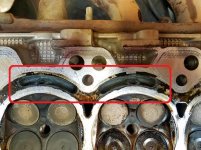
20160702_110756.jpg

This is the type of long term damage I am talking about when you don't use the coolant designed for the vehicle. Just because you don't see the effects or feel any problems doesn't mean it isn't causing damage.
 

Attachments

  • 20160702_110756.jpg
    20160702_110756.jpg
    108.9 KB · Views: 1,784
Last edited:
Register to hide this ad
Interesting and surprising to me. What are the major differences between coolants? Why would any of them cause this kind of damage?
 
What color was the coolant?

Green?

Green-ish ~ Orange-ish? Was not at all SLLC that's for sure.

[MENTION=128391]kwill[/MENTION]

That's a more complicated answer... SLLC doesn't have Silicates among other additives in it. Coolant technology has come a long way from your typical "green stuff" Basicaally coolant is designed for the engine it goes in. There's tons of dissimilar metals and materials in an engine and they can react in bad ways over time, coolant has additive packages and chemical properties tailored to prevent these types of bad interactions and are tailored to the specific engine typically.
 
Last edited:
I have seen this many times when doing heads. Even when the right coolant is used but they don't maintain it same thing will happen. See it a lot on the Jeep v8, a few imports such as Subaru and Nissan. Also see it on the Duramax diesels.

People assume since the engine is not overheating the coolant is fine and if low just top it off with whatever is cheapest
 
I have seen this many times when doing heads. Even when the right coolant is used but they don't maintain it same thing will happen. See it a lot on the Jeep v8, a few imports such as Subaru and Nissan. Also see it on the Duramax diesels.

People assume since the engine is not overheating the coolant is fine and if low just top it off with whatever is cheapest

That's true too, if you don't change the coolant at the proper interval, the additive packages and chemical protection that it offers will more than likely run out and cause similar issues.
 
That's true too, if you don't change the coolant at the proper interval, the additive packages and chemical protection that it offers will more than likely run out and cause similar issues.

While many have likely gotten away with Toyota's 100K coolant change recommendation, I prefer to do so more often.
 
While many have likely gotten away with Toyota's 100K coolant change recommendation, I prefer to do so more often.

Technically the 1st coolant change is due at 100k, after that it's supposed to be done every 50k. Not many people realize that, but it is detailed in the maintenance guide and I believe owner's manual. :)
 
Technically the 1st coolant change is due at 100k, after that it's supposed to be done every 50k. Not many people realize that, but it is detailed in the maintenance guide and I believe owner's manual. :)

Yes - I have seen that. Mine will get changed a lot sooner than 100K.
 
Another item about coolant in our modern (aluminum) engines is when the pH changes over time.
This can do as much damage as putting in the wrong coolant.
 
Toyota SLLC. Period.

Great info Blackworks! This is just re-enforces my unwillingness to get non-OEM radiator fluid. I understand the savings many people want when they go aftermarket fluid, but it clearly isn't worth it.
 
A pic is worth 1000 words.

Good thread, thanks for showing us this [MENTION=66389]BlackWorksInc[/MENTION]
 
Great info Blackworks! This is just re-enforces my unwillingness to get non-OEM radiator fluid. I understand the savings many people want when they go aftermarket fluid, but it clearly isn't worth it.

What savings? What are they buying? Zerex Asian comes out to the same price as Toyota red from the dealer, last time I checked.
 
I dont get why people don't use red. I get its hard to find, but I parked my car for 2-3 days when i realized i was short in my coolant swap. if you plan it ahead, its it comes out ~18 per gal (2 after dilution)

00272-1LLAC-01 - Genuine Toyota ANTIFREEZE GALLON W

just look around buy it when you meet a free shipping quota and your parts order. Way cheaper than amazon zerex asian equivlant
 
I dont get why people don't use red. I get its hard to find, but I parked my car for 2-3 days when i realized i was short in my coolant swap. if you plan it ahead, its it comes out ~18 per gal (2 after dilution)

00272-1LLAC-01 - Genuine Toyota ANTIFREEZE GALLON W

just look around buy it when you meet a free shipping quota and your parts order. Way cheaper than amazon zerex asian equivlant

You have to be careful, Toyota LLC (Long Life Coolant) aka "Toyota Red" is what your 2002 3rd Gen 4Runner takes, it is a LOW Silicate formula among some other differences.

Toyota SLLC (Super Long Life Coolant) aka "Toyota Pink" is a NO Silicate formula among some other things and is spec'd for your 2004 4th gen 4Runner and newer.

Toyota SLLC is backwards compatible, meaning your 2002 3rd gen can use it in place of the Toyota LLC, but your 4th gen cannot use Toyota LLC, it needs SLLC or equivalent. Also, diluting LLC does not make it SLLC, I've had some people get that information from even parts departments and it's completely wrong; LLC is usually undiluted, while SLLC is pre-mixed. Additionally the use of Distilled Water is not as recommended these days because apparently the "pure" water actually can cause some weird metallurgic interactions (I need to find a source for this as I had one in another thread someone posted.)
 
You have to be careful, Toyota LLC (Long Life Coolant) aka "Toyota Red" is what your 2002 3rd Gen 4Runner takes, it is a LOW Silicate formula among some other differences.

Toyota SLLC (Super Long Life Coolant) aka "Toyota Pink" is a NO Silicate formula among some other things and is spec'd for your 2004 4th gen 4Runner and newer.

Toyota SLLC is backwards compatible, meaning your 2002 3rd gen can use it in place of the Toyota LLC, but your 4th gen cannot use Toyota LLC, it needs SLLC or equivalent. Also, diluting LLC does not make it SLLC, I've had some people get that information from even parts departments and it's completely wrong; LLC is usually undiluted, while SLLC is pre-mixed. Additionally the use of Distilled Water is not as recommended these days because apparently the "pure" water actually can cause some weird metallurgic interactions (I need to find a source for this as I had one in another thread someone posted.)


Oh sorry I didn't read into which one, but yes definitely not the same. not sure why they decided not to make a premixed red. anyway I was trying to convey, that if you hunt for it, you can get pink or red, for really about the same price as the aftermarket.
 

Members online

No members online now.

Forum statistics

Threads
278,309
Messages
3,554,071
Members
248,016
Latest member
Advally Service

Trending content

Back
Top