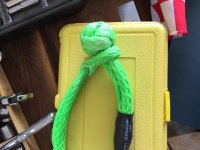
Recovery Gear Options

All my local friends with many years of off-roading experience tell me to skip the high-lift and carry a good cylinder jack.


I recommend doing what I did, and sign up for a good off-road recovery course and learn how to use your gear. People are scared of Hi-Lift jacks. No doubt they can be dangerous, but so can any tool. Train up and you'll be safe.

One thing that is apparent is that everyone is going to have a different opinion on what gear you need based on their experiences. The folks that trained me would tell you that along with the appropriate straps, all you need is a winch and a hi-lift. Forget the rear locker, MaxTrax, exhaust jack, etc. If you watch Xpedition Overland or Ronny Dahl you'll want MaxTrax...
 
No, my feedback was pretty spot-on.

A 4runner's Gross vehicle weight is ~ 6,300lbs.

A 4.75T D shackle (like this one from ARB: ARB D Shackle 4.75T, 10,472lb (ARB207D)) has a rated WLL of about 10,500lbs...note that is the WLL, not the ultimate strength, which is much higher (2-3x higher, depending on how the testing is conducted). I think getting a D shackle with a WLL higher than your strap's break strength (which should be somewhere around 16k-19k lbs) is quite an overkill for a 4runner.

10,500lbs covers the 4runner's gross weight and then some, for purposes of WLL. A 4.75T D shackle is more than sufficient for a 4runner.

You can go check out this article on offroad recovery tools for more info: Essential Tow-Point Ideas for Proper Off-Road Recovery: Off-Road.com
im a bit confused as to what your actual position is on this.

I would suggest to always get the largest shackle you can fit on your equipment. mostly, due to ease of use. trying to rig for an extraction and having to fumble with tiny connections is a major PITA.
 
I was going to try to not respond here but I think I need to give a contrarian view. Why? Read on.

If you take all these guy's recommendations (some are good, some not) and load up with what they SAY they use, you will need a 6X12 trailer to haul your recovery gear!

I am a minimalist when it comes to recovery and pretty much everything else. I have the pleasure of going off road for quite a few years and I have used a lot of gear... wait, I have PACKED a lot of gear and very seldom used it. Sure, it's better to have it and not need it but where do you draw the line? If you read some of these posts it would be better (and cheaper) just to buy another vehicle to follow you around just in case you get stuck!

Most of the time I am off road with no other vehicles. Sure, eastern off roading is a bit different than western off roading but the principle is the same even if the terrain is different. Before deciding on a recovery kit you have to ask yourself a huge question: "What will I be doing off road?" If you are going to an Off road park to challenge your vehicle with obstacles you need a certain recovery kit. If you are overlanding you need a different recovery kit. Why? Because if you are overlanding you will be smart enough to GO AROUND the tough obstacles lol. Personally I always take the easy way around something so that means I very seldom need any recovery gear. If you are always going to take the hard path then that will require a lot of recovery gear.

With that said my normal recovery box has:
Come Along
Bottle Jack
Gloves
Folding Saw
Two lengths of 50' strong synthetic rope (you need to learn some knot skills)
Folding shovel
Multi tool.
Ratchet Straps

This is still almost too much crap to carry around! I have a hi lift I never use or carry anymore and have a bunch of shackles, blocks, sheaves, wire rope that is in a box and will never get used.

So ask yourself two things:
1. Will I always take the sure thing way and
2. Where do I draw the line on crap to carry.

Good luck.
 
I was going to try to not respond here but I think I need to give a contrarian view. Why? Read on.

If you take all these guy's recommendations (some are good, some not) and load up with what they SAY they use, you will need a 6X12 trailer to haul your recovery gear!

I am a minimalist when it comes to recovery and pretty much everything else. I have the pleasure of going off road for quite a few years and I have used a lot of gear... wait, I have PACKED a lot of gear and very seldom used it. Sure, it's better to have it and not need it but where do you draw the line? If you read some of these posts it would be better (and cheaper) just to buy another vehicle to follow you around just in case you get stuck!

Most of the time I am off road with no other vehicles. Sure, eastern off roading is a bit different than western off roading but the principle is the same even if the terrain is different. Before deciding on a recovery kit you have to ask yourself a huge question: "What will I be doing off road?" If you are going to an Off road park to challenge your vehicle with obstacles you need a certain recovery kit. If you are overlanding you need a different recovery kit. Why? Because if you are overlanding you will be smart enough to GO AROUND the tough obstacles lol. Personally I always take the easy way around something so that means I very seldom need any recovery gear. If you are always going to take the hard path then that will require a lot of recovery gear.

With that said my normal recovery box has:
Come Along
Bottle Jack
Gloves
Folding Saw
Two lengths of 50' strong synthetic rope (you need to learn some knot skills)
Folding shovel
Multi tool.
Ratchet Straps

This is still almost too much crap to carry around! I have a hi lift I never use or carry anymore and have a bunch of shackles, blocks, sheaves, wire rope that is in a box and will never get used.

So ask yourself two things:
1. Will I always take the sure thing way and
2. Where do I draw the line on crap to carry.

Good luck.
and then a lot of recovery gear can be left out, if you add a winch :D
 
It kinda surprises me the effort that some are willing to put in to avoid having a winch. For me it's the recovery tool of choice 99% of the time. They have gotten so cheap and so reliable in the last 10 years, if you're going where you're getting stuck, it's just the best tool for the job most of the time. An inexpensive hitch mount winch can be had for around $350. I'll take that over max trax every time.

I offroad alone probably 95% of the time. And I get stuck. But self recovery is a piece of cake with a winch and a few bits of hardware to go with it.
 
Talking about recovery gear, below is a post I did awhile back that might help a few of you guys understand some of the numbers. We were talking about shackles in this situation but near the bottom you will see the amount of forces generated using different recovery methods. Another guy wanted this so I thought I would just go ahead and post it here too. Hope this helps.


"Alright [MENTION=85512]eddiebx[/MENTION], you have officially asked me the most complex question to date! So here goes:

(disclaimer: in order to understand this explanation you need to understand physics and upper level math. In order to not reinvent the wheel I pulled selected links from the internet to help with the explanations. Everything here applies to a general condition but every recovery is unique with it's own set of challenges. Use this information at your own risk because recovering a vehicle is inherently dangerous. The data presented looks correct to me but I did not go through and check every single formula or conversion. I will try to write this so non engineers and physicists will understand. Use this as a general guide only!)

In reality, the recovery point on a vehicle is important, but not as important as the recovery method or equipment.
Let's start by addressing the actual question of "Is a front mounted receiver safe for a vehicle recovery?" The answer is, you guessed it, yes and no lol. Let me explain:

Without knowing the actual material specs of the hitch and the actual conditions in which the recovery is taking place I cannot tell you whether the hitch mount will fail. If the manufacturers tell you the rating though you should take that number as gospel. But in reality, what does this rating mean?

Well, the rating has to be used in context. Eddie mentioned that a "winch pull would be gentle and a hard tug would put more force on the vehicle." That could be true or not. If you are making a STATIC recovery (vehicle is stationary and a winch or come along is being used for example) the loads being transmitted will be more constant (instead of gentle) compared to a DYNAMIC recovery (vehicle is stationary and pulling vehicle is moving) that means forces will change considerably. Let's take a few examples:

Example 1: Vehicle is stuck and a winch is being used with wire rope connected to another vehicle.
In this example, the winch puts out a known force. The vehicle that is the "tie down" vehicle is a known weight and we all know that force required to slide the tie down vehicle across the dirt is much less than the weight of the vehicle right? This is a static recovery, for all intents and purposes used here today. This method is used quite often and is very straightforward. There is minimal rope stretch and the forces transmitted will be limited to the force required to slide the anchor vehicle or get the vehicle unstuck. You can also keep going and if your winch has enough pulling force this will continue until something fails. The math here is simple: Winch develops “X” amount of force on “Y” wrap and “Z” force is required to break free the stuck vehicle. If your components are good for the “Z” force you will be fine. If not, well...

Example 2: Vehicle is stuck and another vehicle is pulling it with a recovery strap.
This is an example of a DYNAMIC recovery. The strap is designed to stretch and by doing so will “ramp up” the transmitted forces. It will go from zero to maximum forces required to break the vehicle free from it’s position, the total amount of force able to be generated or until something fails.

Now THIS math is quite a bit different. It’s one thing to have something at rest, or static. It’s a different ball game when something is moving! The math, while straightforward, might require a primer. I have included a few links here:

This link should be used to understand the concepts Kinetic energy - Wikipedia, the free encyclopedia

This link should be used to better understand the relationships of vehicle dynamics http://filebox.vt.edu/users/hrakha/P...on Model.pdf

This is a nice link explaining recovery straps and their strength properties How To Choose A Recovery Strap Or Tow Strap - YouTube

Here is another link on the basic equipment needed for recovery Road to Recovery

And here is a link that goes through the math of making an actual recovery Offroadtb.com Dynamic Recovery

I have taken an excerpt from this last link that you should find pertinent to this conversation. In these series of calculations he is showing the differences of using a proper recovery strap, a static strap (non stretch) and a chain. THIS IS THE MOST IMPORTANT PART OF THIS POST! Why? [MENTION=85512]eddiebx[/MENTION] asked me if using a front hitch was a safe recovery point. I answered “yes” and no” and the following explanation will justify my answer. As you will see in his three examples, just by changing the equipment has changed the transmitted forces tremendously!

“The effects of using a non-dynamic connector:
We’ll use an average 5,000 lb vehicle as our example recovering vehicle. The two vehicles are attached with the strap, loose at first. The recovering vehicle proceeds forward with a bit of gas, reaching only 5 mph when reaching the end of the strap. At this point the vehicle has gathered kinetic energy equal to 1/2*mass*velocity^2.
KE = 0.5 * 5000 lb * (5 mi/hr)^2 = 5.7 kJ
We will assume for this instance that the stuck vehicle will remain stuck and will not budge (worst case)… so all of the recovering vehicle’s energy transfers into the strap and is turned into elastic potential energy. This stored energy will be equal to the kinetic energy that the truck had. This stored energy relates to the force exerted on each end by the following: energy = average force * distance. The distance is how far the strap stretches. The average force is assuming the rope exerts constant force, which ours does not. Because it’s force exerted most closely resembles a linear relationship to the stretch, the average force should be multiplied by 2 to get the maximum exerted force (which is all we are interested in here)… assuming the system reaches equilibrium without failure.

In instance 1, we will use a dynamic strap, which can stretch about 6 feet.
5.7 kJ / (6 ft) * 2 = 2,089 lbf (well within the safe range of most straps)

For instance 2, we used a static strap, which we will assume stretches only 4 inches before reaching equilibrium.
5.7 kJ / (4 in) * 2 = 25,072 lbf (enough to snap a strap or possibly rack your frame)

For the last instance, what if we used a chain, which has extremely minimal stretch. So we will say 0.5″…
5.7 kJ / (0.5 in) * 2 = 200,576 lbf (you will certainly break something!!)

So, I hope this gives you a real world, numerical understanding of why dynamic straps should ALWAYS be used in dynamic vehicle-to-vehicle recoveries.
* I did not show unit conversions for the sake of simplicity (there were a lot)”

Well! Now you guys should see that not all pulls are created equal! Same conditions, same vehicles, the only thing that changed was the connecting method!
I have used all three methods of connection in the past. We have even taken a hydraulic cylinder with a pressure gauge attached, mounted the cylinder in the connecting straps and used the pressure to measure the force developed during drawbar pull tests. These ratios are very close to our actual testing conclusions.


So, to summarize, IF you use the proper methods for recovery a front mounted receiver with the proper hooks should be fine. Even the OEM hooks will suffice with the proper recovery technique. I hope this answers your questions. Oh, don’t try to use these calculations for your own application unless you really understand the math. This guy left out a LOT of steps and conversions but it kept it simple and easy to understand."

 
I need to buy some basic recovery gear

Should I do Soft Shackles or D Shackles?

Should I have both a Kinetic/Snatch Rope and recovery strap?

Can anyone link me to some that I can buy on Amazon?

How is this?:
Soft Shackles
Bubba Rope - Gator-Jaw Soft Shackle | 4WheelParts.com

Kinetic Rope:
Amazon.com: KINETIC RECOVERY ROPE (Snatch Rope) MILITARY-GRADE (BLACK) - 1 inch X 30 ft with Heavy-Duty Carry Bag (4X4 VEHICLE RECOVERY): Home Improvement

Strap:
http://www.amazon.com/Smittybilt-CC...qid=1453493272&sr=1-1&keywords=recovery+strap

Receiver Hitch:
http://www.amazon.com/Smittybilt-29...xgy_263_3?ie=UTF8&refRID=1HFF4R6Z5E0SF46TCJ1K
 
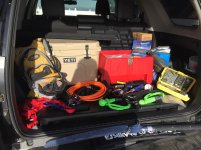
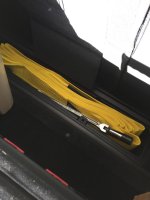
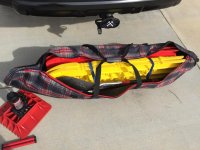
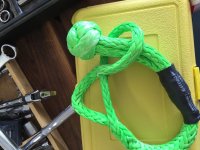
Dave, here you go....all this stuff has saved my arse at one point in time...
 

Attachments

  • IMG_2261.jpg
    IMG_2261.jpg
    133.6 KB · Views: 1,360
  • IMG_2263.jpg
    IMG_2263.jpg
    121.9 KB · Views: 1,016
  • IMG_2286.jpg
    IMG_2286.jpg
    136.4 KB · Views: 1,079
Nice new Gear

Dave, here you go....all this stuff has saved my arse at one point in time...

Thanks redkat

The only problem is this gear is all brand new. It's never been used. You need to get out more often. ... I'm in So Cal. Let's go!
Dave
P.S. I still don't see or know how those soft shackles work. What holds that loop together?
 
Here's a good video on how to make your own soft shackle:
I'd keep at least one regular metal shackle with you though. Soft shackles don't do sharp corners very well.

<iframe width="854" height="480" src="https://www.youtube.com/embed/s8QJEdYqe_E" frameborder="0" allowfullscreen></iframe>

If you're learning how to make stuff out of high tech ropes, whoopie slings are really useful for lots of stuff too!

<iframe width="854" height="480" src="https://www.youtube.com/embed/KtJGTgpv4dc" frameborder="0" allowfullscreen></iframe>
 
Last edited:
Chain analogy

Talking about recovery gear, below is a post I did awhile back ... Hope this helps.

... If you are making a STATIC recovery ...

“The effects of using a non-dynamic connector:
We’ll use an average 5,000 lb vehicle as our example recovering vehicle. The two vehicles are attached with the strap, loose at first. The recovering vehicle proceeds forward with a bit of gas, reaching only 5 mph when reaching the end of the strap. At this point the vehicle has gathered kinetic energy equal to 1/2*mass*velocity^2.
KE = 0.5 * 5000 lb * (5 mi/hr)^2 = 5.7 kJ
... the stuck vehicle will remain stuck and will not budge (worst case)…

In instance 1, we will use a dynamic strap, which can stretch about 6 feet.
5.7 kJ / (6 ft) * 2 = 2,089 lbf (well within the safe range of most straps)

For instance 2, we used a static strap, which we will assume stretches only 4 inches before reaching equilibrium.
5.7 kJ / (4 in) * 2 = 25,072 lbf (enough to snap a strap or possibly rack your frame)

For the last instance, what if we used a chain, which has extremely minimal stretch. So we will say 0.5″…
5.7 kJ / (0.5 in) * 2 = 200,576 lbf (you will certainly break something!!)

...
... Even the OEM hooks will suffice with the proper recovery technique. I hope this answers your questions. ..."

Thanks Greg,

Both of your posts here are full of good info.

One problem with this mathematical comparison of the three lines is that you assume the pulling vehicle is moving at 5 mph when it hits the end of the chain. We all know that with a chain you'd pull the slack out slowly before applying any force. You'd start pulling from a dead stop. We can all imagine that if you hit the end of a chain at 5 mph what will happen to the anchor points or the chain. The weakest point will break.

See my post a couple of pages back about the reason we use anything made of steel at a working strength limit (WLL) instead of the ultimate or breaking strength.

One video I saw yesterday said that if something fails in a line of rigging a chain will drop rather than go flying because it has no stretch or kinetic energy. Of course that assumes it is not attached to a kinetic strap or rope.

Long ago an old codger said to me, "A chain is only as good as the weakest link". Now that I'm older than that old codger I have to wonder about using short lengths of chain as part of a recovery system. :fishing:
 
One video I saw yesterday said that if something fails in a line of rigging a chain will drop rather than go flying because it has no stretch or kinetic energy. Of course that assumes it is not attached to a kinetic strap or rope.

Having seen this first hand - I can assure you that the chain will become a very dangerous piece of projectile. I saw one go through the headlight assembly of a Ford truck about 10 years ago. Pure chain between the stuck truck and the pulling truck. Hit the end and snapped in the middle.

I use a short choker chain for various tasks, but it definitely can become a projectile.
 
Thanks redkat

The only problem is this gear is all brand new. It's never been used. You need to get out more often. ... I'm in So Cal. Let's go!
Dave
P.S. I still don't see or know how those soft shackles work. What holds that loop together?

Recovery gear should be new or near new, stuff needs to be replaced periodically esp. after its been loaded up a few times. I keep my gear clean. Recently purchased an extra set of recovery boards for Dumont Dunes. Yes, Its a good idea to practice using gear and working out possible scenarios, although every recover situations presents its unique set of circumstances. Be prepared and know your limitations. I try not to get myself in risky situations, even more so when solo.
 

Attachments

  • IMG_2288.jpg
    IMG_2288.jpg
    125.7 KB · Views: 955
  • IMG_2289.jpg
    IMG_2289.jpg
    131.9 KB · Views: 989
  • IMG_2290.jpg
    IMG_2290.jpg
    129.7 KB · Views: 982
Recovery gear should be new or near new, stuff needs to be replaced periodically esp. after its been loaded up a few times. I keep my gear clean. Recently purchased an extra set of recovery boards for Dumont Dunes. Yes, Its a good idea to practice using gear and working out possible scenarios, although every recover situations presents its unique set of circumstances. Be prepared and know your limitations. I try not to get myself in risky situations, even more so when solo.

?? I'm all for keeping equipment in good condition, but I don't think it should be new or near new. Dyneema should be good for thousands of hours of loading. Sailboat rigging is slightly different as it's sk78, but it's easily good for 5+ years though it's sized creep not ultimate strength, but even after 2 years of uv it maintains about 95% of its strength in tests. But there's probably not much reason ever to replace a dyneema soft shackle unless it's visibly damaged or has been in the sun too long. There's just no way you'd ever approach the lifespan of the material using for occasional recovery.
 
Most people on here reference D-rings, but I would suggest soft-shackles. Cost little more, but weigh less, don't become a lethal projectile when failing, don't seize up under pressure.

http://www.amazon.com/gp/aw/d/B00PE...ft+shackle&dpPl=1&dpID=41cjQobW1lL&ref=plSrch

Okki
Edit : well crap. I should have read page 4 before typing! LMAO.... So +1 for soft shackles
before this thread, I had never heard of such a thing.


and now I can see why. crikey! at that price, I don't see any reason to use them. I don't see how quality shackles would ever fail for OUR use. they are spec'd for weights that we could never hope to achieve with our rigs.

to each their own I guess. but im going to continue using my old fashioned D shackles.
 
D-ring projectile

before this thread, I had never heard of such a thing.


and now I can see why. crikey! at that price, I don't see any reason to use them. I don't see how quality shackles would ever fail for OUR use. they are spec'd for weights that we could never hope to achieve with our rigs.

to each their own I guess. but im going to continue using my old fashioned D shackles.

Yea, I hadn't heard of soft shackles until I started doing a lot of searches.

The D-ring becomes a projectile if anything else in the rigging line fails. If you use it between two straps, a very simple example, and one of the two straps fails, it goes flying as the other strap recoils. All the videos on how to rig say not to use a D-ring out in the rigging line. It can be used on the car or on a tree saver.
 
Soft Shackles & new gear

Recovery gear should be new or near new, stuff needs to be replaced periodically esp. after its been loaded up a few times. I keep my gear clean. Recently purchased an extra set of recovery boards for Dumont Dunes. Yes, Its a good idea to practice using gear and working out possible scenarios, although every recover situations presents its unique set of circumstances. Be prepared and know your limitations. I try not to get myself in risky situations, even more so when solo.

redkat,
Thanks for the photos of the soft shackle in various shapes. Now I think I see how they work. These would be okay for joining two straps or anything else out in the middle of the rigging.

As a scuba diver's Divemaster (lifeguard) for many years, I used to really watch anyone who showed up with all new gear. They were obvious newbies. We'd watch how they assembled their gear and got ready for the dive. New divers also take a lot of time because they're apprehensive about the dive. I remembered that when I saw all your new gear. I'll be looking like the newbie too when my recovery gear arrives.
 
Shackles soft or steel are equally safe as long as you stop and think what you are doing and inspect them for damage before and after each use. A crosby bow shackle (3/4) is designed with a 4 to 1 safety factor that is close to 42000lbs breaking load.

Few things to note regarding steel shackles.
- do your self a favor and get a bolt type shackle, they are less likely to get loose and "can" be subjected to a side load.
- if you use a screw pin shackle don't "back the pin out a 1/4, 1/2 or whatever turn" they are design to be secured tightly a quality shackle will not bind.
- Screw pins Should NOT be exposed to side loads. Therefore think before securing them to factory recovery points. The angle at which those are located will cause a side load on almost all scenarios.
 
Recovery gear list

Well everyone, thanks for all of the useful responses. I placed an order for most of my recovery gear on Amazon today.
:bluejump:
Here's my list:
Viair 400P Automatic air compressor. I really wanted the 440P but could not be sure I could make it shut off Automatically when the pressure peaked.
VIAIR Corporation - 12-Volt & 24-Volt Air Compressors and Pneumatic Systems
ARB 2&3/8 x 30' kinetic recovery strap
2 - Gator Jaw 7/16" soft shackles (thanks redkat)
4 - 3/4" D-Ring shackles, rated
1 snatch block rated to 33,000 lbs
50' of 7/16" Amsteel Blue synthetic winch rope will use this to upgrade the Wyeth-Scott come along when I get it.
1 - no name tow hitch receiver with 3/4" D-Ring shackle (they're all made in China, AFAIK)
1 - 5/8" receiver pin with clip pin
1 Toyota brand receiver hitch cover (to keep my shins off of that receiver)

I need to order the come-along from Wyeth Scott directly. I didn't see any 3-ton models on line. Maybe next week I'll order that.

What I didn't find was a short bridle harness that I've seen in videos to connect both front recovery loops with a V-shaped line to the snatch strap or rigging line. I looked at short chains and short kinetic ropes but they were all over $50 so I will keep looking. I'd like to be able to use both recovery points for difficult pulls.

I got down under the truck and took a good look at the recovery loops under the 4Runner today. They're actually quite stout and well anchored. The single rear anchor loop depends on two large bolts and a smallish fillet weld point. There's threaded holes on the right side for another matching loop but guess what's there right below the frame. The exhaust pipe. That's another reason to turn the exhaust out to the side behind the rear wheel. If you can buy that part from Toyota then you'll have two recovery points besides the hitch.

Thanks again.
Dave
 

Members online

Forum statistics

Threads
278,316
Messages
3,554,107
Members
248,016
Latest member
Advally Service

Trending content

Back
Top