RichinRidgewood
New member
....You appear to be a troll. You've added nothing. You have no apparent interest in learning. So, that kinda only leaves one conclusion....
Now we are into name calling....nice.
Just finishing my next post stay tuned.

....You appear to be a troll. You've added nothing. You have no apparent interest in learning. So, that kinda only leaves one conclusion....


Now we are into name calling....nice.
Just finishing my next post stay tuned.

What?
?
I don't know what to say here. I don't really have time to go though all of this and correct it.
He's definitely trolling you, then trying to play victim accusing you of name calling.Name calling? I think it's just identifying your behavior. You asked why people prefer solid axles. The answer is that they work better for some uses. You then seem to challenge that answer with nothing other than typical trolling responses. The premise of your comments is that it must be an irrational or ignorant person who prefers a solid axle. Then when confronted with the facts that demonstrate otherwise you're could have simply said "interesting, I wasn't aware of that reason". Instead you've demonstrated that you had no intent on learning, just being a troll.
Here are a few things out of a couple hours of reading I did lately
Dependent
On dependent systems with large displacements the camber angle becomes so severe on both tires and the tire contact patch on both tires so small that the benefit of claimed “more articulation” is greatly reduced or worthless.This is factually wrong. I demonstrated exactly why with a photo. The assumption that the ground is made up of level steps is not consistent with reality. (see the picture of that cartoonish white Jeep thing with the front axle vertical and the tire sitting on its sidewall.)
Also you have the front axle between the wheels so you really only have less than the radius of the wheel assembly as ground clearance.
This is oversimplified. IFS has variable ground clearance. The range of travel must be heavily limited to retain ground clearance greater than a solid axle through the suspension cycles. In both cases without portal hubs the axle centerline remains the rotational axis of the wheel. Ultimately the ground clearance of an independent system is gained by trading away compression travel range and droop. You can't have full range of motion AND more ground clearance. It's basic geometry
Front dependent systems have high unsprung weight and they are susceptible to shimmy and steering vibrations.
“Shimmy of the front axle had become a serious problem by the 1920s. General Motors (GM) engineer Maurice Olley’s description of the problem
“On a smooth road with front wheels carefully balanced, the car might be traveling at 60 or 70 mph. Suddenly, for no apparent reason (perhaps a small dip or pothole passing under one front wheel), the steering wheel would be wrenched out of the driver’s hands, and would start oscillating violently, while each front wheel would leap along the road in giant ten foot jumps. The front axle would be tramping at 550–600 cpm [cycles per minute], each front wheel jumping three inches into the air.” (1)
All systems can exhibit harmonic imbalance. Google steering shimmy here for the 5th gen. This is neither unique to either system or preventable on either system.
“Olley and his colleagues at GM determined that a solution to the shimmy problem was the switch to the independent front suspension (IFS), which “suppresses shimmy by connecting the mountings of the two wheels through the entire sprung mass of the front of the car”. The IFS also had the advantage of allowing for softer front spring rates, which decreased how much the car would pitch over bumps — this flat ride proved pleasant.” (4)
GM engineers aren't very good at engineering. I think we've learned that lesson enough times by now haven't we? And I think we all agree that IFS does have lower sprung weight and is often more comfortable at higher speeds. I don't know that this has any relevance to this discussion
I have personally seen this and had it happen to me in a solid front axle F-series.
Cool story. Not sure why it matters. I've had a shimmy in an IFS car too. I don't think IFS is bad as a concept because I've had one with a harmonic imbalance.
Car and Driver refers to this as “…Ox-cart technology….” (5) WGAF what car and driver call it?
Independent
With an independent front or rear you can have zero camber angle change throughout the travel range, what ever range you choose to design to, and maintain full tire contact patch or you can design in the camber angle required for the job the vehicle has to do. You can also design in zero bump-steer as well.
Again - this is not ideal for off road use. This is only optimal if you assume you live in lego land where all surfaces are flat. They are not. Camber changes that follow the terrain are preferable to static camber through the suspension cycle
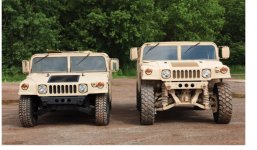
Here are some of the benefits of the TAK-4 and TAK-4i independent suspensions used on our military vehicles.
“Equipping the TAK-4 suspension on HMMWVs provides numerous benefits, including:
–A 70 percent off-road profile capability and 14 inches of independent wheel travel to overcome obstacles and navigate rugged, mountainous environments
–Ground clearance increased to 17 inches to improve mobility and occupant visibility while also helping to counter underbody blasts, such as IEDs, by enabling more stand-off distance
–A 40 percent increase in the vehicle’s maximum speed and a 46 percent improvement in braking
–Restoring a 2,500-pound vehicle payload capacity when the crew is embarked with all current add-on armor installed, which allows for consideration of an under-vehicle armor vee-shaped panel solution to further improve survivability
–Improved ride quality, with a reduction in suspension vibration and harshness for less crew fatigue” (3)
“The new Oshkosh TAK-4i intelligent independent suspension system suspension provides 20-inches of wheel travel ..
TAK-4i intelligent independent suspension system suspension is an ‘intelligent’ independent suspension, providing variable ride height through gas springs.
“In all cases the operating profile of the system is 70% off-road, 30% on-road.” (2)
This is why the special forces buy and use Toyota's right? And the TAK was never intended to be a great off road truck. It's was built for carrying a lot of weight over rough roads. It would have zero plausible chance of completing a course like the KOH in Johnson valley. It's probably fine for moderate terrain and does a good job of hauling heavy stuff over that type fo terrain. They are not and were never intended to be capable of the last mile type terrain. The reference is kinda meaningless here.
If the 4Runner had an independent rear suspension it would be a much better vehicle imho. Actually a BOF with 4 wheel independent from a major automotive manufacturer like Toyota would be pretty ‘effn awesome. SRS is not going to stop me from buying a 4Runnner.
The Sport of Rock Crawling amounts to micro percents of the 4 wheel drive vehicles used in the world. I doubt I will ever do it again. It was fun in a rented Jeep in Hawaii for a day. Here are some purpose built vehicles that have interesting articulation
You did not go rock crawling in Hawaii in the same sense that we're calling something like the Rubicon trail rock crawling. I'm glad that you had fun. I think the Rav4 better suits what you think of as offroad driving.
Spider excavator
All Mountain Inc.- All Mountain Construction Spider Excavator Services
YouTube
Turbo diesel Hexapod Walking Machine
YouTube
Conclusion: I haven't seen anything in my reading to convince me that Solid Front Axle systems on a 4 wheel drive vehicle are anything I would want to have (again). This was almost a stupid waste of time since I knew this all ready however since I did get to read a 200+ page paper on vehicle suspension design it was probably worth my while. Thanks to everyone who replied.
1) W. Milliken and D. Milliken. Chassis Design: Principles and Analysis. Society of Automotive Engineers, Inc., 2002.
2) Oshkosh TAK-4 Independent Suspension System - Wikipedia
3) Oshkosh TAK-4 Independent Suspension System Enhances HMMWV Capabilities | DefenceTalk
4) Geometric Design of Independent Suspension Linkages D.E Kline
5) https://www.caranddriver.com/news/a15340751/explained-the-five-most-common-automotive-suspensions/
Now we are into name calling....nice.
Just finishing my next post stay tuned.
...I also have a gown with 3 stripes......
.... troll .....

Are you about finished up here?
There’s a Honda Pilot forum that can use your expertise

Well lookee here. We have a real doctor on this board. I mean a doctor maybe like a Dentist is a Doctor but any how a PHD.
My worthless Bachelor of Science in Electrical Engineering and my Master of Science in Mechanical Engineering from a couple big name schools in Michigan and 30 years of experience working as an Engineer and a Director for some of the biggest companies in the world is no match for that. I am, after all, a "troll".
So Jetboy why dont you scratch out a few force diagrams, derive the formulas, explain your constraints and compare both cases. Don't bother with Matlab it's too cumbersome. Do it on paper with a pencil. This shouldn't take you so long you have a PHD. I even gave you a head start with the formulas in the papers I posted.
(PHD) Pile it High and Deep there son. Help me understand.
Well lookee here. We have a real doctor on this board. I mean a doctor maybe like a Dentist is a Doctor but any how a PHD.
My worthless Bachelor of Science in Electrical Engineering and my Master of Science in Mechanical Engineering from a couple big name schools in Michigan and 30 years of experience working as an Engineer and a Director for some of the biggest companies in the world is no match for that. I am, after all, a "troll".
So Jetboy why dont you scratch out a few force diagrams, derive the formulas, explain your constraints and compare both cases. Don't bother with Matlab it's too cumbersome. Do it on paper with a pencil. This shouldn't take you so long you have a PHD. I even gave you a head start with the formulas in the papers I posted.
(PHD) Pile it High and Deep there son. Help me understand.
See, now you turned it into a pissing contest...you've just lost all credibility.
Surprised the 3 houses, 10 car, 4 trophy wives and 11 figure bank account wasn't mentioned...
See, now you turned it into a pissing contest...you've just lost all credibility.
Surprised the 3 houses, 10 car, 4 trophy wives and 11 figure bank account wasn't mentioned...
Nope married to my first (and will be my only wife), 1 old car, 1 old motorcycle, a bunch of degrees, semi-retired, (Billions of dollars in a bank account? how is that even possible?) I have traveled a lot and will continue to do so.
This thread turned from tech discussion into a name calling and cow pie throwing contest. Too bad could have been worth something.

Isn't the Mercedes C-Class a passenger sedan?I can't even remember how many leaf springs I had to replace on my Chevrolets and Pontiacs. They didn't last very long. It was often.
It seemed like I needed front end suspension parts and a front end alignment every year and that was with 60-70 series tires too.
I have done maybe 2 - four wheel alignments on my 14 year old 180k MB C-class (IFS/IRS). I haven't had to replace any drive shafts (knock wood). I did have a worn front link about 100k miles ago
Point being if the IFS/IRS is designed right you wont need alignments and parts any more than with a solid.
Dude, your 3rd post in this thread you were saying how SFA might make sense for a "budget weekend warrior", and you're whining about some cow pies lobbed back at you? Watch some rock bouncing vids and count how many SFA vs IFS rigs you see. Want to go to one of their events and tell the 95% of guys who run SFA/SRA on the hardest courses on the planet in their $50-100k+ rigs how they're "weekend warriors" because your 20 yr old Benz has only needed a few alignments? Get real. Every one of those guys and most of the guys here have weighed the pros and cons of both, and all decided on at least an SRA if not SFA. Maybe they know some things about it firsthand that you don't?
Every truck, and really every BOF vehicle that I know of, designed by multiple PhDs with millions of data points behind them, of uses a SRA. Maybe they know some things from a century of design research and stress testing that you don't?
Every design has its place. If you don't want to off-road, don't want to tow heavy things, don't mind replacing perfectly good CVs because the boots cracked yet again, and are willing to pay slightly more for slightly better on-road handling, then buy a Highlander, buy a Prius. No one cares. I poke way more fun at mall crawlers than I do the suburban dad who drives an IFS/IRS vehicle because it suits his needs. It's your insistence on tearing down people whose different needs are met by a different design than your preference that led your thread down the road it traveled.