mom
Banned
SUMMARY:
My 4Runner developed progressively more severe pedal pulsation upon braking.
The solution was effected by performing a repeating series of aggressive rebedding runs. The fact that rebedding is fast, free, and effective in some cases, indicates that others with similar issues may benefit from similar solutions.
I'm not saying uneven pad deposition is the cause/solution for 'your' vibration upon braking; I'm just saying it was the cause & solution for mine. YMMV
BACKGROUND:
- 8 Myths ... Holding You Back from Performing the Best Brake Job, by Andrew Markel
- The "Warped" Brake Disc and Other Myths of the Braking System, by Carroll Smith
- Brake Roughness and Vibration: Causes & Solutions, by Dave Mann
- There's no such thing as 'warped' brake rotors, by Michael Block
- Avoiding Brake Judder at the Track, by Dave Zeckhausen
- Brake Rotor Shake Demystified, by Dali Racing
- Raybestos Brake Tech School, Part One: Rotors Don't Warp, by Police Fleet Manager Magazine
REBEDDING:
- Removing the Mystery from Brake Pad Bed-In, by Matt Weiss
- How to Bed-in Your Brakes, by Dave Zeckhausen
Notes:
Note 1: (Not all references wholly agree.)
The various references don't all agree on all points, e.g., rotors "can" deform, but the actual word "warp" must, by necessity, assume actual distortion measurements of the rotor disassembled from the hub (keeping in mind lateral runout isn't necessarily warp; neither is disc thickness variation).
Note 2: (The well-known Tundra modification was never an option for me.)
The vaunted "Tundra modification" is not an option mainly because my '97 4Runner 2WD has 15" wheels which won't fit either the 199 mm calipers (pre 2002.5 Tundra) or the 231 mm calipers (2002.5 to 2006 Tundra after TSB).
Note 3: (Some say the often-suggested Tundra modification does not actually increase initial stopping power.)
For 4Runners with larger wheels, the Tundra's 5mm thicker rotors and 15% larger pads should theoretically allow greater heat dissipation (which, some say, doesn't increase initial stopping power apparently because the plumbing isn't changed ... but almost all say the greater heat dissipation should at least increase both kinds of fade resistance.
Note 4: (Some debate whether the Tundra modification can actually reduce shudder.):
Whether the increased heat dissipation of the Tundra modification also reduces uneven pad deposition is a healthy matter of debate with much anecdotal evidence but far fewer facts.
Note 5: (Almost all say it's critical to bed the pads and rotors properly.)
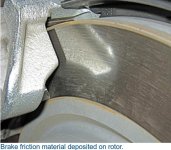
Lest anyone conclude that pad deposition, in and of itself, is a bad thing, per se, remember that braking friction is due partially to breaking covalent bonds between the pads and a (hopefully even) deposition layer on the rotor. What naturally follows is that proper rebedding is an essential component of a properly performed pad-replacement procedure.
Note 6: (Some suggest we modify our braking habits to prevent shudder.)
An understanding of the formation of uneven brake pad deposits should naturally result in a conscious change in your braking habits to reduce or eliminate further uneven pad deposition. For example, after a long hard stop, leaving the foot pressed on the brake pedal is just asking for a pad imprint. Once imprinted, the vicious cycle begins anew as explained in the references.
My 4Runner developed progressively more severe pedal pulsation upon braking.
The solution was effected by performing a repeating series of aggressive rebedding runs. The fact that rebedding is fast, free, and effective in some cases, indicates that others with similar issues may benefit from similar solutions.
I'm not saying uneven pad deposition is the cause/solution for 'your' vibration upon braking; I'm just saying it was the cause & solution for mine. YMMV
BACKGROUND:
- 8 Myths ... Holding You Back from Performing the Best Brake Job, by Andrew Markel
- The "Warped" Brake Disc and Other Myths of the Braking System, by Carroll Smith
- Brake Roughness and Vibration: Causes & Solutions, by Dave Mann
- There's no such thing as 'warped' brake rotors, by Michael Block
- Avoiding Brake Judder at the Track, by Dave Zeckhausen
- Brake Rotor Shake Demystified, by Dali Racing
- Raybestos Brake Tech School, Part One: Rotors Don't Warp, by Police Fleet Manager Magazine
REBEDDING:
- Removing the Mystery from Brake Pad Bed-In, by Matt Weiss
- How to Bed-in Your Brakes, by Dave Zeckhausen
Notes:
Note 1: (Not all references wholly agree.)
The various references don't all agree on all points, e.g., rotors "can" deform, but the actual word "warp" must, by necessity, assume actual distortion measurements of the rotor disassembled from the hub (keeping in mind lateral runout isn't necessarily warp; neither is disc thickness variation).
Note 2: (The well-known Tundra modification was never an option for me.)
The vaunted "Tundra modification" is not an option mainly because my '97 4Runner 2WD has 15" wheels which won't fit either the 199 mm calipers (pre 2002.5 Tundra) or the 231 mm calipers (2002.5 to 2006 Tundra after TSB).
Note 3: (Some say the often-suggested Tundra modification does not actually increase initial stopping power.)
For 4Runners with larger wheels, the Tundra's 5mm thicker rotors and 15% larger pads should theoretically allow greater heat dissipation (which, some say, doesn't increase initial stopping power apparently because the plumbing isn't changed ... but almost all say the greater heat dissipation should at least increase both kinds of fade resistance.
Note 4: (Some debate whether the Tundra modification can actually reduce shudder.):
Whether the increased heat dissipation of the Tundra modification also reduces uneven pad deposition is a healthy matter of debate with much anecdotal evidence but far fewer facts.
Note 5: (Almost all say it's critical to bed the pads and rotors properly.)
Lest anyone conclude that pad deposition, in and of itself, is a bad thing, per se, remember that braking friction is due partially to breaking covalent bonds between the pads and a (hopefully even) deposition layer on the rotor. What naturally follows is that proper rebedding is an essential component of a properly performed pad-replacement procedure.
Note 6: (Some suggest we modify our braking habits to prevent shudder.)
An understanding of the formation of uneven brake pad deposits should naturally result in a conscious change in your braking habits to reduce or eliminate further uneven pad deposition. For example, after a long hard stop, leaving the foot pressed on the brake pedal is just asking for a pad imprint. Once imprinted, the vicious cycle begins anew as explained in the references.
Attachments
Last edited: