- SS uses OEM joints and bushings which I'm fond of. Recommend staying OEM with uppers
- Metal Tech uses the currie johnny's with zerks. Lowers are offset and uppers also have johnny joints and are adjustable.
- Toytech carries the Rokman Pro series with adjustable lowers and adjustable uppers. Spendy $$ for the uppers.
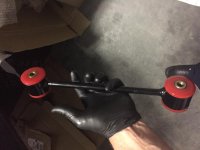
I don't have any of those, but I'll contribute my opinion because I was one of the pioneers of 3rd gen modified rear lower control arms (RLCA's) back in about 2002. I might have been the first to catastrophically destroy my weak stock RLCA's on the trail. It's easy to bend the stock arms on rocks or ledges. So I'm a huge fan of upgrading RLCA's so the tube is a lot stronger than stock and potentially can also improve articulation.
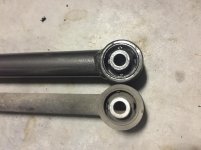
First, the basics: SS has a pic on his web site comparing the stock tube thickness. If you're going off-road, you really should upgrade to anything that's about 1/4" thick wall tubing and roughly 1.5" diameter or so. You won't bend those.
I agree with the goal of having at least one rubber or poly bushing at one or both ends of any of the rear control arms. With the suspension design being a 5 link (4 links plus panhard), there are massive forces fighting between all the links with compression and tension in all of them, not to mention they still have to deal with rotation.
It's incredibly stupid to replace both ends of upper and lower links and maybe even the panhard with all "rod ends" / heims or Johnny Joints or any other joint that allows rotation but is otherwise rigid. If you have a ton of rod ends back there, you are guaranteed to "lock up" your rear end so it won't articulate, plus you'll likely break some bolts for those links, which a friend has done, plus you'll feel and hear a lot more vibations and noises. You can't assume that more rod ends equals more articulation -- that only works if you have something like a double triangulated 4-link or 3 link.
Many years ago I wheeled with Steve at Sonoran Steel. In the past I have disagreed with some of his conclusions, but in this case I agree with what he says on his web site about don't mess with the upper links - the stock upper links work great as is and it's very tight to try to adjust the length there anyway. There's very little motivation to do anything with the uppers. I also agree that it's not a bad thing to stick with rubber on both ends of the lower links, although I still think it can be a good thing to have only one end of the lower links with a high quality joint that allows good rotation.
What I don't understand about some of the new RLCA products is that the Currie Johnny Joint has very little room around it within the Toyota brackets for it to rotate much. It'll hit the side of the brackets pretty quickly because the joint itself is so wide. So then you're not fully utilizing the joint's ability to rotate and you might just be subtracting from the advantage of the flex of rubber joints at both ends.
I think it's a small advantage to being able to slightly adjust the length of either RLCA rather than just a rigid tube between rubber bushings at both ends. Yes, this can be useful if you want to make minor fixes to "yaw" or the pinion angle.
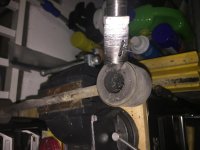
One of my early attempts at custom RLCA's used the stock Toyota rubber bushing on the axle end, a nice strong 1/4" wall 1.5" diameter DOM tube in the middle, and a 3/4" heim rod end at the other end. I had to drill out the bolt hole slightly larger from M14 to 5/8" to accommodate the 3/4" heim at the frame end. Unfortunately the 3/4" rod ends did not last long at all due to rapid wear. I tried a few different designs of 3/4" heims. I frequently struggled with squeaks although I tried to grease them and use heim boots on the sides to help grease them. I eventually gave up on those.
What I ultimately ended up with was to re-use those links with new threaded bungs welded in the one end of those tubes with the 7/8" Summit Machine Jimmy Joints. Those are basically huge heims that are rebuildable and greasable. One important point is they have much more surface area than any 3/4" heims. so one set of Jimmy Joints has lasted me almost 10 years and counting. I recently examined them and have no issues with them. I had to use medium strength threadlock on the ring in the side of that joint, but otherwise, I have no complaints about using them. I chose Jimmy Joints over Currie Johnny Joints because they are much narrower so they fit in the Toyota frame bracket with lots of room for rotation.
I utilized Spidertrax to assemble my original custom solution, although that's because they build control arms to your specs and they have a machine shop that can deal with the press-fit Toyota rubber bushings on one end. They don't have 4Runner products for this and they aren't familiar with my latest revision of these.
Sorry for the book. Yes, mine is a custom solution, but now you should have more knowledge to make a wiser choice for yours.