Sound Deadening Project Write Up

Not intending to stray too far off topic, but one recommendation I heard recently for soundproofing a room in a regular house was to essentially build a 2nd wall all around the room, separated from the existing walls by 1" of dead air space. Basically, a box inside a box. The 2nd, inner wall would have two layers of drywall on it. The dead air space apparently greatly reduces the noise level inside the room. (This is effective only if HVAC duct does not connect to or pass through the walls or ceiling of the room.)

In a 4Runner, maybe the layer of Mass Loaded Vinyl corresponds to the double layer of drywall, and the closed-cell foam corresponds to the dead air space. But the problem of installing a 2nd windshield, or a double-pane windshield, remains.
 
In a 4Runner, maybe the layer of Mass Loaded Vinyl corresponds to the double layer of drywall, and the closed-cell foam corresponds to the dead air space. But the problem of installing a 2nd windshield, or a double-pane windshield, remains.

That would be a fairly accurate way to look at it.
 
Ah, so then the gains are mostly for sound quality as in you should not hear much if any rattling after you put in a new system
 
I think there is some confusion over the purpose of the CLD (Constrained Layer Dampening) products. (Dynamat and similar)
The primary function of this is to reduce vibrations, not reduce noise. The recommended amount to use is 25-30% coverage. If you use enough of it you will notice some sound reduction, but it comes at a cost of excess weight and price.

To get real sound reduction you need to complete the 3 step process. The CDL should be followed by CCF (Closed Cell Foam) and then MLV (Mass Loaded Vinyl)
While OCF (Open Cell Foam) is preferable due to its frequency reduction properties, it can be negatively affected by water intrusion creating possible mold issues. Closed cell foam is not as affected by this issue.

The foam is used to decouple the MLV from the CLD. The most sound reduction will come from the MVL. This is just a solid weighted layer that is quite effective and blocking sound intrusion.

You will see the most noticeable sound reduction by doing the doors. Next will be the hatch, rear wheel wells and foot wells in the front. Doing the rear sides and pillars will also help. You will get some reduction from the floors and firewalls, but these are fairly well covered with factory material. Doing the roof can be effective as well, but you must be careful with the headliner.

You won't get a truly quiet environment due to the glass used in the 4Runner. Being that it is at head level, a majority of the sound comes from here. Some of the Lexus vehicles come with double pain glass, which helps quite a bit.

Thank you for this explanation. I also thought it is for sound reduction
 
Very helpful description. From the pictures, it looks like there may be room in the doors to install additional storage areas.

There MAY be room in the doors for additional storage, however, realize:

1. The window is UP in these pics. It needs room to move down
2. The holes in the doors are designed to give access to the window and door actuators as well as door handle, etc. Any extra storage would need to consider the ability to continue to have this access.
 
I think there is some confusion over the purpose of the CLD (Constrained Layer Dampening) products. (Dynamat and similar)
The primary function of this is to reduce vibrations, not reduce noise. The recommended amount to use is 25-30% coverage. If you use enough of it you will notice some sound reduction, but it comes at a cost of excess weight and price.

To get real sound reduction you need to complete the 3 step process. The CLD should be followed by CCF (Closed Cell Foam) and then MLV (Mass Loaded Vinyl)
While OCF (Open Cell Foam) is preferable due to its frequency reduction properties, it can be negatively affected by water intrusion creating possible mold issues. Closed cell foam is not as affected by this issue.

The foam is used to decouple the MLV from the CLD. The most sound reduction will come from the MVL. This is just a solid weighted layer that is quite effective at blocking sound intrusion.

You will see the most noticeable sound reduction by doing the doors. Next will be the hatch, rear wheel wells and foot wells in the front. Doing the rear sides and pillars will also help. You will get some reduction from the floors and firewalls, but these are fairly well covered with factory material. Doing the roof can be effective as well, but you must be careful with the headliner.

You won't get a truly quiet environment due to the glass used in the 4Runner. Being that it is at head level, a majority of the sound comes from here. Some of the Lexus vehicles come with double pain glass, which helps quite a bit.

Good information and agree on most points. Of note, Sound Skins includes has a foam layer built in addition to the foil and butyl. Your call out is still a good one as other responses have mentioned Dynamat, etc, which is only foil / butyl.

I'm considering adding some Mass Loaded Vinyl, but that will likely be phase 2.
 
There MAY be room in the doors for additional storage, however, realize:

1. The window is UP in these pics. It needs room to move down
2. The holes in the doors are designed to give access to the window and door actuators as well as door handle, etc. Any extra storage would need to consider the ability to continue to have this access.

Good points! I forgot about the window rolling up and down.
 
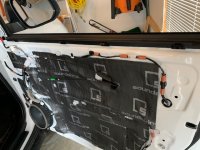
I got mine done today. It took 5 hours to do all the doors and the rear hatch with 80mil Kilmat. IMO a very worthwhile project. Had I remembered that we have a db meter at work, I would have done some before/after testing, but the butt dyno says it's a little quieter going down the road. The big deal is that the doors sound solid now, which was my initial motivation for doing this. Since I only used 2/3 of the 36 sqft, I'll add some to the rear panels and wheel wells eventually.
 
Couple of suggestions.
There is absolutely no advantage to trying to use 1 whole sheet or just a few really large pieces. No one sees behind the door panel and it doesn't make a difference in sound reduction. This product is mainly to reduce vibrations. Using a full sheet is far more important when installing Mass Loaded Vinyl as this is where the most sound reduction will come from.

Make sure to thoroughly clean the inside of the door with isopropyl alcohol.

Not cleaning all of the vapor barrier adhesive will have no affect on the adhesion of the CDL

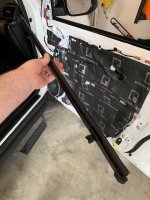
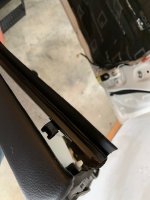
When pulling off the door panel, pull straight out from the window, not up. There is a bar that fits into the window channel that has clips that the door panel click into. Makes it 100 times easier to reinstall.

Agree with all points. I want to call our your last point in particular so everyone is sure to see it.

When you pull off the panel, there is a bar that fits into the window channel that will pull off with the panel, and that is fine. However, it will save significant frustration and swearing if you pull this bar off the panel and re-install it separately from the panel, itself. Be aware, you need to use a fair amount of force to pull off the bar. Just pull straight out and you will be fine. Below are some pics of the bar attached, unattached, and re-installed on the door, before the panel. Once you have the bar reinstalled, all you have to do is push the panel straight onto the door. All the clips will click in place.
 

Attachments

  • IMG_4306.jpg
    IMG_4306.jpg
    63.9 KB · Views: 1,850
  • IMG_4308.jpg
    IMG_4308.jpg
    102.2 KB · Views: 1,856
  • IMG_4311.jpg
    IMG_4311.jpg
    97.1 KB · Views: 1,872
Long time no update?


Unfortunately, no update. I have had two giant boxes of second skin luxury liner pro sitting in my basement for six months, but started a new job around that time and don’t have the time to tear things apart. I have enough to do the doors and floor, but I’m thinking of just having a local shop do the work with their stuff and sell the LLP. If there is an update rest assured I’ll post it here.


Sent from my iPhone using Tapatalk
 
Inspired...

Well after reading your post I have 90 square feet of SecondSkin Luxury Liner Pro and 136 square feet of KILMAT that is going in this weekend... Might of bitten off more than I can chew on this one...
 
Reading this write-up is giving me flash backs and wanting to install some SD on the doors of the runner.

DIY'ed a Second Skin Damplifier Pro and LLP install about 3 years ago on a previous car. Although not a 4Runner, I did learn a few things by doing it in a few stages and would probably approach doing the 4runner differently and selectively based on effectiveness.

The trunk and openings behind the seats was completed first and it did absolutely nothing in terms of perceived and measured noise reduction even with the LLP. With a sound meter, this registered 0db reduction at 70mph in the cabin. I would probably consider this the least important part. It did help with heat reduction in the trunk and probably would have been effective reducing rattles if there was a sub installed.

The doors were the best bang for the buck. With just the SD material, it vastly improved the SQ of the door speakers and also cut down perceived road noise although sound meter didn't register any db reduction. It felt as if there was a noise barrier draped around the perimeter while driving. With this completed, it was now pretty obvious that the road noise was penetrating through the quarter panels, tunnel, footwells, and floor boards at this point because the doors were dead silent.

I did the hardest parts last but were the most effective. Adding the SD and LLP on the floor boards, foot wells, quarter panels, and tunnel registered a -3db drop at 70 mph.

It was a ton of work in the middle of summer and probably added 80 lbs of weight but it was worth it after everything was said and done. For the 4runner, I'll probably load up on the doors and call it a day. I don't miss the sharp edges, cutting to fit weird angles on the floors and the awkward positions trying to get the SD material in odd places.

Maybe it's not that bad in the 4runner so I hope those of you that are eventually going to install throughout will share your process pictures. Best of luck!
 
peps, been reading this; interesting stuff; at a bit of an expense, time and effort; my hats off to you all; if your keen on noise reduction you may have missed the nosiest areas! ... you gotta hear this, lol!

In an attempt to protect the frame from rust and abbrasion, along with the wheel wells and underside of my 4Funner, and also found it helped with sound dampening; I sprayed the wheel wells, frame & underside with "rock guard"; 2 cans at $8 / can I was in a bit of a hurry, I sprayed all the open obvious accessible areas in two - 1/2 hour sessions without a lift and at times on my back. Now I also have an aftermarket opened exhaust that vibrates and is noisier than stock, so the sound dampening was noticeable and a great benefit, Both at idle and on the highway. Also I added a vinyl roof skin that helps with noise too! Just "me" observations that you all could benefit from too; my 2 cents :)-
 
Last edited:
I just lined the drivers door last weekend to prep for a speaker upgrade and it was much more of a pain in the arse than I thought. And certainly took longer. And resulted in a couple of hand cuts. Hats off to anyone attempting the entire vehicle :hatsoff:
 
Just finished install of my OEM Plus speaker upgrade. All 6 speakers. I insulated the front doors and I think it made a positive difference, and the speakers sound much better than stock! I can actually play music now. Only issues I had involved getting the door cards back on. I hosed up the passenger side door. I reinstalled the door handle wires backwards so when I closed the door I couldn't get the door to open again! Door handles wouldn't work. Tried everything. So I unscrewed the door card from inside and had my wife pull the door away from the card on the outside. She wasn't happy :bash:

Then going to dinner I asked her how she liked the new sound, and...wait for it....she said she didn't notice anything. "I never really paid attention to begin with" :frusty:
 
Thanks for clarifying.

I think there is some confusion over the purpose of the CLD (Constrained Layer Dampening) products. (Dynamat and similar)
The primary function of this is to reduce vibrations, not reduce noise. The recommended amount to use is 25-30% coverage. If you use enough of it you will notice some sound reduction, but it comes at a cost of excess weight and price.

To get real sound reduction you need to complete the 3 step process. The CLD should be followed by CCF (Closed Cell Foam) and then MLV (Mass Loaded Vinyl)
While OCF (Open Cell Foam) is preferable due to its frequency reduction properties, it can be negatively affected by water intrusion creating possible mold issues. Closed cell foam is not as affected by this issue.

The foam is used to decouple the MLV from the CLD. The most sound reduction will come from the MVL. This is just a solid weighted layer that is quite effective at blocking sound intrusion.

You will see the most noticeable sound reduction by doing the doors. Next will be the hatch, rear wheel wells and foot wells in the front. Doing the rear sides and pillars will also help. You will get some reduction from the floors and firewalls, but these are fairly well covered with factory material. Doing the roof can be effective as well, but you must be careful with the headliner.

You won't get a truly quiet environment due to the glass used in the 4Runner. Being that it is at head level, a majority of the sound comes from here. Some of the Lexus vehicles come with double pain glass, which helps quite a bit.
 

Members online

Forum statistics

Threads
278,312
Messages
3,554,085
Members
248,016
Latest member
Advally Service

Trending content

Back
Top