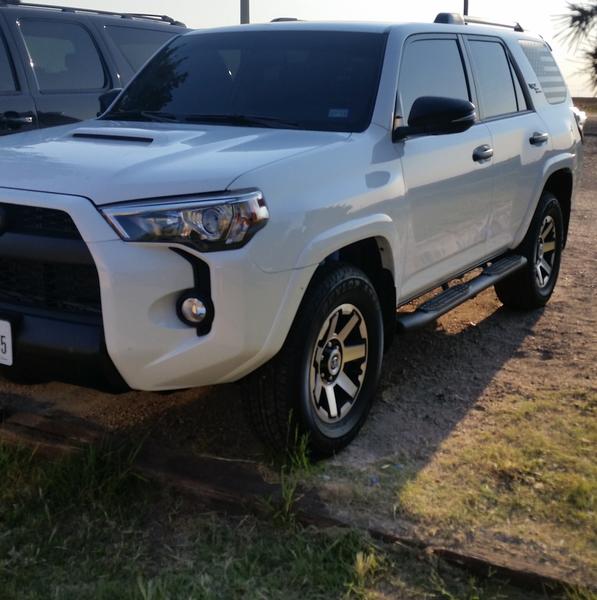
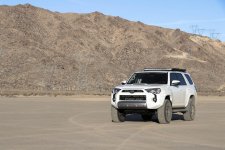
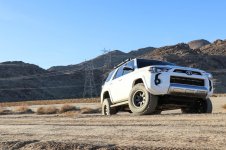
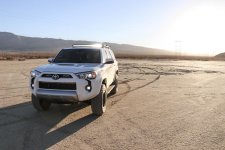
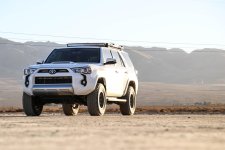
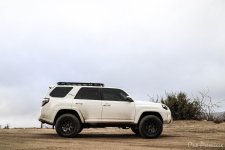
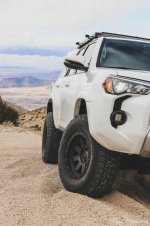
Update: Photos Coming Soon
So I went on quite the suspension venture with this one. This 4Runner really tested my knowledge. Being a stubborn *******, I dismissed the advice of those who know there stuff (aka Scott @ Camburg). So below, I am going to share my experience so others dont have to spend 5 or 6 weekends in a row swapping shocks and springs. I've gotten my time down to 1.5 hours to swap front shocks and springs, including spring compression. Level: Master Builder.
I decided against coilovers because this thing is a pavement princess and will only see dirt 1% of the time. And when it does see dirt, I am not trying to keep up with a trophy truck through 3 foot holes where I have to worry about shock fade ect. I really question those who claim they are experiencing shock fade, because it takes a lot of speed for an extended period to get shocks hot enough to fade. Dont get me wrong though, coilovers out of the box are the best solution for these trucks, just a whole lot of overkill. I ran the first set of Fox Extended Length Resi Coilovers with an Upper Arm on a 2010 Tundra and they thing was like a boat on the morning glass.
1.
Front: Dobinsons 302 Coil / 700 Strut
Rear: Dobinsons 723 / Stock Shock
Lift Gains: 2.75"+ Front / 2.25"+ Rear (The rear sat about 1.5" higher than the front, measuring hub to fender)
The stuff from Dobinsons is heavy-duty. There coils have a few extra turns than most other products on the market. The wire is 17mm, and you can tell. The springs are heavy. I have no doubt in my mind that these would hold up over a very long time. If you beat the S out of your rig, you may want to give there stuff a shot. Especially the guys hauling a ton of extra weight. The on road feel was solid, not as comfortable as I had hoped for, but it definitely handled like a sports car. Low speed "sharp" bumps were a little rough, which is understandable considering how burly these springs are.
1A.
Front: Dobinsons 302 Coil / 700 Strut
Rear: Dobinsons 599 / Stock Shock
Lift Gains: 2.75"+ Front / 1.5"+ Rear (The rear sat about .5" higher than the front, measuring hub to fender)
I swapped the rear 723 Springs for the 599 Springs. Gave me a very even lift.
2.
Front: Dobinsons 302 Coil / OME 90010
Rear: Dobinsons 599 / OME 60080
Lift Gains: 2.75"+ Front / 1.5"+ Rear (The rear sat about .5" higher than the front, measuring hub to fender)
This time around, my general thought was shocks. The ride felt stiff with the previous set-up. I couldn't feel the suspension working. My thought was the stock rear shocks could not keep up with the new rear coil springs, and larger heavier tires. So I installed the OME 90010 up front and they 60080 out back. This was the set-up I ran on my Tacoma (Different Shock Numbers Obviously) and it rode like a dream. Not the case for the 4Runner. The front end felt more controlled paired with the Dobinsons 302 Coil Spring, the rear felt like I was running 2x4's in place of shocks. I thought my rig was going to buck me out. The rear OME shocks are definitely designed to haul 200+ lbs of extra weight. So those were out.
3.
Front: Dobinsons 302 Coil / Bilstein 5100 Set @ 0.
Rear: Dobinsons 599 / Bilstein 5100
Lift Gains: 2.75"+ Front / 1.5"+ Rear (The rear sat about .5" higher than the front, measuring hub to fender)
I will say this I was nervous about running the 5100. I used these on a 2014 Tundra and they didn't ride the way I had hoped. However, these worked the best thus far in my quest to find the ride I was looking for. They sharp bumps in the road were still there, but generally the ride dynamics had improved.
4.
Front: OME 2884 / Bilstein 5100 Set @ 0.
Rear: Wheelers T13 / Bilstein 5100
Lift Gains: 2.75"+ Front / 1"+ Rear (The rear sat a little less than .25" higher than the front, measuring hub to fender)
Still not satisfied, I tried the OME 2884 Spring and added the T13 spring out back. I was a lot closer at this point. The ride was really good for the amount of lift I was getting. The T13 is an excellent spring, felt like stock just with more lift. Really happy with these, Wheelers nailed it. Now I know with past Toyota trucks, they really dont like anything over 2.5" without an upper arm. They like a lot of droop! Knowing this, I knew the amount of lift I was getting in the front was too much and this was contributing to a pogo-stick like ride. Rather than the suspension moving the body was moving. NEXT.
5.
Front: OME 2883 / Bilstein 5100 Set @ 0.
Rear: Wheelers T13 / Bilstein 5100
Lift Gains: 2"+ Front / 1"+ Rear (The rear sat a little less than .5" higher than the front, measuring hub to fender)
So I swapped the 2884 for the 2883. I felt like this was it. The end of the road. The ride was the best it had been through out all of the suspension changes. It felt good. Stable at speed, cornering and braking all felt great. Thought there was still apart of me that thought "it could be better". At this point my neighbors were beginning to wondering if I was running an auto shop out of my garage. 5 Weekends of the worlds loudest air compressor and the sound of an impact grinding up a harbor freight spring compressor. (Note: If you are using a threaded rod spring compressor, get some High Pressure Lube used in machining applications, it will prolong the life of the tool. You only need a little amount, about the size of a pearl right at the nut on the threaded rod. Makes everything butter smooth and helps with the heat.)
Now prior to picking up the 4Runner, I had planned on running the Bilstein 6112 from the start. This was based off my research and the advice of those who had direct experience with them. However, Dobinsons was a new name and a new approach to dialing in Toyota suspension. I was hooked and wanted to give it a shot. The Dobinsons stuff is great, I think they are going to bring some killer products to the market in the future. You can tell they've put in a lot of R&D into their springs to bring a no-bullshit product to market. I was not given a discount, or anything for free I paid the same price anyone else would pay and I am saying this to add some integrity to my opinion. Though it didn't work for me, I really wanted it too! Those springs look really cool under the 4Runner.
So even though I was pleased with the 2883/5100 and T13 combo, I was still very curious about the 6112. Long story short, impulse kicked in and I had a box of the 6112's 24 hours later. The rear shocks 5160's are on order. I had to give them a shot.
6.
Front: Bilstein 6112 w/Included Spring Set @ 6th Perch (2.2") on bothsides
Rear: Wheelers T13 / Stock Shocks (5160's are on order)
Lift Gains: 2.2"+ Front / 1"+ Rear (The rear sat a little less than .5" higher than the front, measuring hub to fender)
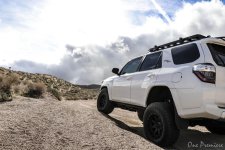
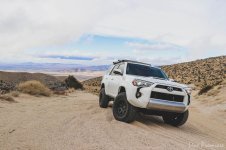
This is the finish line. I made it. Holy guacamoley. The 6112 is the pinnacle of a non-coilover solution for the 4Runner. I was very skeptical because I've always created lift using longer springs, never by compressing the shit out of the stock spring. So the fact that Bilstein was using this method with a 600lbs spring I was having a lot of doubt. I was wrong. 110% Wrong. The ride is exactly what I was looking for. Like others have said, the ride is very controlled. It almost eliminates all of the sharp road bumps. There is no bounce (commonly felt among 5100's), the handling is perfect. Stable at speed and eats up any road imperfections with ease. Still a little brake dive but thats to be expected on a short wheel base, coil sprung rear rig like the 4Runner. I am only mentioning brake drive once in this post because honestly brake dive is normal for properly functioning suspension geometry. So the guys getting all crazy about brake dive need to understand what it is, and why it's happening before trying to eliminate it. Take a stock 4Runner to an alignment guy who uses a tape measure and not a laser and ask him to fix the brake dive, because a lot of it is in the geometry.
Bottom line: Happy, very happy. I invited those local to OC that are on the fence about suspension to come drive my 4Runner.
I know I am going long here, but I want to try and provide everything I learned in this process.
KDSS:
Now this is my first experience with KDSS and I am really impressed with it. I know there a lot of mixed reviews out there but if you looks at the engineering behind it, it's a really cool system.
I was a little troubled by all of spacer talk to correct the "lean" since there is a way to correct it without spacers. I have the 6112's set evenly. They are on the same perch side to side.
Each time I put the front end on jack stands I opened the KDSS valves 3 full turns. Now in order for this to be effective, you need to have all 4 wheels off the ground. Since I was too lazy to jack up the rear end, the KDSS rams are still hard to move. However, I was going to need to open them anyways to correct the lean. Once the 6112's were on, I dropped it back on the ground and it was leaning to the driver side. Before closing the valves I went over to the passenger side and stood on the running board evening out the stance. Yes, that's all it took. I closed the valves and drove it. As of writing this the stance is perfectly even side to side. So you can throw spacers at your truck all day long because every situation is different (added weight, ect.) I am just giving you my solution and results.
So tips for reinstalling the swaybar with KDSS:
(Note: this may not be the proper way, but it was the fastest easiest way for me)
1. Attach the passenger side or side opposite the ram first.
2. Use (2) speed clamps to pull the swaybar towards the arm.
3. Bolt the lower hole first.
4. Use a screw driver to align the braket with the top hole. (There are holes for a screw driver on the mounting surface and on the bracket for exactly this purpose)
5. Profit.
Last note:
This is likely a placebo, but I did a zero point calibration after all of this for good measure. I swear it helped. I was not having any traction control issues, just thinking about the change in ride height and how it affects the yaw sensor.
That's what I've got for now. I will likely add to this post as I find my grammar and general writing mistakes.



 , and great offroad, despite many saying KDSS sucks for washboard.