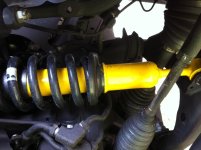
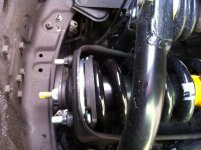
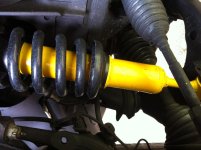
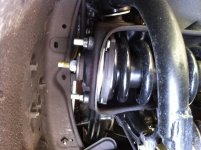
My passenger front is 1 & 7/8" lower than the drivers and the passenger rear is 7/8" lower than the driver rear. I am running the heavy duty OME all around. I have looked at trying the recall but my TE has hex bolts not allen screws/bolts. I am assuming that you turn them three revolutions to free the valves just like the LC's correct? I held off, hoping to avoid the $1,050 mistake spoken of earlier (thanks for the warning). :happens:
I am thinking that it has something to do with the rigid sway bar links on the opposite sides of the hydraulic rams. I am trying to find someone/way to have some longer ones made. If it works I will let everyone know as this has been very frustrating. My Toyota dealer has been little help saying that Toyota tells them that KDSS is not to be tampered with as it is a self learning system. I say it's a self leaning system.
Any ideas would be appreciated. Thanks!
Did you do the lift yourself? Sounds like maybe something was installed wrong or a mix up in spring rates to be that far off.Try re-doing the lift and swapping parts left to right to see if it leans to the other side and then you'll know that one of the springs is stiffer then the other causing it.
There is a procedure for leveling KDSS but it's pretty involved and not sure about special tools needed.I would
NOT try this unless you know what you are doing and have the right tools.
From the Repair Manual.........
KDSS Problem:The height of the left and right side of the vehicle is different
After confirming the difference between the left and right sides, perform vehicle tilt calibration.
KDSS TILT CALIBRATION
(a) Remove the stabilizer control valve protector .
(b) Loosen the lower and upper chamber shutter valves of the stabilizer control with accumulator housing.
NOTICE:
When loosening a shutter valve, make sure that the end protrudes 10 to 12 mm (0.394 to 0.472 in.) from the surface of the block. Do not turn the shutter valve any further.
Do not remove the shutter valves.
HINT:
By loosening the shutter valves, the upper and lower chamber will be fully connected, and the vehicle height is corrected by the equalization of the upper and lower chamber oil pressure.
(c) Bounce the vehicle to stabilize the suspension.
(d) Check the difference in height between the left and right sides of the vehicle. Refer to Measure Vehicle Height.
HINT:
When the vehicle height of the left and right side of the vehicle is not within the specified range, bleed the air .
(e) Tighten the lower and upper chamber shutter valves of the stabilizer control with accumulator housing.
Torque: 9.0 N·m (92 kgf·cm, 80in·lbf)
(f) Install the stabilizer control valve protector .
3. INSPECT FOR SUSPENSION FLUID LEAK
CAUTION:
Fluid is pumped into the system at a high pressure of approximately 3 MPa (30.6 kgf/cm2, 435 psi). If a fluid leak is discovered, immediately release the pressure and repair the fluid leak.
(a) Perform a driving test.
(b) Check for fluid leakage from the parts and connections shown in the illustration.