TE KDSS w/ OME... Lean to the Right??

I was leaning to the passenger side as well. The driver side coilover had the spacer on it to compensate for the gas tank weight so I just swapped my coilovers left to right and now I'm good.

ALright i'll try that, i'm suprised that 10mm spacer would make it lean this much. thanks for the quick reply sir.
 
I just installed the OME rear suspenspeion on my 4runner with KDSS. I noticed a slight lean this afternoon. I'll be doing the front tomorrow morning. As I was reading Slee's install write up, I noticed on page 4 that he says to put the 5mm trim packer on the passenger side strut if the vehicle is equipped with KDSS. I always thought it was a typo until I saw this thread. I was also browsing through [MENTION=85512]eddiebx[/MENTION] 's killer lift install thread and he raised the excellent point that the Aussies "driver's" side is on the right...it makes sense that the driver side (Aussie) needs the trim packer. I may put the trim packed strut on MY passenger side to see if that resolve the KDSS lean.

Basically, this would confirm Narkhelek's idea of switching the struts from side to side.
[MENTION=58068]Narkhelek[/MENTION], do you still have a little lean in the rear or did the trim packer up front pretty much level everything out?
 
Last edited:
[MENTION=58068]Narkhelek[/MENTION], do you still have a little lean in the rear or did the trim packer up front pretty much level everything out?

I still have a bit more lean in the rear but that is most likely because I have a big heavy storage box full of gear in the back on that side. The difference is only about half an inch though.
 
Did anyone ever confirm if the trim packer needs to be on the driver or passenger side?

Nothing eh? I'll be installing an OME lift this weekend. I guess I'll just have to give it a shot and hope for the best. I'll be putting the trim packer on the passenger side based on the most recent comments.
 
I think this needs further exploration.

1. There is no learning. The system only has two positions - open and closed. Open at low speed. Closed at high speed.

The system should be symmetrical. Front to back. Meaning the spacing between the KDSS piston side and fixed bushing should be equal distance apart. Similarly the lever arm from the KDSS sway bar rotating center to the axis of the bushings of the piston and fixed end should be similar distance. And the location of the mount of the sway bar to the axle or a-arm must also be approximately the same. If all of those parameters are correct, KDSS should always self level when run at low speed. The fluid forces on each piston should reach an equilibrium point where there is no force on either sway bar at rest.

We are finding that lifts may result in a lean to the passenger side.

This means that both pistons (both are on the driver's side) are putting a downward force on the sway bars when the vehicle is sitting level. What is causing the equalization of force to balance at a non-zero location. Zero being the point where the KDSS piston is equal extension as the fixed side.

My guess is that a lift - because the sway bar is fixed essentially in 3 locations and has a fixed arm length that is shorter than the control arms in the rear in particular the lift puts a downward pressure on both ends of the two sway bars, pulling them downward. The passenger side - being fixed acts like a limit strap of sorts. The driver's side will equalize where both pistons are slightly extended from the zero point. This is because the system is not truly pure hydraulic master/slave, but also has expansion chambers that only have around 500psi of pressure. The downward force on the free end from the lift is likely causing a small amount of extension that would be prevented with pure hydraulic master/slave.

The test would be to disconnect both front and rear and see if they self level to an original zero point.

Otherwise I'm kinda at a loss for the cause.

adjusting the springs to compensate is not a good solution. It will cause a suspension imbalance side to side and poor handling. It results in a spring rate on the passenger side that's different from the driver's side because it's compensating for an effective negative spring from the sway bar on the passenger side. It's a bandaid, not a fix. I suspect a small spacer on the fixed end would solve the issue, or a pair of spacers on the axle mount locations.

 
Last edited:
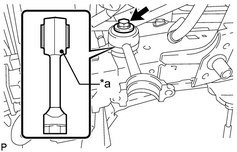
So... the solution is to put an adjustable link in the passenger side KDSS fixed side location. Basically take this part out. Cut the shaft. Weld in a threaded adjuster. Re-install but extend the overall length by somewhere around the height of the lift or a bit less. Not sure in my mind how far to extend it yet.

C214458E01.png
 
So... the solution is to put an adjustable link in the passenger side KDSS fixed side location. Basically take this part out. Cut the shaft. Weld in a threaded adjuster. Re-install but extend the overall length by somewhere around the height of the lift or a bit less. Not sure in my mind how far to extend it yet.

C214458E01.png

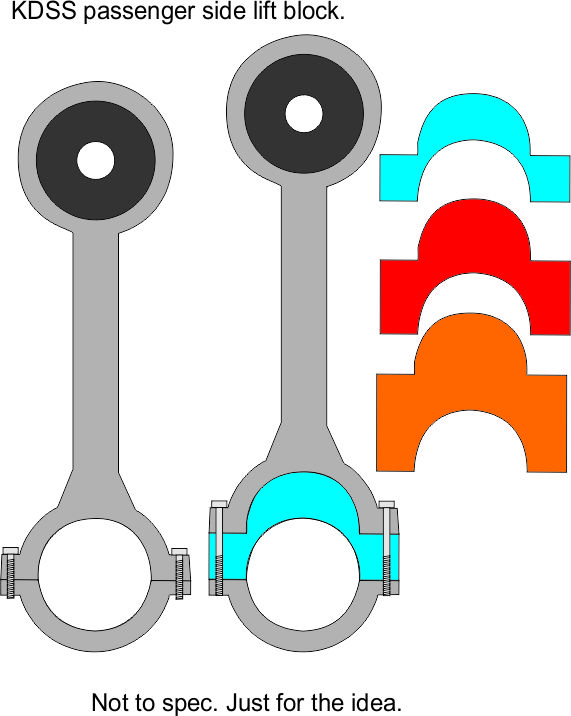
I think the height of the lift would be too much. I think between 1/2" and 1" would fix it. It would be easier for these lift manufacturers to make a machined block and longer bolts to fit between the passenger link and the sway bar. Maybe different sizes depending on the amount of lift.

OK my brain is on overdrive and can't sleep so I made this. I believe this would let the piston equalize and not get maxed out trying to compensate for the lift. I am not an engineer and didn't even sleep in a motel six thinking about this.

Also I don't know if these links are the same size for the 4Runner, Tundra, FJ and others but if they are it would be a great extra $$ for the lift manufacturers.

kddslift1.jpg
 
Last edited:
you know.. what if the system is over compensating because it knows it's at a different angle(height, when you lift) so therefore it's pressurizing it at a higher amount and that pushing on the cylinders on that side causing it to over extend? i'm just throwing this crazy thought out there for others to think about and maybe look into.
 
you know.. what if the system is over compensating because it knows it's at a different angle(height, when you lift) so therefore it's pressurizing it at a higher amount and that pushing on the cylinders on that side causing it to over extend? i'm just throwing this crazy thought out there for others to think about and maybe look into.


It's not that complex. It doesn't have sensors to measure height so really....my belief and theory is that is it going to lean no matter what. Toyota knows it leans a little and has an acceptable amount of lean it allows.

It's a trade off of sorts. It can be corrected per the manual and videos out there but seems to always come back. I'll take it though as I was doing 60mph through 35 mph curves today. I love it.
 

Members online

Forum statistics

Threads
278,316
Messages
3,554,110
Members
248,016
Latest member
Advally Service

Trending content

Back
Top