time to embarass myself - solid v. IFS

jacal

New member
I've been mulling this over in my mind for a bit and cannot figure it out:

Why are the best off-road rigs always solid axle? What is it about IFS that reduces pure off-road ability?

I know the answer will have something to do with contact which equals traction, but why can't IFS be the same or better? ditto for articulation and so on... Is the problem just that it hasn't been done or are there other factors.


J
 
Register to hide this ad
jacal said:
I've been mulling this over in my mind for a bit and cannot figure it out:

Why are the best off-road rigs always solid axle? What is it about IFS that reduces pure off-road ability?

I know the answer will have something to do with contact which equals traction, but why can't IFS be the same or better? ditto for articulation and so on... Is the problem just that it hasn't been done or are there other factors.


J
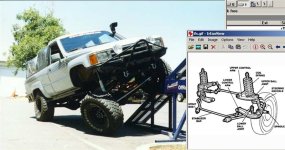
Pictures are worth a thousand words. Look how short the control arms are in the ifs. Just not as much potential for range of motion compared to the solid axle. Two wheels on the ground is better than one.
 

Attachments

  • ifs, solid axle (medium).jpg
    ifs, solid axle (medium).jpg
    60.5 KB · Views: 4,946
Last edited:
One way to think about it is this:

An IFS could be designed to give excellent articulation / suspension travel, but it would be extremely difficult to do that and also have the level of handling to match modern IFS systems. It would be a compromise at best.

And don't kid yourself when you see pics like the one above. That type of articulation doens't happen with everything connected. The first thing most guys do is disconnect / remove the sway bars, but of course the handling turns to shit.
 
Makes sense, yes that pic helped put it together. Stronger, and just a better platform to get articulation out of while maintaining driveability (re-connecting sway bars and the like after wheelin notwithstanding).

Do we have an RTI for the stock runner (4th gen)? and some other vehicles to compare it to?


J
 
I've seen long travel ifs front suspensions on prerunner style trucks where the passenger side a-arm connects on the driver side of the vehicle, and the driver side a-arm connects on the passenger side. Basically they make a big X. These types of suspensions should rival a solid axle for limits of articulation, but I don't know how you'd get a front diff and axles iin there for 4wd...

EDIT: here's what I'm talking about:
1482_MDR_g5608.jpg

Steering.jpg
 
Last edited:
jacal said:
Do we have an RTI for the stock runner (4th gen)? and some other vehicles to compare it to?
J

4runner RTI is about 420. FJ Cruiser is about 490. GX470 with KDSS is about 520. Toyota Land Cruiser is about 540. Land Rover Discovery SII (NOT LR3) is about 700 range. 2007 Jeep Wrangler Rubicon with optional front disconnects is about 820.

The numbers above are from the top of my head over years of reading. They are not exact numbers but are within 20 or so points. It should give you a general idea.
 
Solid axles definetly give more flex which helps a lot with rock crawling, but IFS has a better on and off road ride quality, which is why they switched to it. But with lockers and good spotting, an IFS suspension can go most places solid axles go. I didn't believe it until i went wheeling with a bunch of tacoma guys with IFS on extreme rated off road trails. The guy had a tacoma with 2-3" lift lockers and 32" tires and got through the whole trail with a little rock stacking here and there. Solid axle is better, but don't underestimate IFS:cool:
 
IFS would never do this
100_1057.JPG


see how much flex isnt there in the front. had this been a SAS, there wouldn't be as much rear wheel lift. But IFS has advantages in speed and whoops.

wheelin_045.jpg
 
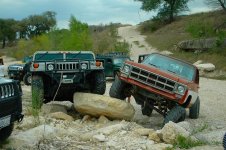
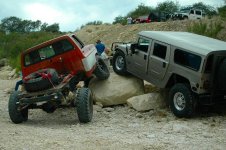
Here is an interesting pic to compare the differences: (the passenger tire on the H1 is off the ground)
 

Attachments

  • 064 (medium).jpg
    064 (medium).jpg
    105.4 KB · Views: 3,688
I love it!
A $400 modded scrap beater takes a $100,000+ stock truck for flex. Talk about bang for your buck value.
 
Thai said:
Here is an interesting pic to compare the differences: (the passenger tire on the H1 is off the ground)

Perfect! That's the kind of pic I would have posted if I hadn't been too lazy to track it down.:clap:
 
I'm surprised that this wasn't posted this being a 4Runner site and all, but here's the same 4Runner on the same obstacle, before and after a solid axle swap.

4run88.jpg


4run96.jpg
 
As you can see in the above pics, one of the biggest advantages with solid axles are that when one side goes up, it forces the other side down. (to the limits of articulation, of course) That works better for rock-crawling, because you can keep the tires on the ground for traction.

That won't happen in an IFS vehicle, as the wheels aren't connected together on a common beam. IFS is mostly seen in competition on desert racing trucks, since it can handle uneven dips and jumps at high-speed much better than solid axles. Plus, centerline clearance is better, since you don't have the pig hanging down. The steering setup tends to be more complicated on solid axles too.

A good set of lockers front and rear in an IFS vehicle can make up for a lot of the differences with a solid axle truck.

--Mike
 
i have that same question i see the difference for crawling but im not into crawling im more in to mud and trails will an ifs be good for that stuff
 
joey_magnelli said:
i have that same question i see the difference for crawling but im not into crawling im more in to mud and trails will an ifs be good for that stuff

Should be good enough.
 
Thai said:
4runner RTI is about 420. FJ Cruiser is about 490. GX470 with KDSS is about 520. Toyota Land Cruiser is about 540. Land Rover Discovery SII (NOT LR3) is about 700 range. 2007 Jeep Wrangler Rubicon with optional front disconnects is about 820.

The numbers above are from the top of my head over years of reading. They are not exact numbers but are within 20 or so points. It should give you a general idea.

Alright, I'll embarass myself. What is "RTI?" Since we are talking about articulation, I will am going to guess that RTI represents the amount in some fashion. And just curious why does the FJ Cruiser has a little more than a 4runner, and why does the GX have a lot more? Charlie
 

Members online

No members online now.

Forum statistics

Threads
278,310
Messages
3,554,080
Members
248,016
Latest member
Advally Service

Trending content

Back
Top