Not for mountains
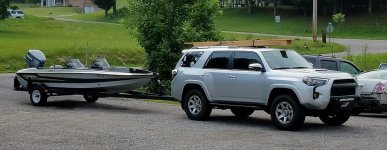
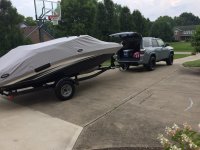
A couple weeks ago I hauled my 18' bass boat down to northeastern Tennessee. I learned while the 4.0 V6 is fine for that weight and more on flat land, it is barely sufficient in the mountains.
My route from Columbus OH was via US-23 south to Norton VA, US-58 Alt east to Abingdon VA, US-58 east to Damascus VA then SR-91 south to Mountain City TN. I took the same route to return. While down there a pressing need for boat repairs, I also had to drive it from where I was staying up to Bristol TN, and then wound US-421 east from Bristol to Mountain City (known as The Snake). I see no point in paying for the privilege of using the interstate through WV, I hate fighting traffic while towing, and there's so few places to stop.
Overall boat, motor, trailer, fuel, and associated accessories is 2600-2800 lbs. Vehicle had passengers (just me and dog) total 300lbs and gear 600lbs. Northbound trip the cargo was closer to 1200lbs.
Going downhill was never a problem, even without trailer brakes. I generally shift to S5 at the top of the hill 10mph below my desired speed and let the truck have a break and gravity can do the rest. Any time I was gathering too much speed, downshift to 4 and long-pump the brakes a few times and it would be reasonable again even on long 7-8% grades.
Going uphill was a different matter. On flat/hilly terrain, I generally drive in S4 around 65-70mph. Going up any hill more than 1/4mi long I'd lose speed and have to downshift, but that's not unexpected. If I could keep more than 3500rpm the truck would hold 60-65mph in 3rd gear. Anything less, even 100rpm and it would just slowly drop off. There were a couple grades where the only way to save speed was to dump to 2nd gear and watch 0.0mpg come up with more than 4500rpm just to keep it above 45mph. I was doing better than the tractor trailers, but it was obvious that the truck was straining.
I did try turning the A/C off for a few hills and didn't notice a difference. Being it was 88F and 85+% humidity with a dog that likes to cast her bad breath on me when she gets hot, I decided it was pretty important to leave on. I do notice a power difference as a daily driver with the A/C off, although that is probably a combination of both lighter load and cooler air (I always run the A/C above 75F outside).
The Snake. Primarily winding low speed turns and switchbacks. It's impossible to exceed 40mph for more than an instant, even without the trailer. The truck did just fine here in S2, only downshifting to first gear once or twice when the low speed and incline really warranted it.
Wikipedia 1GR-FE said:
I've come to realize the power band in the 4.0 is just too high for my liking. The vehicle by itself is fine, but as a towing platform it certainly has limitations. Being that I tow this load & route about once a year, I can live with it knowing that it will take a while and be some work. It does make me wish I'd considered the 4.6L V8 of the GX460 a little harder. I drove dad's 2006 Tundra with the 2UZ-FE 4.7L V8 and that thing is smooth. While I didn't get to use it to pull my boat up the same roads which were giving my boat trouble, I can tell you it would certainly handle them more easily. "There's no replacement for displacement." It has caused me to recently consider the idea of selling the 4Runner and looking for a slightly older GX460 or LC, but I want neither the fancy electronics of the Lexus or bigger size of the LC. I might have to consider going back to a 4th Gen 4Runner instead (same engine as dad's Tundra).
One thing I failed to consider was that fuel would make a difference. I was running BP 87 octane 10% ethanol crap while southbound. Northbound was unknown brand 90 octane 100% gasoline. Between the two, obviously the latter did better on both power and fuel economy. There were less downshifts to 2nd and I had better range while northbound. Average mpg southbound was 11.8, northbound was 12.3. I just wish I could find a reliable source of ethanol free at home (damn Ohio corn farmers). In general the elevation change was primarily uphill on southbound, ~1100MSL origin to ~2300MSL at destination. So the northbound trip was overall more downhill, but I doubt that makes as much of a difference as the fuel.
This is from right after doing The Snake