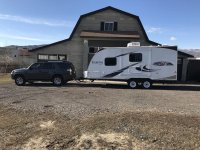
I must say this thread is/was extremely helpful. Just drove my travel trailer (roughly 3600 ibs) from Utah to Wisconsin with stock 2015 Trail Premium. Having a WDH makes a big difference. Installed RedArc Tow Pro Elite trailer brake controller day the before I hit the road. Averaged 62 MPH.

You are using an out of date browser. It may not display this or other websites correctly.
You should upgrade or use an alternative browser.
You should upgrade or use an alternative browser.
Towing experiences with your 5th Generation
- Thread starter dsir56
- Start date

2flyfishin
New member
You’re probably referencing Jetboy’s post above but, I’ll say it again, he was pretty much spot on. Without getting too deep in the weeds on this stuff, you’re looking for horsepower which is the rate of work (not just work). The question is simply what the horsepower is at a given RPM. Low rpm torque equates to low rpm horsepower, which does make for advantages in comfortable towing. Whichever way you slice it, torque x rpm / 5252 will always equal horsepower.
Yes your equation is correct. Now lets put it into the real world. All numbers will be at the crank. You have 2 semi’s, one with it’s normal motor with 500 hp, 1850 lb-ft of torque. The other you have the hellcat motor, 707 hp, 600 lb-ft of torque. The load they’re pulling needs 650 lb-ft of torque to get it rolling. The semi with it’s normal motor, 40% less horse power drives away using only 35% of the torque it generates. The one with the hellcat motor in it never moved. Why because even with 707 hp, the motor can’t spin with enough force ( i.e. torque) because it only generates 600 lb-ft of torque whe a minimum 650 was needed just to get the load moving. No gearing could help it. When towing, you are putting more load on the engine, the engine that turns the crank with more force ( torque) will handle the load better. On the flip side, if you were to shoehorn the semi motor into the hellcat, it would never come close to being as fast as the hellcat is with it’s normal motor! The ample torque and horsepower in the hellcat with it’s weight is through the roof. Remember, there are multiple numbers in that equation and having certain numbers higher in certain places in that equation can be more valuable for certain things. It all depends on the needed application.
WVhillbilly
Member
No, the Hellcat wouldn't tow it because it's a Dodge and either had an electrical issue or the trans went out before you got anywhere.
Yes your equation is correct. Now lets put it into the real world. All numbers will be at the crank. You have 2 semi’s, one with it’s normal motor with 500 hp, 1850 lb-ft of torque. The other you have the hellcat motor, 707 hp, 600 lb-ft of torque. The load they’re pulling needs 650 lb-ft of torque to get it rolling. The semi with it’s normal motor, 40% less horse power drives away using only 35% of the torque it generates. The one with the hellcat motor in it never moved. Why because even with 707 hp, the motor can’t spin with enough force ( i.e. torque) because it only generates 600 lb-ft of torque whe a minimum 650 was needed just to get the load moving. No gearing could help it. When towing, you are putting more load on the engine, the engine that turns the crank with more force ( torque) will handle the load better. On the flip side, if you were to shoehorn the semi motor into the hellcat, it would never come close to being as fast as the hellcat is with it’s normal motor! The ample torque and horsepower in the hellcat with it’s weight is through the roof. Remember, there are multiple numbers in that equation and having certain numbers higher in certain places in that equation can be more valuable for certain things. It all depends on the needed application.
No gearing could help it? You sure about that?
Last edited:
You are angry that you didn't research more carefully before you purchased the 4R and so very defensive because you want to blame Toyota rather than admit you made a mistake.
So you're going to tell me how I feel about my decision to purchase a 4runner?
I am actually quite happy with my 4runner. It runs reliably and has accomplished everything I've asked of it thus far.
But I do anticipate needing more payload and towing capabilities in the future. And I would like a vehicle that gets better fuel efficiency. Toyota, thus far, doesn't offer a vehicle which meets all those requirements, but other companies do.
Just because I appreciate the offerings of other companies and dislike certain aspects of my 4runner, doesn't mean that I hate Toyota vehicles.
Power matters, torque doesn't have any meaning without an RPM component and when you have that you're really talking about power. I really wish torque would quit being published because it's basically a meaningless number for consumers (it does matter for transmission manufacturers).
That's why most OEM's provide torque and horsepower figures at a given RPM. And those figures are far from "meaningless."
Horsepower is a reflection of torque and vice versa; recall that HP = (torque * RPM)/5252.
So when you have a small turbo diesel that only delivers 160-180 hp @3,400 RPM, but 350-369lb-ft @ 2,000 RPM (2.8l Duramax would be a good example) you're getting far more usable horsepower at a lower RPM compared to a v6 gasoline, like the 1GR-FE, which delivers maximum horsepower (236-270) @ 5,200-5,600 RPM and maximum torque (266-278lb-ft) @ 4,000-4,400 RPM.
The diesel also has 185hp and takes over 9 seconds to get to 60mph unloaded. It's probably a fine motor - but it's too small for a 4runner in our market.
And Diesel today is $2.98 average in the USA. Gasoline is 2.56. Cost/mile getting 23mpg on diesel is similar to 19.75mpg with gasoline.
Peak horsepower and 0-60 times are not the important figures when it comes to diesels. And honestly, they matter little for gasoline truck engines too. The low-end torque, which translates into low-end horsepower delivery is what is important.
Have you ever towed a trailer or thrown a heavy load onto a gasoline 4runner and then compared it to a similarly-sized diesel? If you haven't, you should give it a try. The diesel's ability to pull/haul heavy loads and get decent mpg's doing so is unrivaled, even by a turbo gasoline (which tends to suck down fuel when under load).
As for fuel pricing, yes, in many areas 87 octane gasoline is cheaper than gasoline (by as much as .30-40 cents). But even with that price disparity, the diesel will save money over time due to lower fuel consumption. And in many areas (Canada and Alaska) regular octane gasoline isn't priced that differently from diesel.
The 4runner will easily out-pull the diesel Colorado in an absolute comparison. It will pull a heavier trailer up a steeper hill. It has a much higher ability to do work. There's no question that a 1GR with the pedal down will run away from a Colorado diesel with the pedal down with any trailer regardless of weight.
The more important question is whether it's more comfortable and/or more fuel efficient to drive at 2800rpms in a 4runner vs 2000rpms in a small diesel. The little diesel might very well win that comparison. I haven't driven one so I can't compare them.
The 1GR-FE will "out pull" (meaning pull the same load faster) compared to the 2.8l Duramax. But it will be reving very high (~ 4000 RPM) to deliver its max torque (reving even higher to deliver max horsepower) which means fuel efficiency will be seriously degraded and the cabin noise will be high. By comparison, the Duramax delivers max torque at relatively low 2,000 RPM.
Yes, the 1GR-FE can tow the same weight faster, but the question that is relevant to many 4x4/truck owners is: which engine would be preferred for such purposes?
I'll also point out that the 2.8l Duramax Colorado has a higher towing rating than either the Tacoma or the 4runner.
Last edited:
I just picked up a 2018 Keystone Hideout 175LHS yesterday. Weighs in at 3,300lbs dry I do believe. First drive was bringing it home from the dealer which is about 70km's on the freeway. Trailer pulled really well, I have a center line weight distribution hitch from Husky, seemed to do the trick. Was able to maintain 105km/h in S4 the whole way home, only once did it shift down to third going up a pretty large incline. Most of my towing will be relatively close to home within 200km's at the most so I think this setup will do just fine for the time being.

Jetboy
New member
The 1GR-FE will "out pull" (meaning pull the same load faster) compared to the 2.8l Duramax. But it will be reving very high (~ 4000 RPM) to deliver its max torque (reving even higher to deliver max horsepower) which means fuel efficiency will be seriously degraded and the cabin noise will be high. By comparison, the Duramax delivers max torque at relatively low 2,000 RPM.
Yes, the 1GR-FE can tow the same weight faster, but the question that is relevant to many 4x4/truck owners is: which engine would be preferred for such purposes?
I'll also point out that the 2.8l Duramax Colorado has a higher towing rating than either the Tacoma or the 4runner.
This side by side test has already been done by TFL Truck. The Tacoma easily out pulls a Colorado diesel up a hill. With a 5k lb trailer the Colorado could not maintain 55mph speed up the pass.
The 4runner and ZR2 have the same tow rating. Only the non-offroad model Colorado has the higher rating. The ZR2 and 4runner both probably fail on the handling test portion. I think 5k lbs is a reasonable limit given the 109" wheel base.
Of course there's always that other elephant in the room - GM quality. I've spent a night in a shithole motel in the middle of Arizona when my GM HD2500 blew apart a transfer case towing a trailer. Neither the transmission (allison 1000) or transfer case made it to 100k miles. But that's another issue entirely. I don't care if it gets 100mpg - the hassle of breaking down and thousands of dollars to replace drivetrain parts will never be offset by fuel economy.
Last edited:

teotwaki
Senior Member
So you're going to tell me how I feel about my decision to purchase a 4runner?
When you crank out another 440+ word diatribe in favor of other brands but primarily geared against the 4Runner you only serve to further prove my point.
:sadwave:
This side by side test has already been done by TFL Truck. The Tacoma easily out pulls a Colorado diesel up a hill. With a 5k lb trailer the Colorado could not maintain 55mph speed up the pass.
Actually both the gasoline and diesel variant performed the TFL Ike Gauntlet test just fine. The gasoline was faster, but it was also reving higher and consuming much more fuel. Again, refer back to our earlier discussion on capability versus preference.
TFL evidently had a preference for the diesel's performance and driving characteristics as they gave the diesel Colorado, not the gasoline Colorado nor Tacoma, its Golden Hitch Award. TFLtruck Announces 2016 Gold Hitch Award Recipients
The 4runner and ZR2 have the same tow rating. Only the non-offroad model Colorado has the higher rating.
All of the 4x4 Colorado's can go offroad, just like all of the 4x4 4runners and Tacomas can. The ZR2 is a highly modified version of the Colorado; its limited payload and towing is supposedly due to airflow and suspension setup.
Of course there's always that other elephant in the room - GM quality. I've spent a night in a shithole motel in the middle of Arizona when my GM HD2500 blew apart a transfer case towing a trailer. Neither the transmission (allison 1000) or transfer case made it to 100k miles. But that's another issue entirely. I don't care if it gets 100mpg - the hassle of breaking down and thousands of dollars to replace drivetrain parts will never be offset by fuel economy.
Well perhaps deep down inside, I have always perceived Toyota's reliability to be unrivaled. With that said, the days of "domestic cars are crap" are far behind us. The modern domestic 4x4's and pickup's are generally on par with the Japanese brands when it comes reliability. If you disagree, that "elephant" you perceive is purely a matter of opinion, not fact.
When you crank out another 440+ word diatribe in favor of other brands but primarily geared against the 4Runner you only serve to further prove my point.
You've really gone out of your way to address each and every one of my posts in a very meticulous and mind-numbing fashion.
I'm very content with my decision to buy a 4runner.
I'm very content to acknowledge its strengths and weaknesses.
And I'm very content to admit that I like the some of the trucks being made by other manufacturers.
I've got nothing to be angry or defensive about. You, on the other hand, seem to have an axe to grind. Did you just recently buy a 4runner? If so, go enjoy it and stop worrying about what other people think.
Jetboy
New member
Actually both the gasoline and diesel variant performed the TFL Ike Gauntlet test just fine. The gasoline was faster, but it was also reving higher and consuming much more fuel. Again, refer back to our earlier discussion on capability versus preference.
TFL evidently had a preference for the diesel's performance and driving characteristics as they gave the diesel Colorado, not the gasoline Colorado nor Tacoma, its Golden Hitch Award. TFLtruck Announces 2016 Gold Hitch Award Recipients
All of the 4x4 Colorado's can go offroad, just like all of the 4x4 4runners and Tacomas can. The ZR2 is a highly modified version of the Colorado; its limited payload and towing is supposedly due to airflow and suspension setup.
Well perhaps deep down inside, I have always perceived Toyota's reliability to be unrivaled. With that said, the days of "domestic cars are crap" are far behind us. The modern domestic 4x4's and pickup's are generally on par with the Japanese brands when it comes reliability. If you disagree, that "elephant" you perceive is purely a matter of opinion, not fact.
You've really gone out of your way to address each and every one of my posts in a very meticulous and mind-numbing fashion.
I'm very content with my decision to buy a 4runner.
I'm very content to acknowledge its strengths and weaknesses.
And I'm very content to admit that I like the some of the trucks being made by other manufacturers.
I've got nothing to be angry or defensive about. You, on the other hand, seem to have an axe to grind. Did you just recently buy a 4runner? If so, go enjoy it and stop worrying about what other people think.
I'm merely correcting factual errors. There are a lot of them.
Th elephant is absolutely there. Do you not know anyone who's owned a GM product in the last decade?

e60ral
Banned
I was a fleet manager during the 2nd gen tacoma time with lots of rangers, tacomas, and colorados and the 3rd gen 3rd facelift ranger was the most comfortable and most reliable. I actually stopped buying tacomas because the interiors and seats wore out and the springs and suspension seemed to wear out.
I don't know about 3rd gen, but in the millions of miles we put on them they were all pretty comparable. When it came to full size trucks the GMs did the best (then the ford then tundra but we only had 1 tundra to test)
Sent from my SM-G930V using Tapatalk
I don't know about 3rd gen, but in the millions of miles we put on them they were all pretty comparable. When it came to full size trucks the GMs did the best (then the ford then tundra but we only had 1 tundra to test)
Sent from my SM-G930V using Tapatalk
Jetboy
New member
I was a fleet manager during the 2nd gen tacoma time with lots of rangers, tacomas, and colorados and the 3rd gen 3rd facelift ranger was the most comfortable and most reliable. I actually stopped buying tacomas because the interiors and seats wore out and the springs and suspension seemed to wear out.
I don't know about 3rd gen, but in the millions of miles we put on them they were all pretty comparable. When it came to full size trucks the GMs did the best (then the ford then tundra but we only had 1 tundra to test)
Sent from my SM-G930V using Tapatalk
That certainly doesn't match any experience I've had or ever heard of. For example: https://www.cheatsheet.com/money-ca...de-according-consumer-reports.html/?a=viewall
Or more data based - and IMO the best long term study that currently exists. http://dashboard-light.com/vehicles/Resources/Images/Toyota/Tacoma/Layout.png?v=4
Tacoma


4runner


Tundra

What type of use were they seeing? I can't think of many scenarios where I'd expect a GM truck to outlast a Tundra. The old Colorado was discontinued for a reason. I think the ranger was at least somewhat well liked, although not a very good selling truck.
Long term reliability isn't the only reason to buy cars. Sometimes cars are fun and pieces of shit. That doesn't make them bad. I had lot of fun in a CJ5. But I wouldn't drive one any further than I wanted to walk back.
e60ral
Banned
Well the sample size for the tundra was just 1 as of the time I left, but we had plenty of 2nd gen tacomas and they just wore out. Engine was fine, everything else not as much. They were also a chore to drive compared to the sporty ranger with the 5 speed auto and comfortable seats. My total sample size was literally millions of miles; the 90's and early aught domestic trucks tended to go through transmissions, but by the time I left that was no longer the case and the ranger was by far the best in terms of maintenance cost and quite frankly everyone hated the tacomas because the seats were so terrible (we actually initially bought them for the senior guys, but they became the trucks we gave to the new guys). I have no experience with 3rd gens though, but their teething issues are well known.
Sent from my SM-G930V using Tapatalk
Sent from my SM-G930V using Tapatalk

WVhillbilly
Member
Not sure if it's so much the weight in that case as the fact that you're pulling a V nose brick, behind a brick.
My trucks got about the same mpg if the trailer was empty, or if there was a Super Tenere and a BMW GS in it.
My trucks got about the same mpg if the trailer was empty, or if there was a Super Tenere and a BMW GS in it.
I'm merely correcting factual errors. There are a lot of them.
You're also giving a lot of opinions, many of which were lacking in context or factual basis.
You criticized the 2.8l duramax for producing low horsepower, but you neglected to describe how that horsepower was delivered in relation to other engines.
You said that the gasoline Colorado could "out-pull" its diesel alternative in a TFL test, but you didn't point out how it was screaming at 5k RPM's and getting 2 mpg less in order to achieve that performance. Never mind the added engine wear that comes with that kind of driving; I'd rather not have to deal with that engine noise and degraded efficiency.
Last edited:
Jetboy
New member
You're also giving a lot of opinions, many of which were lacking in context or factual basis.
You criticized the 2.8l duramax for producing low horsepower, but you neglected to describe how that horsepower was delivered in relation to other engines.
You said that the gasoline Colorado could "out-pull" its diesel alternative in a TFL test, but you didn't point out how it was screaming at 5k RPM's and getting 2 mpg less in order to achieve that performance. Never mind the added engine wear that comes with that kind of driving; I'd rather not have to deal with that engine noise and degraded efficiency.
Dude. It's time to give up. I think we're somewhat in violent agreement here.
I described difference in power between the two engine using the proper physical terms with actual numbers to help explain it. I'm not sure what you're looking for. Using torque as a substitute for lower rpm power delivery is an imprecise way to describe what the real difference is. It tells you something - but not much. Yes - it's very common. No - it's still not good way to do it. Actual numbers paint a much better picture.
The Duramax and 1GR make equal power at 2000rpm and 2800rpm respectively.
As you climb in rpms the 1GR continues to increase torque (and power) while the diesel does not increase torque, but does increase power up to 3400 rpms then drops off rapidly.
Peak d-max power is at 3,400rpms - 181hp. The 1GR incidentally still climbing in power an torque and the gap narrows. The 1RG makes 180hp at about 3700rpms. And the 1GR still has another 100hp available. The diesel is tapped out. But the diesel is probably nicer to drive at 2000rpm than the 1GR at 2800. There's a crossover point in there where the 1GR - because of it's additional power - becomes a better choice. I'm not sure where it is, but it certainly exists. Somewhere around 150hp is my guess.
Comparing the engine noise/comfort as TFL does is a bit of a false comparison. If you slow the Tacoma down to go the same speed as the Diesel Colorado you'd only need to run it at about 3,700 rpms. They didn't do that type of comparison.
My guess is that most of the miles with a midsize trailer are going to be under 150hp required. And so the baby duramax is probably more comfortable in most small to midsize trailer towing situations. On that I think we probably agree.
As far as engine wear I'm not sure it's really comparable directly, the 2.8 has 100mm stroke. The 2GR in the Tacoma has an 83mm stroke and a much lighter rotating assembly weight. The wear at a given RPM isn't directly comparable. In terms of piston travel (friction/wear) the Tacoma at 3700rpms has about the same piston wear as the 2.8L at 3000. Making comparable power the 2.8L rods, crank, and bearing experience quite a bit more force than the 2GR. I'd guess that it's also more heavily built internally to withstand the additional forces.
There's not much track record for the 2.8L. It's already a known issue to use in cold weather called the "cold weather surge" problem and hard starts. Colorado owners discuss whether you got a "good one" or a "bad one". Bad ones having cracked manifolds, clogged DPF systems, and regen cycle problems. We do also know it's an updated version of the same VM Motori 2.8 that plagued the Jeep Liberty for a few years. Let's all hope it's a much improved version. That one was terrible.
The GR lasts basically forever.
Last edited:
teotwaki
Senior Member
You've really gone out of your way to address each and every one of my posts in a very meticulous and mind-numbing fashion.
I've got nothing to be angry or defensive about. You, on the other hand, seem to have an axe to grind. Did you just recently buy a 4runner? If so, go enjoy it and stop worrying about what other people think.
Says the guy who parses everyone's responses and replies micropoint by micropoint with another 280 words of repetitious Internet factoids and attacks.
 uke:
uke:You talk about mind numbing? If you repeat the same stuff often enough I guess you figure you've proved the 4Runner is inferior to your beloved brands you wished you had bought. You definitely are obsessed with anyone who contradicts your rants.
I am on my second 4Runner after 239,000 trouble free miles in the 2005 and during 8 of those 13 years I towed a lot.
"Deep down inside" you seem to be very worried about what other people think, LOL
WVhillbilly
Member
I have a fool proof method for dealing with a vehicle that proves unreliable or not to my liking.
I simply trade it on something i like better.
If that was a bad choice, I do it again as I see fit.
It's much easier than endlessly complaining/being pissed off about it.
I simply trade it on something i like better.
If that was a bad choice, I do it again as I see fit.
It's much easier than endlessly complaining/being pissed off about it.
Similar threads

- Replies
- 17
- Views
- 3K


