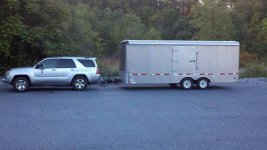
Towing Help- V8 4runner

Just thought I would include a side view of my rig with the WD & Sway Control Setup. As you can see there is very little, if any, sag in the rear.
Also if you look close you will see that with the stock height of my 4Runner, I have the WD shank pointing down and not up like 4runninSD's.
For my ride height, trailer etc. that gives me the leveling I need.
 

Attachments

  • 4Runner_Trailer.jpg
    4Runner_Trailer.jpg
    51 KB · Views: 676
As others have noted, your trailer is not leveled properly, which is caused by the height of the ball being too high. When adjusting the ball height, you will have to take in to account the amount of expected rear end drop of the tow vehicle to get the adjustment right. It may take a try or two to get it right. Also, those that are suggesting you need to adjust the amount of 'links' in your WD setup do not recognize the type of hitch you have. You appear to be using an Equalizer style hitch, the same type I use, and it does not use chains for its WD adjustment. From the pics, it appears that your tension bars are adjusted properly (level with the trailer 'A' frame), so the adjustment for increasing/decreasing the amount of WD is done at the head (ball mount) of the hitch. As I said earlier, you should read carefully the owners manual for the hitch. It has specific instructions on how to setup the hitch properly. It is not difficult, if you have any mechanical ability, but you must understand, and follow the instructions to get it right. And it can take several attempts to get it dialed in. One further thing, any leveling and WD adjustments should be made with the camper fully loaded, gear, supplies, and any other toys, so you are working with what you will actually be towing.

As my sig indicates, I haul a 27' camper, with a total loaded weight of 5,500 lbs. I use the equalizer hitch, and am very satisfied with the way it controls sway on my setup.

 
As others have noted, your trailer is not leveled properly, which is caused by the height of the ball being too high. When adjusting the ball height, you will have to take in to account the amount of expected rear end drop of the tow vehicle to get the adjustment right. It may take a try or two to get it right. Also, those that are suggesting you need to adjust the amount of 'links' in your WD setup do not recognize the type of hitch you have. You appear to be using an Equalizer style hitch, the same type I use, and it does not use chains for its WD adjustment. From the pics, it appears that your tension bars are adjusted properly (level with the trailer 'A' frame), so the adjustment for increasing/decreasing the amount of WD is done at the head (ball mount) of the hitch. As I said earlier, you should read carefully the owners manual for the hitch. It has specific instructions on how to setup the hitch properly. It is not difficult, if you have any mechanical ability, but you must understand, and follow the instructions to get it right. And it can take several attempts to get it dialed in. One further thing, any leveling and WD adjustments should be made with the camper fully loaded, gear, supplies, and any other toys, so you are working with what you will actually be towing.

As my sig indicates, I haul a 27' camper, with a total loaded weight of 5,500 lbs. I use the equalizer hitch, and am very satisfied with the way it controls sway on my setup.

TW, thanks for enlightening us that do not have Equalizer style hitch as to it's lack of links for adjusting and how it generally works.

Since the Equalizer style hitch WD adjustment is done at the head (ball mount) am I correct in thinking that the proper height of the ball mount is important for this system to work properly? If that is true, it would seem that a ball mount that is too high or too low would prevent this WD system (or other WD systems) from doing the best job it is capable of.
 
Just thought I would include a side view of my rig with the WD & Sway Control Setup. As you can see there is very little, if any, sag in the rear.

No sag? Seems your rear dropped 3+ inches in the rear. Any drop is sag. If you mean that the gap from front to rear is equal than that's different. Stock and no load the 4R rear tire to fender gap is about 4 inches higher gap compared to the front.

I use airbags to keep the ride height about the same so I don't blind others at night or have to adjust the headlight angle.
 
So its desert season here in SoCal, so I am prepping my toyhauler for a 4 day trip. I finally was able to get the trailer on flat ground and took some pics to get a second opinion from you guys.

Keep in mind the trailer is NOT fully loaded. I still need to fill it up with 30 gallons of water, a 400ex quad (500lbs) and a CRF450 (220lbs) and Misc food/gear 250 lbs.

I wanted to see what you guys think of the sag in the rear, towing it dry seemed OK, it bounces around a little more than stock but not unbearable. I wanted to see what you guys think of the possibility of FJ rear springs helping a bit?

I have a set of FJ rear springs that I can put on the back, I originally got them to lift the rear to match my 5100s up front but once I got the 5100s installed it was pretty level already.

Take a look at the pics and let me know what you think.

Thanks guys!
The lift on the front makes the sag look worse than it really is. Get some airbags if you occasionally tow, to minimize the sagging look. Or you can set the 5100s to the 2nd level to make the rear just a bit higher than the front. I am assuming that you are on the 3rd setting on the 5100 front end?
 
Last edited:
It's tough to explain (the old saying about a pic being worth a thousand words applies). With the equalizer system, there are two main adjustments, one for the height of the ball for leveling the trailer, and the amount of pitch on the ball mount head which controls the amount of WD applied to tow vehicle. Each adjustment controls that one function, and it doesn't really have any significant impact on the other. The system acheives its WD by increasing the angle of the hitch head where the torsion/spring bars mount. As the hitch head angle is increased away from the tow vehicle, the spring bars pitch further down at the trailer end, so the amount of effort to raise the trailer ends of the bars to rest on the trailer frame mounting brackets is increased. This then increases the amount of weight transfered to the front end of the tow vehicle. The friction of the spring bar pressure on the trailer brackets is what creates the sway control. The system is really simple in its execution, once it has been adjusted properly. The other nice thing about it is, once it is adjusted properly for a specific tow vehicle/trailer combination, it usually doesn't need any further adjusting, unless the weight balance of the trailer significantly changes.
TW, thanks for enlightening us that do not have Equalizer style hitch as to it's lack of links for adjusting and how it generally works.

Since the Equalizer style hitch WD adjustment is done at the head (ball mount) am I correct in thinking that the proper height of the ball mount is important for this system to work properly? If that is true, it would seem that a ball mount that is too high or too low would prevent this WD system (or other WD systems) from doing the best job it is capable of.
 
Yes, thanks TW for correcting me. I couldn't see what he had and I was only familiar with the link system. Best regards, Doug
 

Members online

No members online now.

Forum statistics

Threads
278,309
Messages
3,554,068
Members
248,016
Latest member
Advally Service

Trending content

Back
Top