Transmission cooler: Bypass factory cooler or not?

Martinjmpr

New member
Over on the 3rd gen boards, there's a general consensus that it's a good idea when installing an aftermarket transmission cooler to bypass the factory cooler entirely (which is contained in the radiator) so as to prevent the possiblity of mixing coolant with tranny fluid (which can result in the dreaded "pink milkshake" AT failure.

Just curious about whether that's a concern on 4th gens? I have the tranny cooler now, getting ready to install it, just wondering whether bypassing the factory cooler is a good idea? Anyone else running an aftermarket cooler?
 
Register to hide this ad
I don't remember if the 1GR-FE equipped 4Runners come with a factory or optional external transmission cooler. The 2UZ-FE's have an external cooler that works pretty well and I probably wouldn't bypass it if you had the room.

I don't remember hearing too many issues with pink milkshake syndrome from a failed Toyota radiator, but its not impossible.
 
I wouldn't (didn't) bypass the factory cooler because the radiator helps the fluid get up to temp more quickly...it takes a while as is ( longer than the engine) for the tranny to get up to operating temp. Running a stand alone cooler would pretty much mean any trip less than 15-20 min and the tranny would never even heat up to normal temps and trannys like normal temps.
 
If you're talking about the factory AT cooler that is part of the radiator, definetly bypass it when you have an aftermarket cooler. It eliminates a weak link.
 
I don't remember if the 1GR-FE equipped 4Runners come with a factory or optional external transmission cooler. The 2UZ-FE's have an external cooler that works pretty well and I probably wouldn't bypass it if you had the room.

I don't remember hearing too many issues with pink milkshake syndrome from a failed Toyota radiator, but its not impossible.

IIRC -- and I may be wrong on this, just going from memory -- none of the years of the V6 have an external transmission cooler (not even optional), and all of the years of the V8 do have the external transmission cooler (not an option; they all come with it). Both the V6 and V8 route the transmission lines through the radiator for cooling.

On the Xterra forum (wife has an Xterra), it is apparently a frequent problem on those vehicles where internal failure of the radiator occurs, allowing coolant to mix with the transmission fluid -- resulting in transmission failure. All the automatic trans 2nd gen Xterras have both an internal (in-the-radiator) and external transmission cooler, so the common fix over on that forum is to bypass the internal cooler.

Since the V6 4Runner doesn't have an external transmission cooler, I suppose that if this is a concern, the fix would be to bypass the internal cooler and route the transmission line through an external cooler. However, I haven't read of any problems with the 4Runner radiator breaking down and allowing the fluids to mix, so it may not be necessary.
 
I would not be concerned so much with the OEM radiator, but I would be quite concerned with an after market one. Mine is leaking just a bit, and when it gets replaced, it will also get a separate trans cooler. Cheap insurance and better cooloing.
 
IIRC -- and I may be wrong on this, just going from memory -- none of the years of the V6 have an external transmission cooler (not even optional), and all of the years of the V8 do have the external transmission cooler (not an option; they all come with it). Both the V6 and V8 route the transmission lines through the radiator for cooling.

On the Xterra forum (wife has an Xterra), it is apparently a frequent problem on those vehicles where internal failure of the radiator occurs, allowing coolant to mix with the transmission fluid -- resulting in transmission failure. All the automatic trans 2nd gen Xterras have both an internal (in-the-radiator) and external transmission cooler, so the common fix over on that forum is to bypass the internal cooler.

Since the V6 4Runner doesn't have an external transmission cooler, I suppose that if this is a concern, the fix would be to bypass the internal cooler and route the transmission line through an external cooler. However, I haven't read of any problems with the 4Runner radiator breaking down and allowing the fluids to mix, so it may not be necessary.

Bypassing radiator internal cooler is not the right thing. When the car starts and transmission is cold, it serves as a heater and helps bringing transmission fluid to the operating temperatures rather quickly since engine heats up faster than transmission. Later on it works as a cooler but not very efficient. The proper solution would be putting external cooler inline with the internal with additional thermostat.
 
Trying not to beat a dead horse here but I have spent a day or two researching this topic and since this is one of the only 4th gen threads I have found I will share my findings.
The topic of warming transmission fluid through the radiator was well explained by a Ford transmission engineer:

Posted By: Mark Kovalsky on 09/02/10 08:44pm
The in tank cooler will NOT warm the trans fluid in cold weather. In cold weather the coolant in the tank where the trans cooler is located will be near ambient. If it's 0°F out the coolant in this part of the radiator will be about 10°F or cooler!. This is from actual testing I did as a transmission cooling engineer. After extensive testing on many different vehicles in temperatures as cold as -40°F I never found a condition where the in tank cooler warmed the trans fluid at all.

Putting the radiator cooler after the air to oil cooler will result in warmer transmission temperatures when you need to cool the trans. The system is more efficient going from the trans to the in tank cooler to the air to oil cooler and back to the trans. That's the way all the manufacturers route the fluid because they have people that can calculate this is the right way to do it, and an extensive test program to prove it, too.

Mark
Former Ford Automatic Transmission Engineer, 1988-2007


This post and his work experience in transmission cooling to back his statement can be found in the links below.

RV.Net Open Roads Forum: Towing: Bypass factory trans cooler or keep it?

RV.Net Open Roads Forum: Tow Vehicles: Bypass radiator/tranny cooler combo?

That being said, he and others agree that bypassing the radiator transmission cooler is not recommended because it lowers the transmission temperatures more effectively than external transmission coolers. Can you put big enough external coolers to safely bypass the radiator? It all depends on a lot of factors that are unique to every driver, vehicle, and environment. I am not going to go through all the different scenarios I have read, but there are people who haven't had any problems bypassing and people who switched back to radiator+external cooling setup to reduce high transmission temps they encountered after bypassing the radiator.

As for me, I will be replacing what I believe to be the oem radiator (without bypassing) and setup/monitor a good trans temp gauge. Later down the road I might upgrade my factory external transmission cooler and bypass the radiator to see the difference in temps. I have also pondered the idea of adding a valve to a bypassed system to allow the use of the radiator cooler when needed. If anyone has any thoughts or experience with that please share.

 
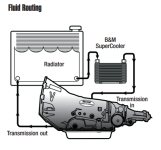
id question what that guy said about testing the tank with the rad cooler in it... on these 4runners & almost any other vehicle i have owned or worked on, both radiator tanks get hot fairly quick even in winter temps, once the T stat opens the fluid is circulated evenly through the radiator & that hot coolant indeed warms the trans fluid better/faster than if it was bypassed. & thats the reason why every manufacturer of aux coolers says to not bypass the rad cooler & to run the aux cooler after the rad cooler so the fluid is warmed in cold weather & it helps reduce the temps when hot. toyota didnt see the need for an aux cooler on the v6 4runners that have a 5500lb towing rating, so adding an aux cooler after the rad cooler is the best all around way to connect it.

another very important thing to consider when bypassing the stock rad cooler is that an aux cooler requires air flow to work, when sitting in traffic or the drive through or off roading where speeds are very slow like climbing a hill or traversing trails, there is no air flow & your trans fluid will get too hot until you can drive at speeds of ~30mph or higher for awhile.

drag racers will bypass the rad cooler or many racing radiators dont even have rad coolers, but they do very short runs at a time & air flow isnt as important... but when the engine is running they have more air flow than any normal car due to the high speeds they reach on the track.

here is the diagram included with all aux coolers, they all say to run them in series after the rad cooler for the most efficient cooling.
 

Attachments

  • Transmission-fluid-cooler-routing.png
    Transmission-fluid-cooler-routing.png
    19.2 KB · Views: 2,961
Damn Alex and firebird, I love me some proper education. These posts remind me of the forums of years ago. Kudos.

Sent from my SM-G981V using Tapatalk
 

Members online

Forum statistics

Threads
278,317
Messages
3,554,126
Members
248,016
Latest member
Advally Service

Trending content

Back
Top